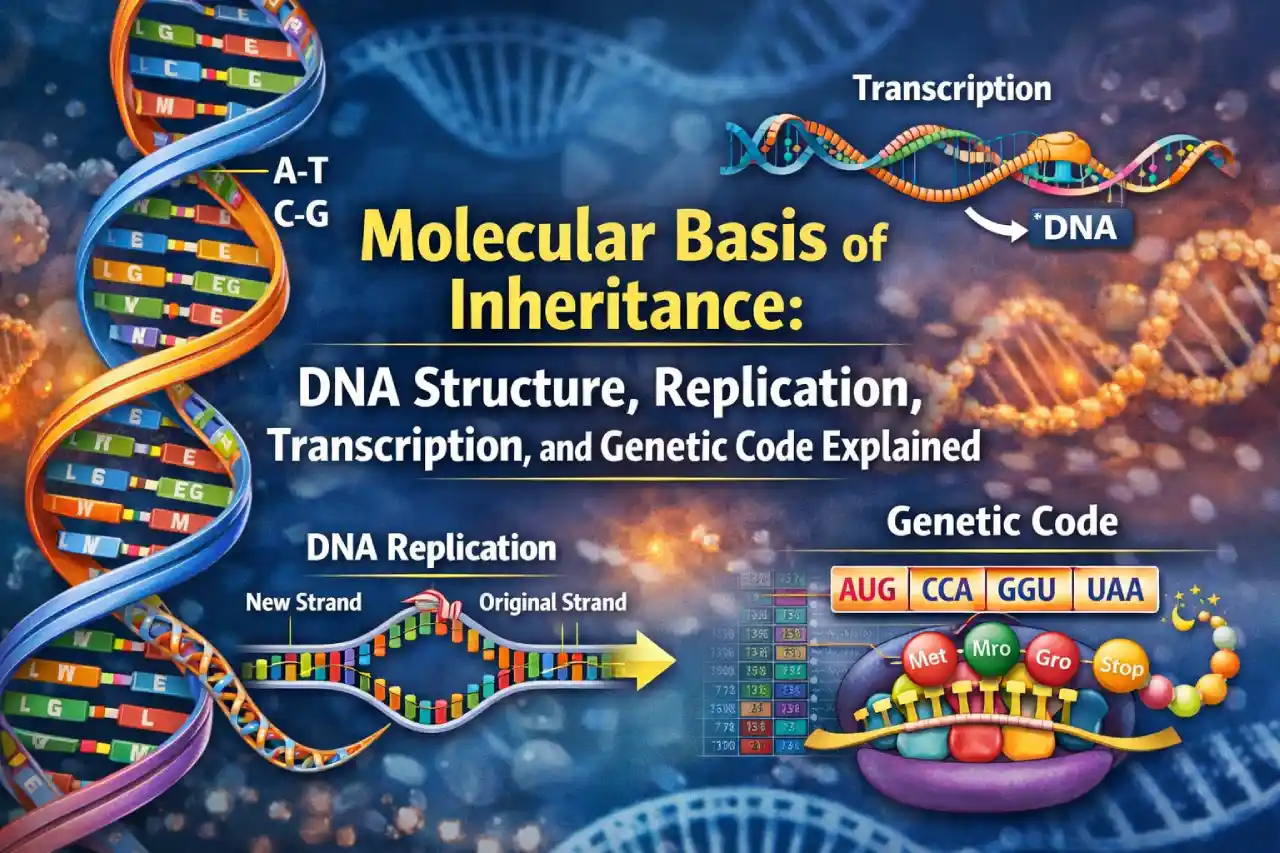
This PDF covers the complete Molecular Basis of Inheritance chapter as per the NEET syllabus. It explains how genetic information is stored, transferred, and expressed in living organisms. The document includes detailed theory, diagrams, experiments, and previous year NEET questions focusing on DNA, RNA, replication, transcription, translation, genetic code, gene regulation, and DNA fingerprinting.
I am writing about this PDF because Molecular Basis of Inheritance is one of the most important and high-weightage chapters in Biology. Many students find it lengthy and confusing due to multiple processes and experiments. This document presents the chapter in a structured, exam-oriented way and clearly shows how NEET asks questions directly from these concepts.
DNA as the Genetic Material
The PDF begins by explaining nucleic acids as the genetic material, highlighting DNA and RNA as polymers of nucleotides. DNA acts as the genetic material in most organisms, while RNA serves this role in some viruses. The structure of DNA as a double helix is discussed in detail, including antiparallel strands, complementary base pairing, hydrogen bonds, and the sugar-phosphate backbone.
The document clearly explains Chargaff’s rule, where adenine pairs with thymine and guanine pairs with cytosine. It also mentions the discovery of DNA by Friedrich Meischer and the double helix model proposed by Watson and Crick using X-ray diffraction data.
Experiments Proving DNA as Genetic Material
Several landmark experiments are explained step by step. The Griffith experiment introduces the concept of a transforming principle. This is followed by the Avery, MacLeod, and McCarty experiment, which proved that DNA is responsible for transformation. The final proof comes from the Hershey and Chase experiment, where radioactive labelling showed that DNA, not protein, enters bacterial cells during viral infection.
These experiments are repeatedly asked in NEET, and the PDF includes both explanations and previous year questions based on them.
Properties of Genetic Material and RNA World
The PDF outlines the essential properties of a genetic material, including replication ability, stability, mutation potential, and expression of characters. DNA is shown to be more stable than RNA due to the absence of the 2′-OH group and the presence of thymine.
The RNA world hypothesis is explained, stating that RNA was the first genetic material and functioned as both genetic material and catalyst. DNA later evolved for better stability and storage of genetic information.
DNA Replication
DNA replication is explained as a semi-conservative process, where each new DNA molecule contains one parental and one newly synthesised strand. The Meselson and Stahl experiment using nitrogen isotopes is discussed in detail as experimental proof.
The PDF also explains replication machinery, including DNA polymerase, replication fork, leading and lagging strands, Okazaki fragments, DNA ligase, and the direction of synthesis from 5′ to 3′.
Download this PDF File: Click Here
Transcription in Prokaryotes and Eukaryotes
Transcription is described as the process of copying genetic information from DNA to RNA. The PDF explains transcription units, promoter, structural gene, and terminator. Differences between prokaryotic and eukaryotic transcription are clearly explained.
In eukaryotes, post-transcriptional modifications such as capping, splicing, and polyadenylation are covered in detail, along with the role of different RNA polymerases.
Genetic Code and Translation
The genetic code is explained as a triplet code that is universal, degenerate, unambiguous, and comma-less. Start and stop codons are clearly mentioned. Scientists like George Gamow, Har Gobind Khorana, and Marshall Nirenberg are credited for decoding the genetic code.
Translation is explained step by step, covering charging of tRNA, initiation, elongation, and termination. The role of ribosomes, tRNA, mRNA, and peptide bond formation is clearly described.
Regulation of Gene Expression and Operon Concept
The PDF explains gene regulation in both prokaryotes and eukaryotes. Special emphasis is given to the lac operon, explaining inducible operons, repressor proteins, operator regions, and regulation in the presence and absence of lactose.
This section is important for understanding how genes are switched on and off based on cellular needs.
Human Genome Project and DNA Fingerprinting
The Human Genome Project is discussed, including its goals, methods, and key findings such as genome size, gene number, and repetitive DNA. The role of bioinformatics is also highlighted.
DNA fingerprinting is explained as a technique based on VNTRs and DNA polymorphism, with applications in forensic science, paternity testing, and genetic disease diagnosis.
Previous Year NEET Questions
A major strength of the PDF is the large collection of previous year NEET questions with answer keys and explanations. These questions cover almost every topic of the chapter and help students understand how directly NEET asks from NCERT-based facts.