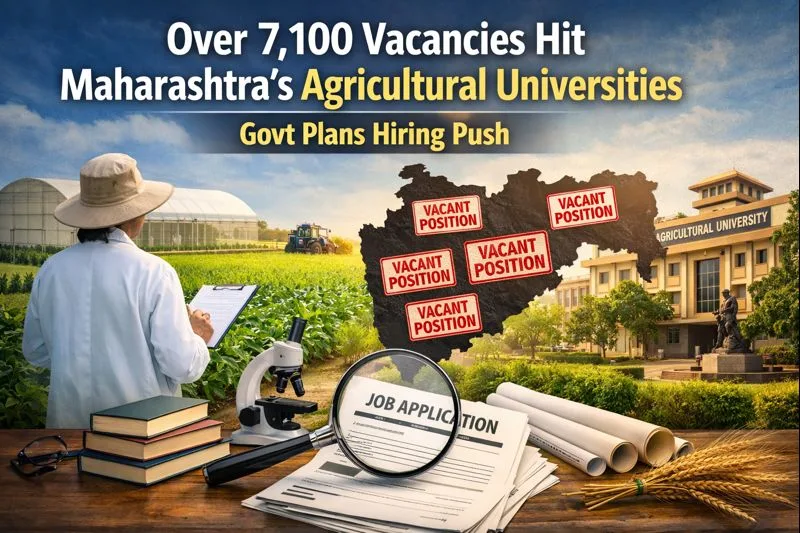
Maharashtra’s agricultural universities are facing a serious staffing crisis, with more than 7,100 teaching and non-teaching posts lying vacant across the state. The shortage has begun to affect both education quality and agricultural research output. The issue was raised in the legislative council, where Agriculture Minister Dattatray Bharne confirmed the scale of vacancies and acknowledged the strain it has put on universities.
These institutions are responsible not just for teaching students but also for developing new farming techniques, crop varieties and solutions to climate-related challenges. When thousands of posts remain unfilled for years, it directly impacts students, researchers and, eventually, farmers. This revelation in the council is important because it brings official attention to a long-standing problem and hints at possible corrective steps in the near future.
Scale of the Vacancy Problem
According to details shared in the legislative council, Maharashtra’s agricultural universities together have over 7,100 vacant positions. These include both teaching and non-teaching roles, spread across multiple universities in the state.
The vacant posts cover:
- Professors and associate professors
- Assistant professors and lecturers
- Research staff
- Administrative and technical employees
- Support and field-level staff
Such a large number of unfilled posts has led to staff being overburdened and departments operating with minimal manpower.
Impact on Education Quality
Teaching shortages have a direct effect on students enrolled in agricultural degree programmes. With fewer teachers available, many universities struggle to maintain ideal teacher-student ratios.
This leads to:
- Reduced classroom interaction
- Delays in syllabus completion
- Fewer practical sessions and field visits
- Limited academic guidance for students
In specialised agricultural subjects, the absence of experienced faculty can seriously weaken learning outcomes.
Setback to Agricultural Research
Agricultural universities are also major research centres. They conduct studies on crops, soil health, irrigation, pest control and climate resilience. Vacancies in research posts slow down or even halt ongoing projects.
Some of the consequences include:
- Delays in developing improved crop varieties
- Slower transfer of technology to farmers
- Reduced participation in national research programmes
- Difficulty in securing new research funding
In a state that regularly faces droughts and changing climate conditions, weak research capacity is a major concern.
What the Government Has Said
Agriculture Minister Dattatray Bharne informed the council that the government is aware of the issue and is taking steps to address it. He said that data from all agricultural universities is being compiled to prepare a detailed proposal.
This proposal will be submitted to the finance department for approval to fill the vacant posts. Once financial clearance is received, recruitment is expected to begin in phases.
Why Vacancies Have Piled Up
Several factors have contributed to the growing number of vacancies:
- Delays in recruitment approvals
- Budget constraints
- Retirement of senior faculty without timely replacement
- Lengthy administrative procedures
Over time, these delays have added up, creating the current situation.
Why Filling These Posts Is Urgent
Agricultural universities are closely linked to the state’s farming economy. Any weakness in these institutions eventually affects farmers on the ground.
Filling vacancies would help in:
- Improving classroom teaching
- Strengthening research output
- Supporting innovation in agriculture
- Training skilled manpower for the agri-sector
- Enhancing collaboration with farmers and industry
A strong university system is essential for long-term agricultural growth.
Expectations From the Proposed Plan
While the minister’s statement offers hope, education experts believe the recruitment process needs to be fast-tracked. Delays in finance approvals or phased hiring could prolong the problem.
Many are expecting:
- Clear timelines for recruitment
- Priority for teaching and research posts
- Transparent and regular hiring cycles
- Adequate budget allocation
Without these, the gap may continue to widen.
What Students and Faculty Are Facing
Existing faculty members are often handling extra workload, teaching multiple subjects and managing administrative tasks. Students, on the other hand, face uncertainty in mentorship and research guidance.
In the long run, this can affect the reputation and academic standing of these universities.