JOIN WHATSAPP
STORIES

Teachers’ Union Warns of School Closures, Job Losses; Seeks Amendments to RTE Act and TET Norms

Teachers’ Union Warns of School Closures, Job Losses; Seeks Amendments to RTE Act and TET Norms

A teachers’ union in Maharashtra has formally demanded amendments to the Right to Education (RTE) Act, warning that the current Teacher Eligibility Test (TET) norms could lead to closure of schools and job insecurity for thousands of educators. The union submitted a memorandum under the leadership of State President and Principal Sudhir Ghagas, urging authorities to revise stringent rules that could impact teachers employed before the TET requirement was introduced. The memorandum was handed over to Rajesh Kankal, Deputy Director of Education (Mumbai Division), and a request was made to forward the concerns to Ranjit Singh Deol, Principal Secretary of the School Education and Sports Department.

This issue is important because TET was introduced to improve the quality of education, but many teachers across Maharashtra were appointed before these norms came into effect. These educators argue that applying new eligibility rules to old appointments is unfair and puts their careers at risk, despite years of service and experience in classrooms.

Schools that cannot meet TET-based staffing requirements fear losing recognition or facing legal action, which could eventually force them to shut down. Instead of improving education, the union believes rigid regulations may disrupt school functioning, especially in semi-urban and rural areas where teacher shortages are already a challenge. The situation raises bigger questions about how reforms should balance quality benchmarks with practical, long-term realities faced by schools and teachers.

Teachers’ Union Demands: Key Concerns

The memorandum highlights the following points:

  • Teachers appointed before TET should not be removed or forced to requalify
  • Schools should not lose recognition due to past appointments
  • RTE Act guidelines must be updated to reflect ground realities
  • Government should offer support to schools struggling with compliance

Why Schools Fear Closures

According to the union, many schools may shut down due to:

  • Inability to replace experienced teachers with TET-qualified ones immediately
  • Financial limitations in hiring new staff
  • Risk of losing affiliation if they do not comply with norms
  • Shortage of eligible TET-qualified teachers in rural belts

These concerns show that lack of policy flexibility could harm the education system instead of strengthening it.

Job Threat to Thousands of Teachers

  • Thousands of teachers appointed before TET face uncertainty
  • Many have more than 10–20 years of experience
  • Losing jobs would not only affect livelihoods but also impact school functioning
  • Teachers believe skill and classroom performance should matter alongside qualifications

Suggested Solutions by the Union

The memorandum proposes:

  • Exemption or special consideration for pre-TET appointed teachers
  • Bridge training or professional development instead of job termination
  • A revised recruitment policy for new teachers only
  • Clear guidelines to protect schools from sudden penalties
Leave a Comment

End of Article

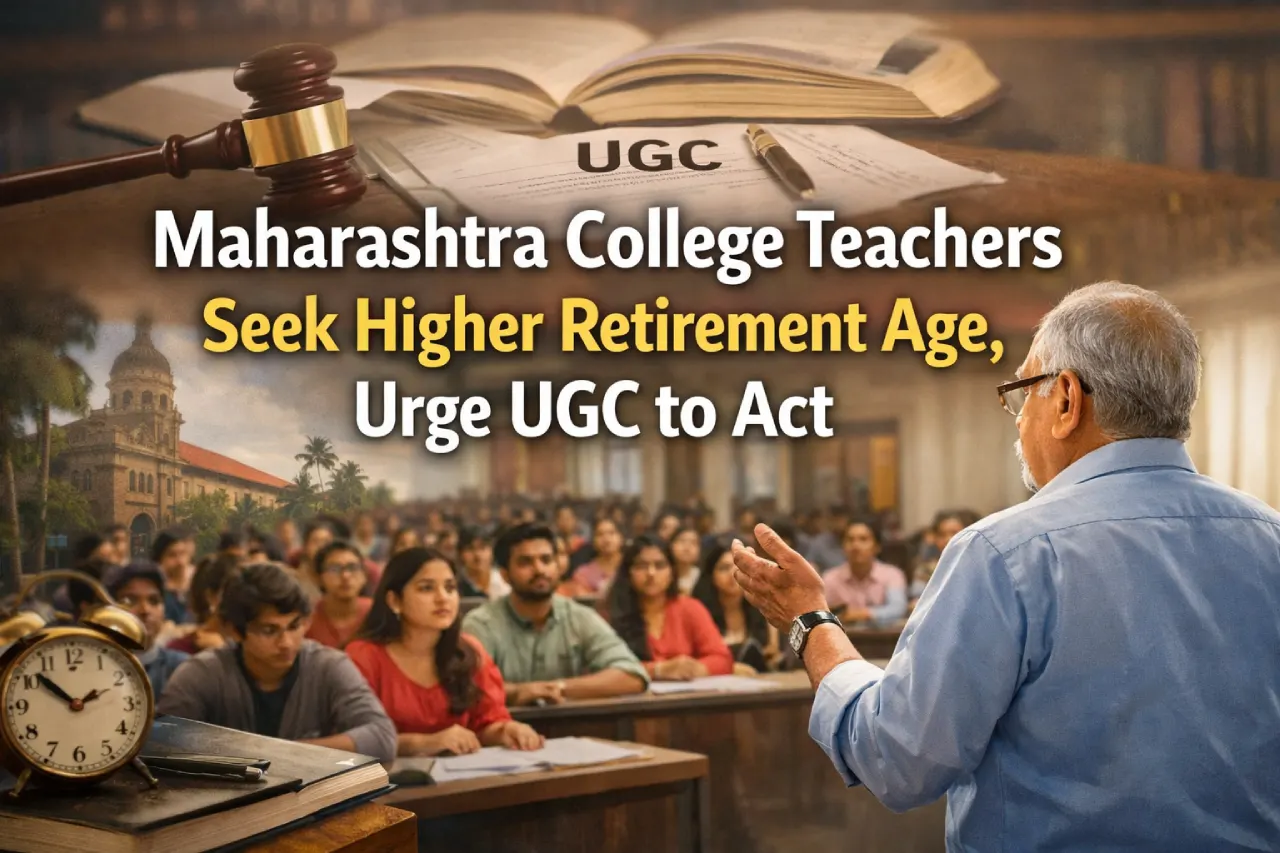
Maharashtra College Teachers Seek Higher Retirement Age, Urge UGC to Act

Maharashtra College Teachers Seek Higher Retirement Age, Urge UGC to Act

Teachers from colleges across Maharashtra have urged the University Grants Commission to raise the retirement age for teaching faculty from the current 60 years to 65 years. The demand has been made by teachers’ associations who argue that experienced educators are being forced to retire too early, even as colleges continue to face staff shortages. They believe extending the retirement age will help retain academic expertise and improve teaching quality in higher education institutions.

I am writing about this issue because it affects not just teachers, but also students and the overall higher education system. At a time when universities are struggling with vacant posts and delayed recruitments, losing senior faculty creates gaps in teaching, research, and mentorship. The demand also raises a larger question about how India values experience in academia and whether policy needs to evolve with changing life expectancy and professional capability.

What Maharashtra Teachers Are Demanding

Teachers’ bodies have formally requested UGC to revise the retirement age for college and university teachers to 65 years, bringing it in line with several central institutions. They argue that many educators remain academically active and physically fit well beyond 60.

According to them, forcing retirement at 60 leads to a loss of institutional memory and teaching continuity.

Why Teachers Want the Age Limit Raised

Teachers say the demand is based on practical realities. Many colleges face:

  • Acute shortage of qualified faculty
  • Delays in permanent recruitment
  • Heavy teaching loads on existing staff

Extending the retirement age would offer immediate relief without additional recruitment costs.

Comparison with Central Institutions

In several central universities and institutions, teachers are allowed to work up to 65 years, and in some cases even longer through re-employment. Maharashtra teachers feel this creates inequality between state and central institutions.

They believe a uniform retirement policy across the country would be fairer and more effective.

Impact on Students and Academic Quality

Senior teachers often play a key role in mentoring young faculty, guiding research scholars, and maintaining academic standards. Their early retirement disrupts this balance and places extra pressure on junior staff.

Students, especially at postgraduate and research levels, are among the biggest losers.

Concerns About Youth Employment

Some critics argue that extending retirement age could limit opportunities for younger aspirants. Teachers’ associations counter this by saying vacant posts already exist and recruitment processes are slow, so extending service will not block new jobs.

They stress that experience and new talent should coexist.

What UGC’s Role Will Be

UGC has the authority to frame regulations related to service conditions in higher education. Any change in retirement age would require policy review and coordination with state governments.

Teachers are hopeful that the commission will consider the request seriously.

Leave a Comment

End of Article

Loading more posts...