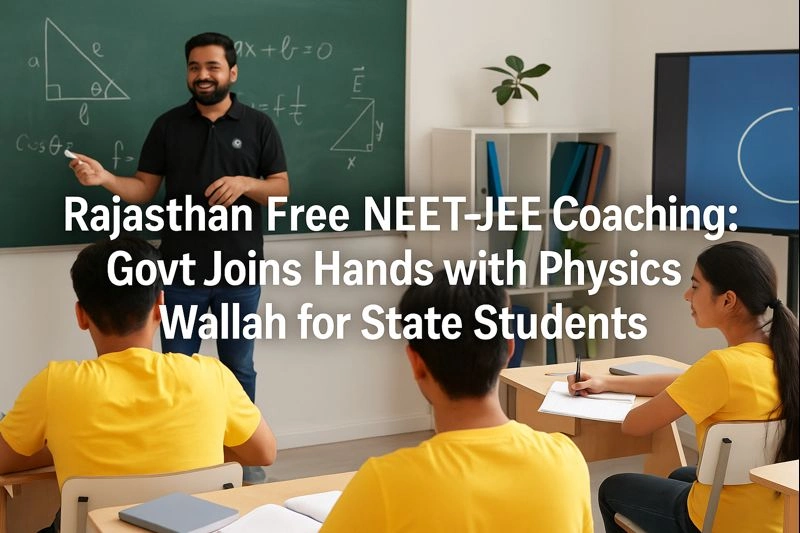
The Rajasthan government has announced a new partnership with the popular ed-tech platform Physics Wallah to provide free NEET and JEE coaching to students studying in government schools. This initiative aims to support talented students from economically weaker backgrounds who often face challenges in accessing high-quality competitive exam preparation.
For years, many bright students in government schools have struggled to compete with peers who receive expensive coaching in Kota and other major cities. With this collaboration, thousands of students will now get structured coaching, online classes, doubt sessions and study material without worrying about fees. This move also shows how a state government can work with private education platforms to uplift public education.
It becomes important for parents, teachers and students to understand how this programme will work, who can benefit from it and what steps schools will follow for implementation. With entrance exams becoming more competitive every year, this support can genuinely transform the future of many students.
About the Rajasthan-PW Partnership
The state government’s education department has tied up with Physics Wallah to bring structured coaching directly to government school students. The aim is clear: to prepare deserving students for NEET and JEE without them having to depend on costly private institutes.
Under this partnership, students will receive:
- Live and recorded classes from Physics Wallah faculty
- Subject-wise study material designed for NEET and JEE
- Weekly tests and performance tracking
- Doubt-solving through online and offline support
- Guidance on exam strategy and time management
The classes will be conducted in a hybrid format, making it easier for students from remote districts to access quality coaching.
Who Will Benefit from the Free Coaching
The programme is being offered to students studying in government senior secondary schools, especially those who have opted for Science (Physics, Chemistry, Mathematics or Biology).
Here is a broad idea of the target group:
- Class 11 and 12 Science students in state-run schools
- Students aiming to appear for NEET or JEE in the upcoming exam cycles
- Talented students who cannot afford private coaching
- Schools identified by the education department for academic support programmes
By bringing free coaching to local schools, the state hopes to reduce the need to relocate to Kota or Jaipur for preparation.
How the Coaching Will Be Delivered
The delivery model is designed to be practical for school setups:
- Digital classrooms will be equipped with smart TVs or projectors
- Physics Wallah educators will conduct scheduled classes
- Schools will appoint nodal teachers to supervise sessions
- Students will get regular assignments and performance reports
- Mock tests will be aligned with NEET and JEE patterns
The state’s education department will monitor attendance and learning progress through a central dashboard.
Why This Initiative Matters
Rajasthan has been a centre for competitive exam preparation for many years, yet a large section of government school students remain underrepresented in NEET and JEE selections. The high cost of coaching, travel, accommodation and study material often keeps these exams out of reach.
This partnership offers a way to correct this imbalance. When students receive coaching within the school environment, several things become easier:
- They do not have to spend on private coaching
- Daily travel is avoided
- Teachers can support students based on classroom performance
- Parents feel more secure since learning happens within the school setup
In the long run, the initiative can improve government school results and help more students secure places in medical and engineering colleges.