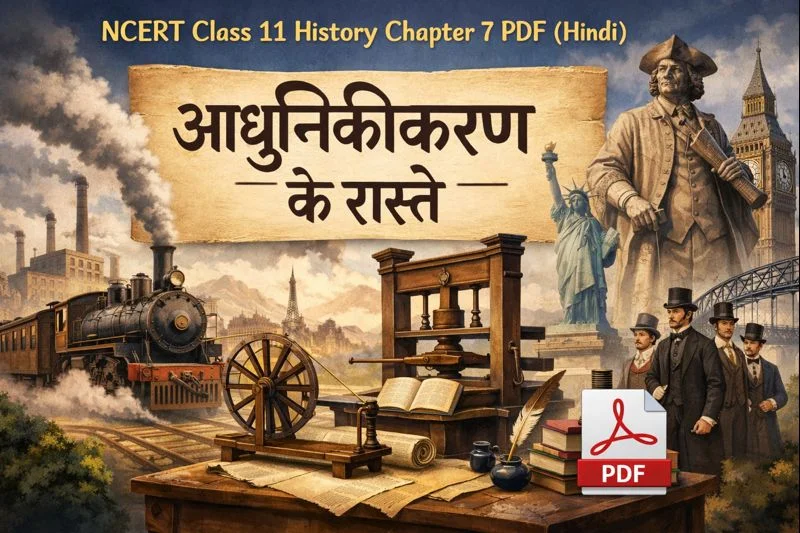
Chapter 7 of Class 11 History (Hindi Medium), आधुनिकीकरण के रास्ते, explains how different countries tried to become modern in the nineteenth and early twentieth centuries. The chapter mainly looks at Japan and China, showing how each society responded to internal challenges and external pressure from Western powers. It discusses reforms in education, industry, military, and governance, and highlights that there was no single path to modernisation. Every country followed its own route based on history, culture, and political conditions.
It shows how Japan modernised rapidly through planned reforms, while China faced internal conflicts and foreign domination that slowed change. These stories help students understand that progress is not automatic or uniform. The chapter also makes us think about our own society and how changes in education, technology, and governance shape a nation’s future. By studying these examples, learners can see that modernisation involves difficult choices, resistance, and long-term planning. It builds a deeper understanding of how today’s modern nations came into being and why historical context matters.
About Chapter 7: आधुनिकीकरण के रास्ते
This chapter compares different models of modernisation, focusing mainly on Japan and China, and explains how political leadership, social structure, and foreign influence affected their journeys.
What Is Modernisation?
Modernisation refers to changes that transform a traditional society into a modern one. These changes include:
- Industrial growth
- Modern education
- Scientific thinking
- Strong central administration
- Modern military systems
Japan’s Path to Modernisation
Japan’s modernisation began with the Meiji Restoration (1868). The Japanese leadership realised that staying isolated would make the country weak.
Key steps taken by Japan:
- Abolished feudal system
- Introduced compulsory education
- Built modern industries
- Strengthened the army and navy
- Adopted Western technology while preserving Japanese culture
Japan’s success shows how planned reforms and unity can bring fast transformation.
China’s Struggle with Modernisation
China faced a much harder path due to:
- Foreign imperialism
- Internal rebellions
- Weak central authority
Major developments discussed in the chapter include:
- Opium Wars and foreign control
- Self-Strengthening Movement
- Boxer Rebellion
- Fall of the Qing dynasty
Despite attempts at reform, China’s progress was slow and uneven.
Role of Nationalism and Reform
Both countries experienced strong debates between tradition and change.
- Reformers wanted modern laws and institutions
- Conservatives wanted to protect traditional values
These debates shaped political movements and future governments.
Comparison of Japan and China
| Aspect | Japan | China |
|---|---|---|
| Speed of change | Fast | Slow |
| Government support | Strong | Weak |
| Foreign control | Limited | Extensive |
| Outcome | Became a modern power | Faced long instability |
NCERT Class 11 History Chapter 7 PDF Download (Hindi Medium)
Students can download the official NCERT Class 11 History Chapter 7 PDF (Hindi): आधुनिकीकरण के रास्ते from here.