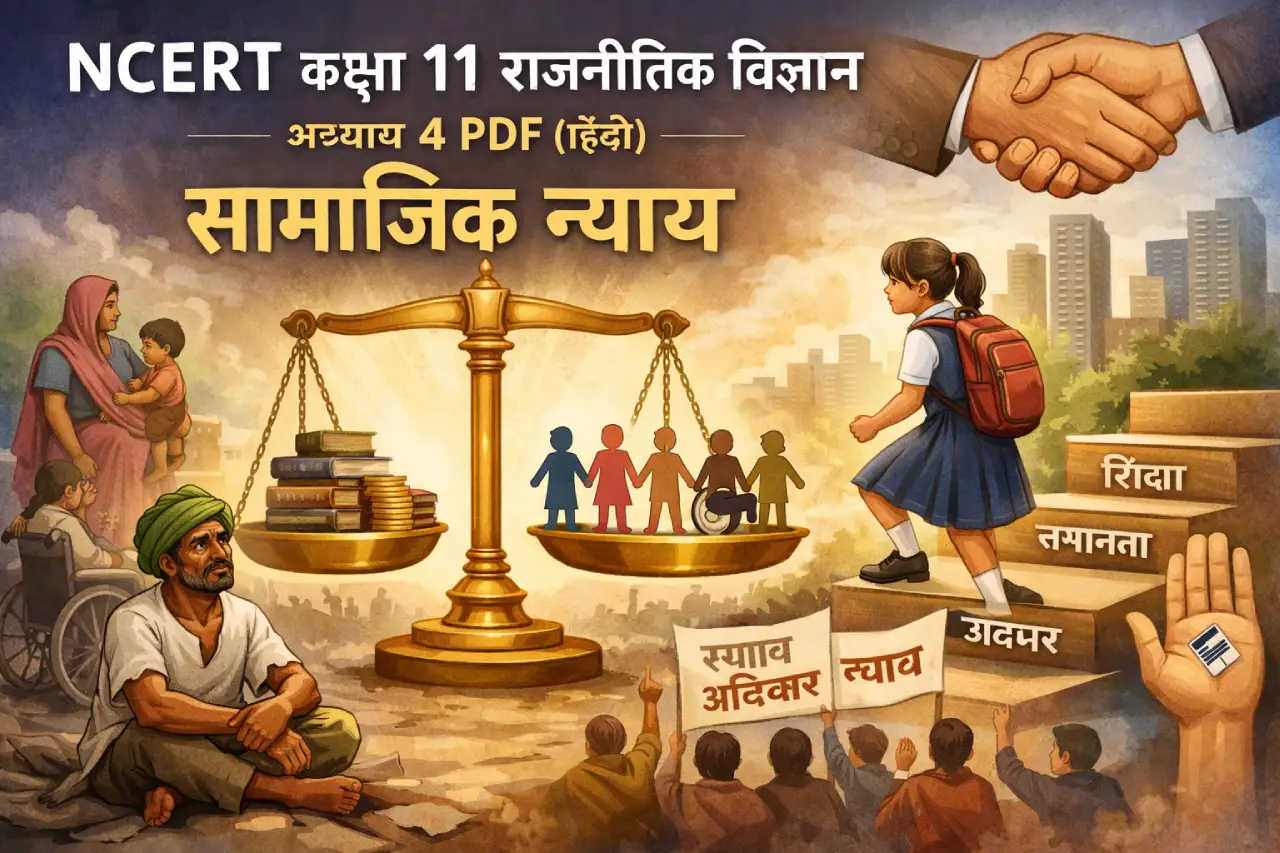
Chapter 4 of Class 11 Political Science Part 1 (Hindi Medium), titled सामाजिक न्याय, focuses on the idea of fairness in society and how justice can be ensured for all sections of people. This chapter explains that social justice is not only about laws but also about correcting long-standing inequalities that exist due to caste, class, gender, and economic background. It highlights how unequal access to resources creates unfair advantages for some and lifelong struggles for others.
From debates on reservation to discussions on minimum wages, education access, and welfare schemes, the idea of social justice shapes public policy in India. Students often hear strong opinions on these issues but may not clearly understand the reasoning behind them. This chapter helps learners see why special policies are sometimes necessary to achieve fairness. It also encourages critical thinking by asking whether treating everyone equally is always just. Understanding this chapter helps students connect classroom theory with real social challenges and develop a more balanced and informed viewpoint.
What Is Social Justice?
Social justice refers to a fair arrangement of social, economic, and political institutions so that every individual can live with dignity. It recognises that people do not start life from the same position, and therefore equal treatment may not always result in equal outcomes.
Social justice aims to:
- Reduce social and economic inequalities
- Protect the rights of disadvantaged groups
- Ensure fair access to opportunities
- Promote dignity and self-respect for all
Why Social Justice Matters in a Democracy
A democratic society is based on the idea that every citizen matters. If large sections of society remain poor, uneducated, or marginalised, democracy becomes weak.
This chapter explains that social justice is essential because:
- It strengthens equality and freedom
- It prevents exploitation and discrimination
- It promotes social harmony
- It builds trust in democratic institutions
Without social justice, political rights alone cannot ensure real freedom.
Means to Achieve Social Justice
The chapter discusses several tools used by governments to promote social justice.
Key Measures Explained
| Measure | Purpose |
|---|---|
| Reservation Policies | To improve representation of disadvantaged groups |
| Welfare Schemes | To support health, education, and basic needs |
| Minimum Wage Laws | To protect workers from exploitation |
| Free or Subsidised Education | To reduce inequality in learning opportunities |
These measures are designed to reduce historical disadvantages rather than create new inequalities.
Social Justice and Equality
Social justice goes beyond legal equality. While laws may treat everyone equally, social justice looks at real-life conditions.
For example:
- A child from a poor family may need scholarships to continue education
- Marginalised communities may need special protection to access opportunities
The chapter makes it clear that fairness sometimes requires different treatment based on need.
Criticism and Debates Around Social Justice
The chapter also encourages students to think critically. Some people argue that policies like reservation affect merit, while others believe they are necessary to balance social inequalities. Understanding both sides helps students develop informed opinions rather than emotional reactions.
NCERT Class 11 Political Science Chapter 4 PDF Download (Hindi Medium)
Students can download the official NCERT PDF by following these steps:
- Visit the official NCERT website
- Click on E-Books
- Select Class 11
- Choose Political Science
- Open Political Theory – Part 1 (Hindi Medium)
- Click on Chapter 4: सामाजिक न्याय
- Download the PDF for study
Always rely on NCERT’s official source for accurate and updated content.