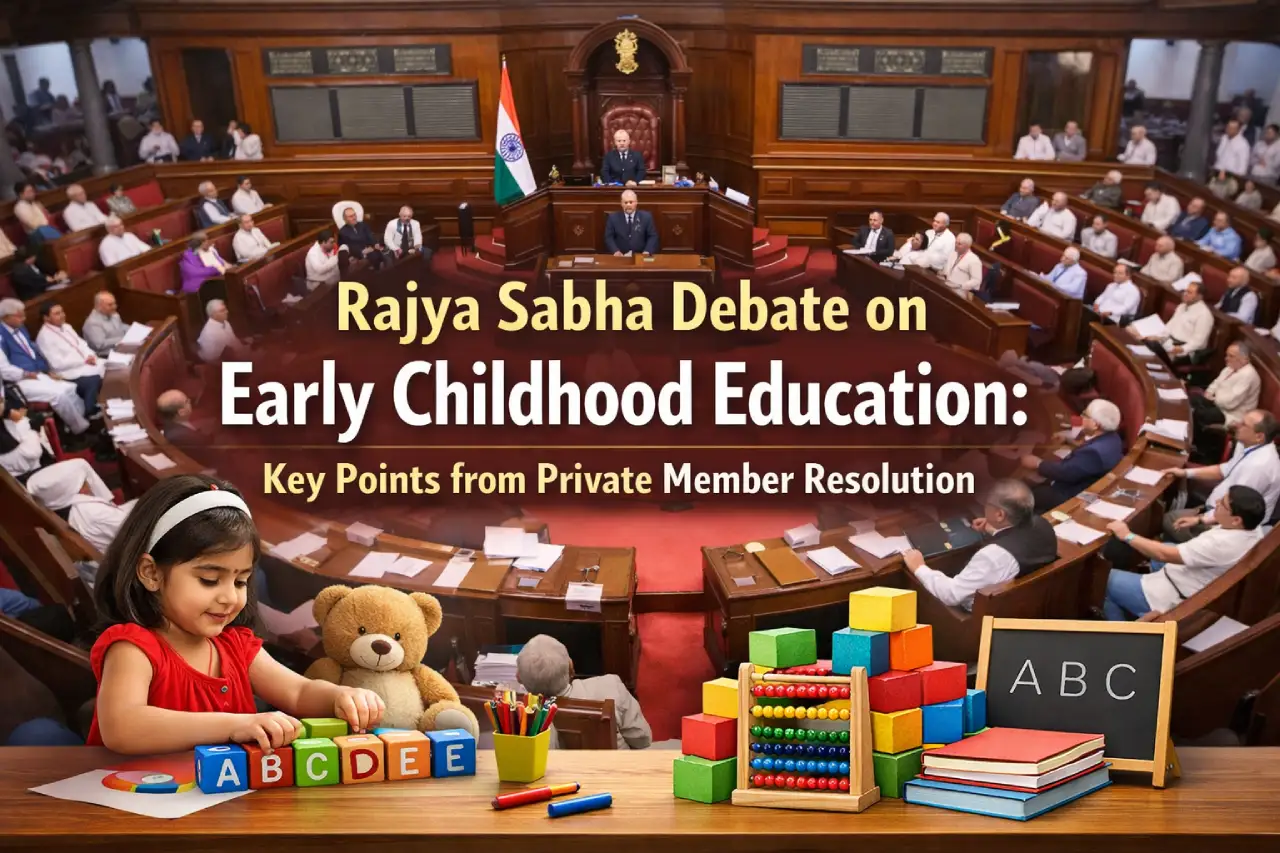
The Rajya Sabha recently took up a Private Member Resolution focusing on early childhood education, bringing renewed attention to the learning and development needs of children in their formative years. Members from different political parties participated in the discussion, underlining the importance of structured early education, nutrition, and care as the foundation for lifelong learning. The debate highlighted how early childhood education plays a crucial role in shaping cognitive ability, social skills, and overall well-being.
From my own observation, public attention usually increases only when school results or higher education policies are discussed, while the years before Class 1 are quietly ignored. This Rajya Sabha discussion is important because it brings the focus back to where learning actually begins. Research has consistently shown that the first six years of a child’s life are critical for brain development. When lawmakers raise this issue in Parliament through a Private Member Resolution, it signals that early learning is no longer being treated as optional or secondary. For parents, teachers, and policy watchers, this debate helps in understanding where future policy direction may be headed.
What Is a Private Member Resolution
A Private Member Resolution is moved by a Member of Parliament who is not a minister. Such resolutions are meant to draw attention to important public issues and influence government thinking, even though they are not binding.
In this case, the resolution aimed to push for stronger policy focus and structured planning around early childhood education across the country.
Key Points Raised During the Rajya Sabha Discussion
During the discussion, members stressed several concerns related to early childhood education:
- The need for a uniform and child-centric early education framework
- Importance of trained educators for pre-primary levels
- Integration of education with nutrition and health services
- Bridging gaps between rural and urban early learning facilities
Several members also pointed out that unequal access to quality early education continues to affect learning outcomes in later years.
Why Early Childhood Education Matters
Early childhood education covers the period from birth to around six years of age. Experts agree that this stage lays the foundation for reading, writing, emotional control, and social behaviour.
When children receive proper early education, they are more likely to perform better in school, stay engaged with learning, and develop problem-solving skills at an early age.
Government’s Perspective During the Debate
During the Rajya Sabha discussion, the government acknowledged the importance of early childhood education and referred to existing programmes and policy efforts aimed at strengthening this sector. Emphasis was placed on improving quality standards, coordination among ministries, and better implementation at the ground level.
The discussion also reflected the need to align early childhood education goals with broader education reforms.
How This Debate Impacts Policy and Society
While a Private Member Resolution does not automatically change laws, it plays an important role in shaping public discourse. Such discussions often influence future policy decisions, budget priorities, and programme design.
For parents and educators, this debate signals growing recognition of early education as a public responsibility rather than just a family concern.
Relevance for Competitive Exam Aspirants
For aspirants preparing for UPSC and other government exams, this topic is relevant under education, social justice, and child development. It can be used as a current example in mains answers, essays, and interviews when discussing human capital development.