JOIN WHATSAPP
STORIES

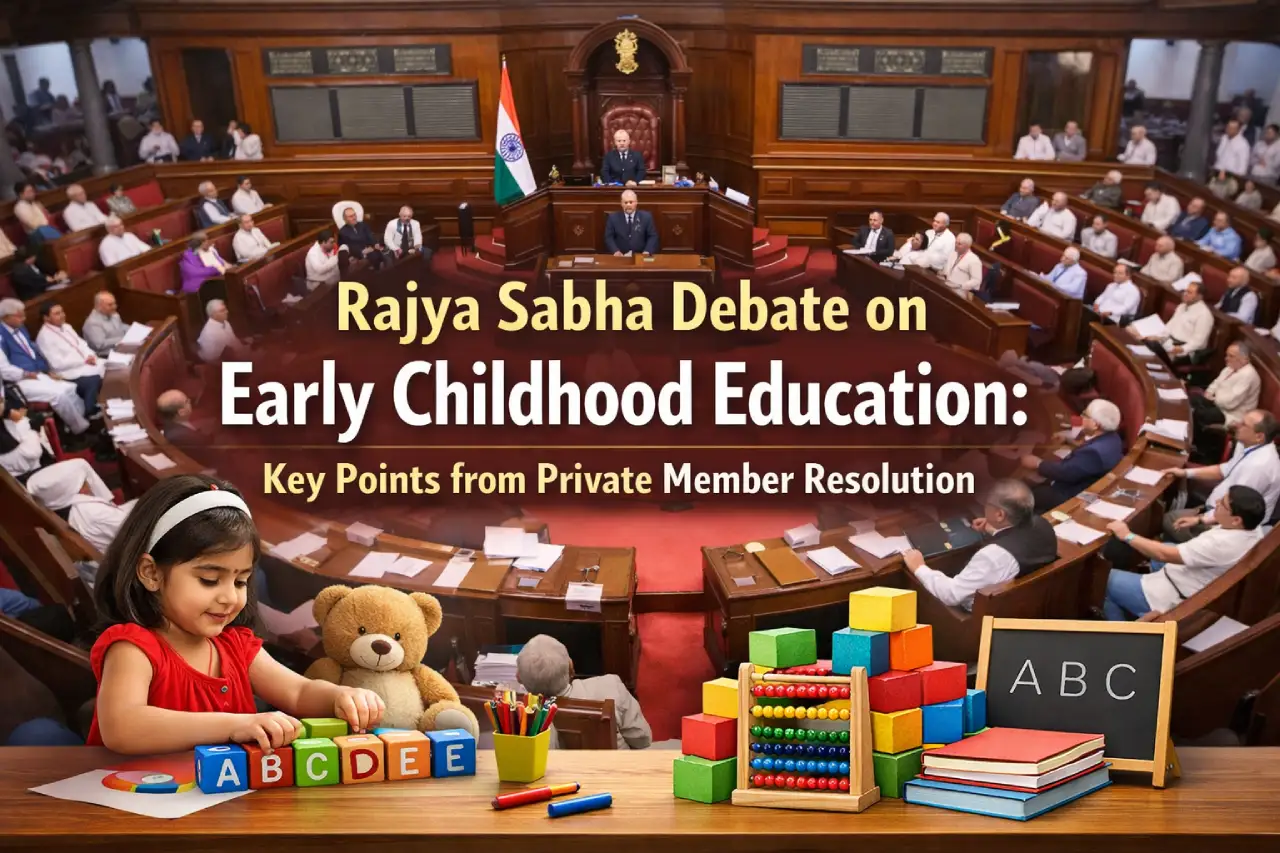
Rajya Sabha Debate on Early Childhood Education: Key Points from Private Member Resolution

Rajya Sabha Debate on Early Childhood Education: Key Points from Private Member Resolution

The Rajya Sabha recently took up a Private Member Resolution focusing on early childhood education, bringing renewed attention to the learning and development needs of children in their formative years. Members from different political parties participated in the discussion, underlining the importance of structured early education, nutrition, and care as the foundation for lifelong learning. The debate highlighted how early childhood education plays a crucial role in shaping cognitive ability, social skills, and overall well-being.

From my own observation, public attention usually increases only when school results or higher education policies are discussed, while the years before Class 1 are quietly ignored. This Rajya Sabha discussion is important because it brings the focus back to where learning actually begins. Research has consistently shown that the first six years of a child’s life are critical for brain development. When lawmakers raise this issue in Parliament through a Private Member Resolution, it signals that early learning is no longer being treated as optional or secondary. For parents, teachers, and policy watchers, this debate helps in understanding where future policy direction may be headed.

What Is a Private Member Resolution

A Private Member Resolution is moved by a Member of Parliament who is not a minister. Such resolutions are meant to draw attention to important public issues and influence government thinking, even though they are not binding.

In this case, the resolution aimed to push for stronger policy focus and structured planning around early childhood education across the country.

Key Points Raised During the Rajya Sabha Discussion

During the discussion, members stressed several concerns related to early childhood education:

  • The need for a uniform and child-centric early education framework
  • Importance of trained educators for pre-primary levels
  • Integration of education with nutrition and health services
  • Bridging gaps between rural and urban early learning facilities

Several members also pointed out that unequal access to quality early education continues to affect learning outcomes in later years.

Why Early Childhood Education Matters

Early childhood education covers the period from birth to around six years of age. Experts agree that this stage lays the foundation for reading, writing, emotional control, and social behaviour.

When children receive proper early education, they are more likely to perform better in school, stay engaged with learning, and develop problem-solving skills at an early age.

Government’s Perspective During the Debate

During the Rajya Sabha discussion, the government acknowledged the importance of early childhood education and referred to existing programmes and policy efforts aimed at strengthening this sector. Emphasis was placed on improving quality standards, coordination among ministries, and better implementation at the ground level.

The discussion also reflected the need to align early childhood education goals with broader education reforms.

How This Debate Impacts Policy and Society

While a Private Member Resolution does not automatically change laws, it plays an important role in shaping public discourse. Such discussions often influence future policy decisions, budget priorities, and programme design.

For parents and educators, this debate signals growing recognition of early education as a public responsibility rather than just a family concern.

Relevance for Competitive Exam Aspirants

For aspirants preparing for UPSC and other government exams, this topic is relevant under education, social justice, and child development. It can be used as a current example in mains answers, essays, and interviews when discussing human capital development.


Leave a Comment

End of Article

How Online Education Is Helping Maharashtra Students Improve Math and English Skills

How Online Education Is Helping Maharashtra Students Improve Math and English Skills

Digital learning has quietly changed the way many students across Maharashtra approach difficult subjects like Mathematics and English. For one student who once struggled with basic concepts, online learning tools became a turning point. With access to interactive lessons, recorded explanations, and regular practice tests, the student was able to learn at a comfortable pace. Over time, weak areas in maths calculations and English comprehension improved, leading to better confidence and noticeable academic progress.

I am writing about this topic because stories like these reflect a larger shift happening in education. Many students still believe that struggling in subjects means they are not capable, which is not true. The right learning support can make a big difference. Digital learning is no longer just an option for urban or elite students, it is becoming a practical solution for learners from different backgrounds who need personalised attention and flexible study methods.

The Challenge Many Students Face

Subjects like Mathematics and English often create fear among students. Maths demands clarity of concepts and constant practice, while English requires reading, listening, and confidence in expression. In traditional classrooms, students who fall behind may hesitate to ask questions, leading to long-term gaps in learning. This is exactly where digital learning tools have started to help bridge the gap.

How Digital Learning Changed the Learning Process

Digital platforms allow students to revisit lessons as many times as needed. Instead of moving at the pace of the classroom, the Maharashtra student could pause videos, revise concepts, and practise questions repeatedly.

Some key benefits included:

  • Step-by-step explanations for maths problems
  • Grammar and vocabulary practice through interactive exercises
  • Instant feedback on tests and quizzes
  • Learning without fear of judgement

This personalised approach helped build understanding and confidence.

Improvement in Mathematics Skills

For maths, digital learning provided structured practice. Concepts like fractions, algebra, and problem-solving became easier through visual explanations and guided practice sessions. Regular mock tests helped the student identify mistakes early and correct them before exams.

Over time, maths shifted from being a fear subject to one of the student’s stronger areas.

Growth in English Language Skills

English improvement came through consistent exposure. Listening to recorded lessons improved pronunciation, while reading-based exercises strengthened comprehension. Writing tasks with sample answers helped the student understand sentence structure and grammar usage.

Slowly, the student became more confident in reading passages and answering questions, both in exams and daily classroom activities.

Role of Self-Paced Learning

One of the biggest advantages of digital education is self-paced learning. The student could study early in the morning or late in the evening, depending on comfort. This flexibility reduced pressure and allowed learning to happen naturally, without stress.

From my point of view, this freedom is especially helpful for students who need more time to understand concepts.

Support from Teachers and Parents

Digital learning worked best when supported by guidance. Teachers helped track progress through performance reports, while parents encouraged regular study habits at home. This combined effort ensured the student stayed consistent and motivated.

Why This Matters for Other Students

This story is not unique. Many students across Maharashtra and other states are benefiting in similar ways. Digital learning does not replace teachers, but it strengthens learning by offering extra support where needed.

Students who struggle should see this as proof that improvement is possible with the right tools.

Leave a Comment

End of Article

Loading more posts...