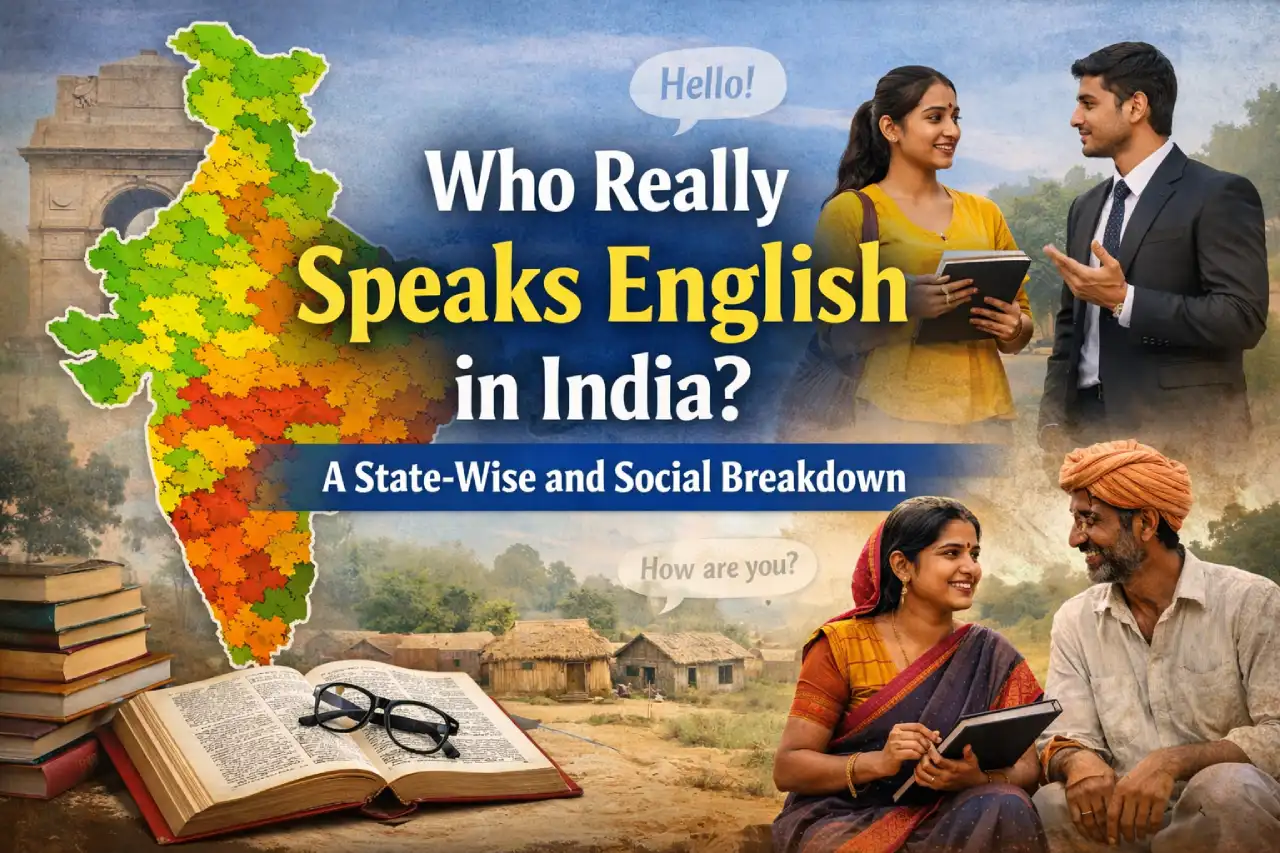
English is often seen as a common link language in India, but in reality, who speaks English and where they speak it varies widely across regions, cities, and social groups. While English has a strong presence in education, government, and professional spaces, it is not equally spoken or understood by everyone. In India, English is more commonly used in urban areas, among the educated population, and in states with stronger access to higher education and services.
I am writing about this topic because English in India is closely tied to opportunity, mobility, and access. It influences education choices, job prospects, and even social confidence. Understanding who speaks English, and where, helps us move beyond assumptions and see the real linguistic landscape of India. It also opens up conversations about inequality, education policy, and language inclusion in a multilingual society.
How Widespread Is English in India
English is not the most spoken language in India, but it plays a powerful role. Only a small percentage of Indians speak English fluently, while a larger group understands or uses it as a second or third language. For many, English is learned primarily through schooling rather than at home.
Its use is often functional, limited to classrooms, offices, exams, or official communication.
Urban vs Rural English Usage
English is far more common in cities than in villages. Urban areas offer greater exposure through:
- English-medium schools
- Colleges and universities
- Corporate offices
- Media, internet, and social platforms
In rural India, English exposure is limited, and local languages dominate daily communication. Even when English is taught in schools, practical usage remains low due to lack of environment and resources.
Which States Speak More English
English proficiency varies widely across states. Southern states such as Kerala, Tamil Nadu, Karnataka, and Telangana generally show higher English usage due to stronger education systems and historical emphasis on English education. Maharashtra, Delhi, and West Bengal also have relatively high English-speaking populations in urban centres.
In contrast, many northern and eastern states show lower everyday use of English, especially outside cities.
Role of Education and Schooling
Education is the strongest factor influencing English usage in India. Students from English-medium or private schools are more likely to speak English confidently. Government schools often teach English as a subject, but limited practice reduces fluency.
Higher education, especially in science, technology, medicine, and management, further pushes English usage.
English and Social Class
English in India is closely linked to class and privilege. It is often seen as a marker of education, confidence, and social status. This creates a divide where English speakers may have better access to jobs and opportunities, while non-English speakers feel excluded, despite being skilled or knowledgeable.
This gap is social, not intellectual.
English in Workplaces and Media
Most formal workplaces in India use English, especially in:
- Corporate offices
- IT and tech sectors
- Higher judiciary and administration
- Higher education and research
English also dominates digital media, online content, and competitive exams, reinforcing its importance for upward mobility.
Is English Replacing Indian Languages
English has not replaced Indian languages in daily life. Most Indians continue to speak their mother tongue at home and in social spaces. Instead, English exists alongside Indian languages, often used selectively for education and work.
India remains deeply multilingual, with English acting more as a bridge than a replacement.