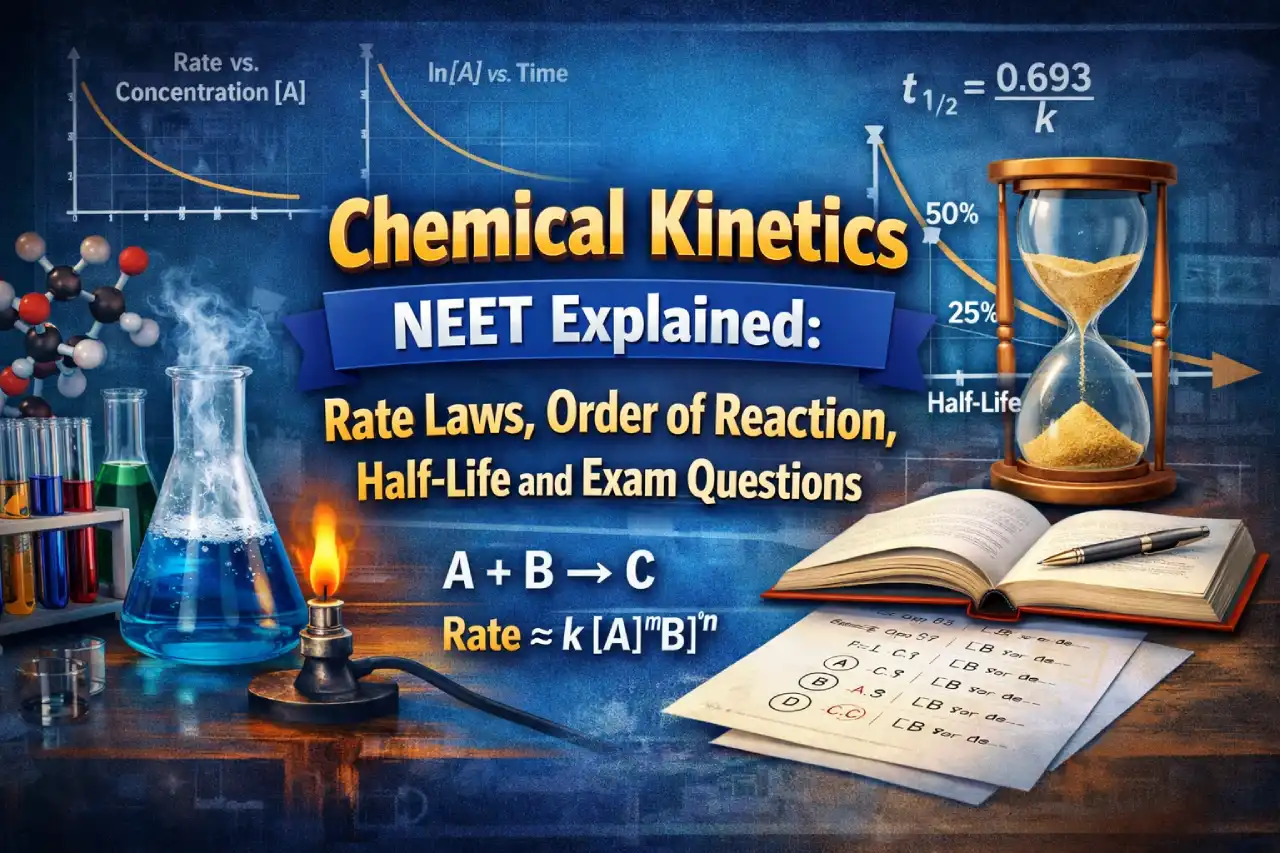
The uploaded PDF is a comprehensive collection of NEET and pre-NEET previous year questions on Chemical Kinetics, along with detailed answer keys and step-by-step explanations. It covers all core concepts such as rate of reaction, order and molecularity, rate laws, half-life, integrated rate equations, Arrhenius equation, activation energy, collision theory, catalysts, and enzyme kinetics. The questions span multiple years and exam formats, clearly reflecting how NEET repeatedly tests this chapter.
I am writing about this document because Chemical Kinetics is a chapter where students often know formulas but struggle to apply them correctly in exams. This PDF shows exactly how concepts are framed in NEET questions and what type of thinking is expected. Analysing these questions helps students move from memorisation to proper conceptual understanding, which is essential for scoring well.
What the PDF Focuses On
The document is organised around previous year NEET questions, followed by:
- Correct options
- Short conceptual explanations
- Mathematical derivations where required
The questions repeatedly test understanding rather than theory alone, making this PDF a strong exam-oriented practice resource.
Rate of Reaction and Rate Laws
Many questions in the PDF focus on defining the rate of reaction in terms of disappearance of reactants and appearance of products. The correct mathematical representation of rate using stoichiometric coefficients is tested multiple times.
The concept of rate law is central, where rate is expressed as
rate = k[A]ᵐ[B]ⁿ
Students are repeatedly asked to determine the order of reaction from experimental data, changes in concentration, or rate comparisons. These questions highlight that order is determined experimentally and not from balanced equations.
Order of Reaction and Its Types
The PDF covers zero-order, first-order, second-order, fractional, and complex order reactions through repeated exam questions.
Key ideas tested include:
- Zero-order reactions having rate independent of concentration
- First-order reactions having half-life independent of initial concentration
- Second-order reactions showing dependence of half-life on concentration
Several NEET questions directly ask how half-life changes when concentration is doubled, making this a high-yield area.
Half-Life and Integrated Rate Equations
A large portion of the questions involve numerical problems based on half-life. The PDF repeatedly uses standard relations:
- First-order: t₁/₂ = 0.693 / k
- Zero-order: t₁/₂ ∝ initial concentration
Students are also tested on time required for specific percentage completion such as 50%, 75%, or 99%, reinforcing the importance of logarithmic expressions in first-order reactions.
Download this CHEMICAL KINETICS PDF File: Click Here
Reaction Mechanism and Rate-Determining Step
Several questions test understanding of reaction mechanisms, where fast and slow steps are given. The PDF clearly explains that the slowest step is the rate-determining step and controls the overall reaction rate.
In such problems, intermediate species are eliminated using equilibrium constants of fast steps, and the overall order of reaction is calculated accordingly.
Arrhenius Equation and Activation Energy
The Arrhenius equation appears repeatedly in the PDF, both in conceptual and numerical form. Questions test:
- Determination of activation energy from slope of ln k vs 1/T plot
- Effect of temperature on rate constant
- Comparison of rate constants at different temperatures
The document clearly shows that activation energy is related to slope, not intercept, and that rate constant increases with temperature.
Effect of Catalyst and Enzymes
Several NEET questions in the PDF focus on catalysis and enzyme action. The key idea reinforced is that a catalyst:
- Lowers activation energy
- Does not change enthalpy, entropy, or equilibrium constant
- Provides an alternate reaction pathway
Enzymes are treated as biological catalysts, and their role in increasing reaction rate by lowering activation energy is tested multiple times.
Collision Theory and Frequency
The PDF also includes questions based on collision theory, especially the meaning of collision frequency (ZAB) and factors affecting reaction rate. Increasing concentration is shown to increase collision frequency but not activation energy or heat of reaction.
Common NEET Trends Seen in the PDF
From the repeated questions, it is clear that NEET frequently asks:
- Order determination from rate data
- Half-life based numericals
- Arrhenius plots and activation energy
- Catalyst and enzyme concepts
- Correct mathematical expression of reaction rate
These areas appear again and again across years.
Why This PDF Is Important for Students
This document works as:
- A topic-wise revision tool
- A question pattern guide for NEET
- A concept-clarity resource through explanations
Solving and understanding these questions can significantly improve accuracy and confidence in the actual exam.