JOIN WHATSAPP
STORIES

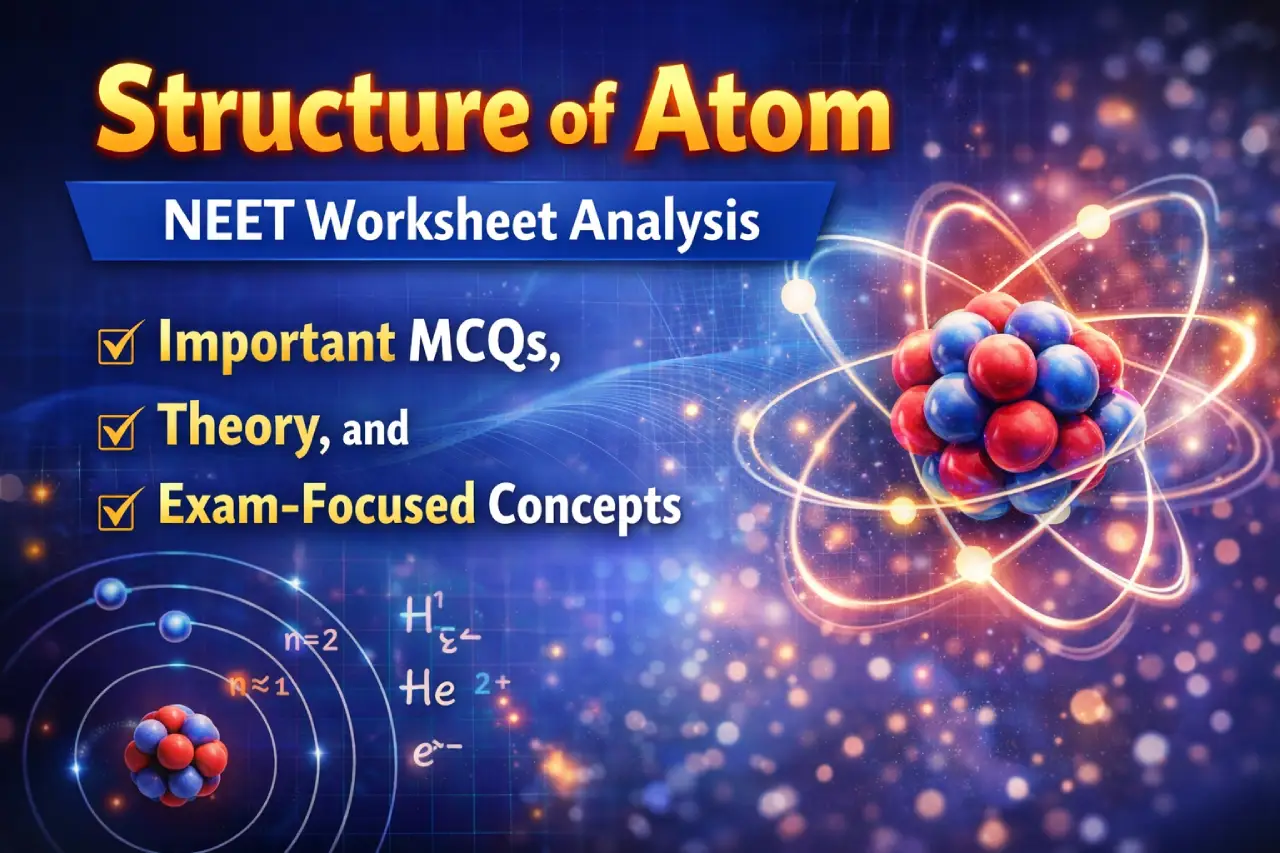
Structure of Atom NEET Worksheet Analysis: Important MCQs, Theory, and Exam-Focused Concepts

Structure of Atom NEET Worksheet Analysis: Important MCQs, Theory, and Exam-Focused Concepts

The uploaded PDF is a Class 11 Chemistry worksheet on the Structure of Atom, prepared mainly for NEET and other competitive exam aspirants. It contains 75 multiple-choice questions with detailed explanations, strictly based on NCERT theory. The questions cover atomic models, electromagnetic radiation, Bohr’s theory, quantum numbers, electronic configuration, spectra, photoelectric effect, and wave–particle duality. The worksheet is designed to test both numerical accuracy and conceptual clarity.

I am writing about this worksheet because the Structure of Atom chapter forms the foundation of physical chemistry and often decides early confidence in NEET preparation. Many students struggle with formulas, constants, and interpretation-based questions. Analysing this worksheet helps identify exactly how NCERT concepts are converted into exam questions and which areas need repeated revision to avoid common mistakes.

Overall Pattern of the Worksheet

The worksheet follows a pure MCQ format with solutions, making it suitable for self-practice and concept reinforcement. Questions range from simple definition-based to calculation-intensive ones involving Planck’s equation, Rydberg formula, and Bohr’s energy expressions. The difficulty level is easy to moderate, matching NEET standards rather than advanced Olympiad level.

Atomic Models and Their Limitations

Several questions test understanding of early atomic models. The worksheet highlights:

  • Limitations of Rutherford’s atomic model
  • Why Bohr introduced fixed energy orbits
  • Stability of atoms explained using quantised energy levels

Students are expected to know not just the models, but also why earlier theories failed and how later models improved upon them.

Electromagnetic Radiation and Photon Energy

A large portion of the worksheet focuses on electromagnetic radiation. Questions involve:

  • Calculation of photon energy using Planck’s equation
  • Relationship between wavelength, frequency, and energy
  • Identification of visible, ultraviolet, and infrared regions

These questions reinforce that shorter wavelength means higher energy, a concept frequently tested in NEET.

Download this Structure of Atom PDF File: Click Here

Hydrogen Spectrum and Rydberg Equation

The worksheet includes multiple questions on hydrogen emission spectra, covering:

  • Lyman, Balmer, Paschen, Brackett, and Pfund series
  • Transitions responsible for visible and ultraviolet lines
  • Use of Rydberg’s equation to calculate wavelength and wave number

Students must clearly remember which series belongs to which region of the electromagnetic spectrum.

Bohr’s Theory and Energy Calculations

Bohr’s postulates are repeatedly tested through numerical questions such as:

  • Energy of electrons in different orbits
  • Radius of Bohr orbits
  • Energy released or absorbed during electronic transitions

The worksheet reinforces that energy is inversely proportional to the square of the principal quantum number, an idea that appears frequently in exams.

Quantum Numbers and Electronic Configuration

A significant section focuses on quantum numbers and orbital concepts, including:

  • Allowed values of n, l, ml, and ms
  • Number of orbitals and electrons in a shell
  • Identification of subshells like 3p, 4f, and 3d

Questions also test Aufbau principle, Hund’s rule, and stability of half-filled and fully-filled orbitals.

Wave–Particle Duality and Modern Physics Concepts

The worksheet covers modern atomic theory through questions on:

  • de Broglie wavelength
  • Heisenberg’s uncertainty principle
  • Photoelectric effect
  • Dual nature of radiation and matter

These questions test conceptual understanding rather than rote learning and often confuse students if basics are not clear.

Spectra, Experiments, and Important Discoveries

Important experiments and effects are also included, such as:

  • Photoelectric effect
  • Stark effect and Zeeman effect
  • Millikan’s oil drop experiment
  • Cathode ray experiments

Such questions are straightforward but require precise factual recall, especially for one-mark NEET questions.

What This Worksheet Teaches NEET Aspirants

From this worksheet, students clearly learn that:

  • NCERT theory is sufficient if understood properly
  • Formula-based questions require careful unit conversion
  • Quantum number rules are non-negotiable
  • Repeated practice reduces calculation errors

The worksheet also shows how similar concepts are tested in different numerical forms.
Leave a Comment

End of Article

Class 11 Sets Question Worksheet: Concept Breakdown, Question Pattern and Why It Matters for Exams

Class 11 Sets Question Worksheet: Concept Breakdown, Question Pattern and Why It Matters for Exams

This mathematics worksheet on Sets, prepared for Class 11 CBSE students, is designed mainly for board exam preparation and for building a strong foundation for higher mathematics. It contains 50 multiple-choice questions, all framed directly from NCERT concepts. The worksheet covers basic ideas like representation of sets, subsets, power sets, operations on sets, complements, and Venn diagram logic. Overall, it reflects the kind of factual yet concept-based questions students regularly face in school examinations Sets WS.

I am writing about this worksheet because the chapter on Sets often feels simple at first but becomes tricky due to logical conditions, symbols, and formula-based questions. Many students lose easy marks due to confusion between subset relations, complements, and set operations. A structured worksheet like this helps convert theory into exam-ready understanding. By analysing the questions carefully, students can clearly identify which areas are repeatedly tested and how basic definitions are turned into scoring MCQs.

Structure of the Sets Worksheet

The worksheet consists of 50 MCQs, with each question carrying one mark. The questions are a mix of direct concept checks and logical application-based problems. While many questions look straightforward, the options are closely framed, which tests clarity and careful reading rather than guesswork.

The overall difficulty level ranges from easy to moderate, making this worksheet suitable for both revision and self-assessment before exams.

Basics of Sets and Representation

Several questions focus on the fundamentals of sets, including:

  • Well-defined collections
  • Roster form and set-builder form
  • Identification of valid and invalid sets
  • Null set and singleton set

These questions ensure that students clearly understand what qualifies as a set and how sets are represented mathematically, which is the starting point of the chapter Sets WS.

Subsets, Proper Subsets and Power Sets

A large part of the worksheet tests understanding of subsets and power sets. Questions include:

  • Finding the number of subsets of a given set
  • Identifying proper and improper subsets
  • Comparing number of subsets between two sets
  • Questions based on formulas like 2ⁿ and 2ⁿ − 1

These are high-scoring areas in exams but require clarity in applying formulas correctly.

Operations on Sets

The worksheet strongly focuses on operations on sets such as:

  • Union
  • Intersection
  • Difference of sets
  • Complement of a set

Many questions are based on standard identities like
A ∩ (A ∪ B) = A
and conditions such as A ∪ B = A or A ∩ B = B. These questions test whether students understand identities logically rather than memorising them.

Download this Sets Question PDF File: Click Here

Complement and Universal Set Concepts

Several MCQs involve complements of sets with respect to a universal set. Students are asked to evaluate expressions involving A′, (A′)′, and combined operations with complements.

Such questions are important because small mistakes in complement logic can lead to incorrect answers even when the concept is known.

Set-Builder Logic and Interval-Based Sets

The worksheet includes questions written in set-builder notation and interval form, especially involving real numbers. These questions test the ability to translate mathematical conditions into correct set notation and vice versa.

Understanding these problems is essential for later chapters involving relations, functions, and coordinate geometry.

Counting and Application-Based Questions

Some questions go beyond direct definitions and involve counting techniques, such as:

  • Comparing number of subsets of different sets
  • Finding values of variables based on subset conditions
  • Questions involving overlapping sets and element distribution

These problems improve logical reasoning and are often used to test deeper understanding in exams.

What Students Can Learn from This Worksheet

From this worksheet, it becomes clear that:

  • NCERT definitions are the backbone of exam questions
  • Set identities must be understood logically
  • Subset and power set formulas need careful application
  • Complement-based questions require attention to detail
  • Regular practice reduces silly mistakes in easy chapters

Overall, this Class 11 Sets worksheet is a strong practice resource that helps students secure marks from a scoring chapter. It builds clarity, confidence, and accuracy, which are essential for performing well in board examinations and future mathematical studies.

Leave a Comment

End of Article

Loading more posts...