JOIN WHATSAPP
STORIES

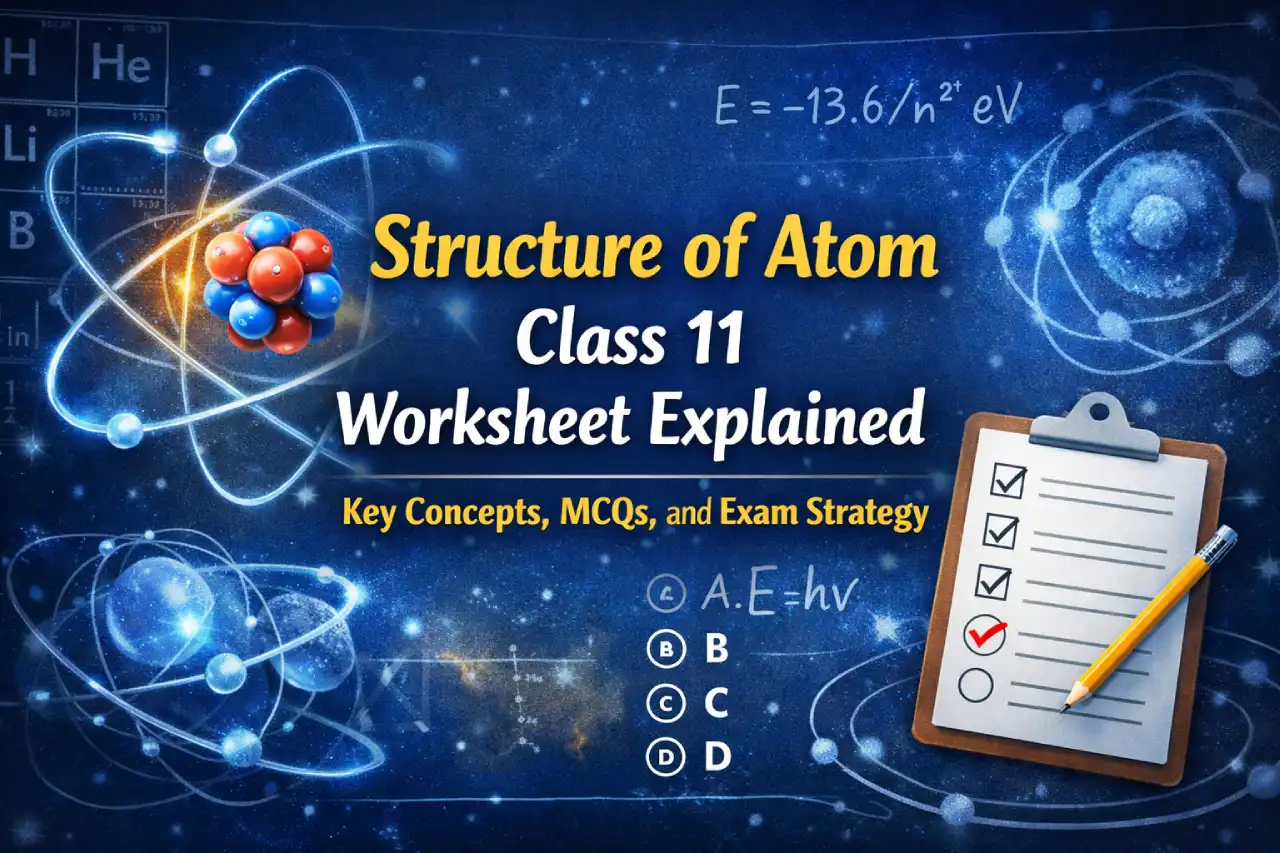
Structure of Atom Class 11 Worksheet Explained: Key Concepts, MCQs, and Exam Strategy

Structure of Atom Class 11 Worksheet Explained: Key Concepts, MCQs, and Exam Strategy

The Structure of Atom worksheet for Class 11 Chemistry is designed to test how well students understand the foundation of atomic theory, quantum mechanics, and electronic structure. This worksheet is not just a list of questions. It carefully covers every important idea from the chapter, starting from early atomic models to modern quantum mechanical concepts. While going through it, I noticed that it strongly focuses on numerical accuracy, conceptual clarity, and correct application of formulas.

I am writing about this worksheet because the Structure of Atom chapter often feels confusing to students at first. Terms like wave number, quantum numbers, spectral series, and energy levels can be overwhelming. This worksheet brings all those ideas together in a structured way and helps students identify exactly where they need more practice. For anyone preparing for school exams, NEET, or other competitive tests, understanding this worksheet properly can make a real difference in scores. Structure of Atom WS 1

Overview of the Structure of Atom Worksheet

This worksheet is meant for Class 11 Chemistry and follows the CBSE syllabus closely. It contains a large number of objective-type questions that test both theory and calculations. The questions are framed in a way that checks whether students truly understand the logic behind atomic structure rather than just memorising facts.

The worksheet includes:

  • Multiple choice questions based on atomic models
  • Numerical problems involving Planck’s equation and Bohr’s theory
  • Conceptual questions from quantum mechanics
  • Questions based on hydrogen spectrum and electronic transitions

Atomic Models Covered in the Worksheet

A major part of the worksheet revolves around the evolution of atomic models. Questions are asked from Dalton’s atomic theory, Rutherford’s alpha-particle scattering experiment, and Bohr’s model of the hydrogen atom.

Rutherford’s experiment-based questions focus on conclusions such as the presence of a small, dense nucleus and the fact that most of the atom is empty space. Bohr’s model questions test ideas like fixed energy levels, quantised orbits, and energy changes during electronic transitions.

Hydrogen Spectrum and Spectral Series

The worksheet gives strong importance to the hydrogen emission spectrum. Students are expected to understand different spectral series such as Lyman, Balmer, Paschen, Brackett, and Pfund.

Many questions ask:

  • From which transition a particular series originates
  • In which region of the electromagnetic spectrum the series lies
  • How wave number is calculated using the Rydberg equation

These questions are especially important for exams because they combine theory with formula-based thinking.

Quantum Numbers and Electronic Configuration

Another major section of the worksheet deals with quantum numbers. Questions test knowledge of:

  • Principal quantum number (n)
  • Azimuthal quantum number (l)
  • Magnetic quantum number (mₗ)
  • Spin quantum number (mₛ)

Students are asked to identify allowed values, match orbitals with given quantum numbers, and determine the number of orbitals and electrons possible. Electronic configuration-based questions also check understanding of Aufbau principle, Hund’s rule, and Pauli’s exclusion principle.

Download this PDF File: Click Here

Numerical Problems and Formula Application

This worksheet includes many numericals that require correct substitution of values and unit handling. Common formulas used include:

  • E = hν
  • E = hc/λ
  • Energy of electron in Bohr orbit
  • de Broglie wavelength equation

Some questions test energy changes during ionisation or excitation, while others ask for wavelength or frequency calculations. These numericals help students build confidence in solving Chemistry problems step by step.

Photoelectric Effect and Dual Nature of Radiation

Several questions are based on the dual nature of radiation and matter. The worksheet checks whether students understand that light behaves both as a wave and a particle.

Photoelectric effect-based questions test ideas like:

  • Threshold frequency
  • Dependence of kinetic energy on frequency
  • Experimental proof of particle nature of light

These questions are conceptually important and often appear in competitive exams.

Importance of This Worksheet for Exams

From my experience, this worksheet works like a mirror. It shows exactly which parts of the chapter you have understood well and which parts still need revision. The wide coverage of questions makes it ideal for:

  • Class 11 Chemistry unit tests
  • Board exam preparation
  • NEET and other entrance exams

Repeated practice of such worksheets helps reduce silly mistakes and improves speed and accuracy.

Leave a Comment

End of Article

Class 11 Sets Question Worksheet: Concept Breakdown, Question Pattern and Why It Matters for Exams

Class 11 Sets Question Worksheet: Concept Breakdown, Question Pattern and Why It Matters for Exams

This mathematics worksheet on Sets, prepared for Class 11 CBSE students, is designed mainly for board exam preparation and for building a strong foundation for higher mathematics. It contains 50 multiple-choice questions, all framed directly from NCERT concepts. The worksheet covers basic ideas like representation of sets, subsets, power sets, operations on sets, complements, and Venn diagram logic. Overall, it reflects the kind of factual yet concept-based questions students regularly face in school examinations Sets WS.

I am writing about this worksheet because the chapter on Sets often feels simple at first but becomes tricky due to logical conditions, symbols, and formula-based questions. Many students lose easy marks due to confusion between subset relations, complements, and set operations. A structured worksheet like this helps convert theory into exam-ready understanding. By analysing the questions carefully, students can clearly identify which areas are repeatedly tested and how basic definitions are turned into scoring MCQs.

Structure of the Sets Worksheet

The worksheet consists of 50 MCQs, with each question carrying one mark. The questions are a mix of direct concept checks and logical application-based problems. While many questions look straightforward, the options are closely framed, which tests clarity and careful reading rather than guesswork.

The overall difficulty level ranges from easy to moderate, making this worksheet suitable for both revision and self-assessment before exams.

Basics of Sets and Representation

Several questions focus on the fundamentals of sets, including:

  • Well-defined collections
  • Roster form and set-builder form
  • Identification of valid and invalid sets
  • Null set and singleton set

These questions ensure that students clearly understand what qualifies as a set and how sets are represented mathematically, which is the starting point of the chapter Sets WS.

Subsets, Proper Subsets and Power Sets

A large part of the worksheet tests understanding of subsets and power sets. Questions include:

  • Finding the number of subsets of a given set
  • Identifying proper and improper subsets
  • Comparing number of subsets between two sets
  • Questions based on formulas like 2ⁿ and 2ⁿ − 1

These are high-scoring areas in exams but require clarity in applying formulas correctly.

Operations on Sets

The worksheet strongly focuses on operations on sets such as:

  • Union
  • Intersection
  • Difference of sets
  • Complement of a set

Many questions are based on standard identities like
A ∩ (A ∪ B) = A
and conditions such as A ∪ B = A or A ∩ B = B. These questions test whether students understand identities logically rather than memorising them.

Download this Sets Question PDF File: Click Here

Complement and Universal Set Concepts

Several MCQs involve complements of sets with respect to a universal set. Students are asked to evaluate expressions involving A′, (A′)′, and combined operations with complements.

Such questions are important because small mistakes in complement logic can lead to incorrect answers even when the concept is known.

Set-Builder Logic and Interval-Based Sets

The worksheet includes questions written in set-builder notation and interval form, especially involving real numbers. These questions test the ability to translate mathematical conditions into correct set notation and vice versa.

Understanding these problems is essential for later chapters involving relations, functions, and coordinate geometry.

Counting and Application-Based Questions

Some questions go beyond direct definitions and involve counting techniques, such as:

  • Comparing number of subsets of different sets
  • Finding values of variables based on subset conditions
  • Questions involving overlapping sets and element distribution

These problems improve logical reasoning and are often used to test deeper understanding in exams.

What Students Can Learn from This Worksheet

From this worksheet, it becomes clear that:

  • NCERT definitions are the backbone of exam questions
  • Set identities must be understood logically
  • Subset and power set formulas need careful application
  • Complement-based questions require attention to detail
  • Regular practice reduces silly mistakes in easy chapters

Overall, this Class 11 Sets worksheet is a strong practice resource that helps students secure marks from a scoring chapter. It builds clarity, confidence, and accuracy, which are essential for performing well in board examinations and future mathematical studies.

Leave a Comment

End of Article

Loading more posts...