
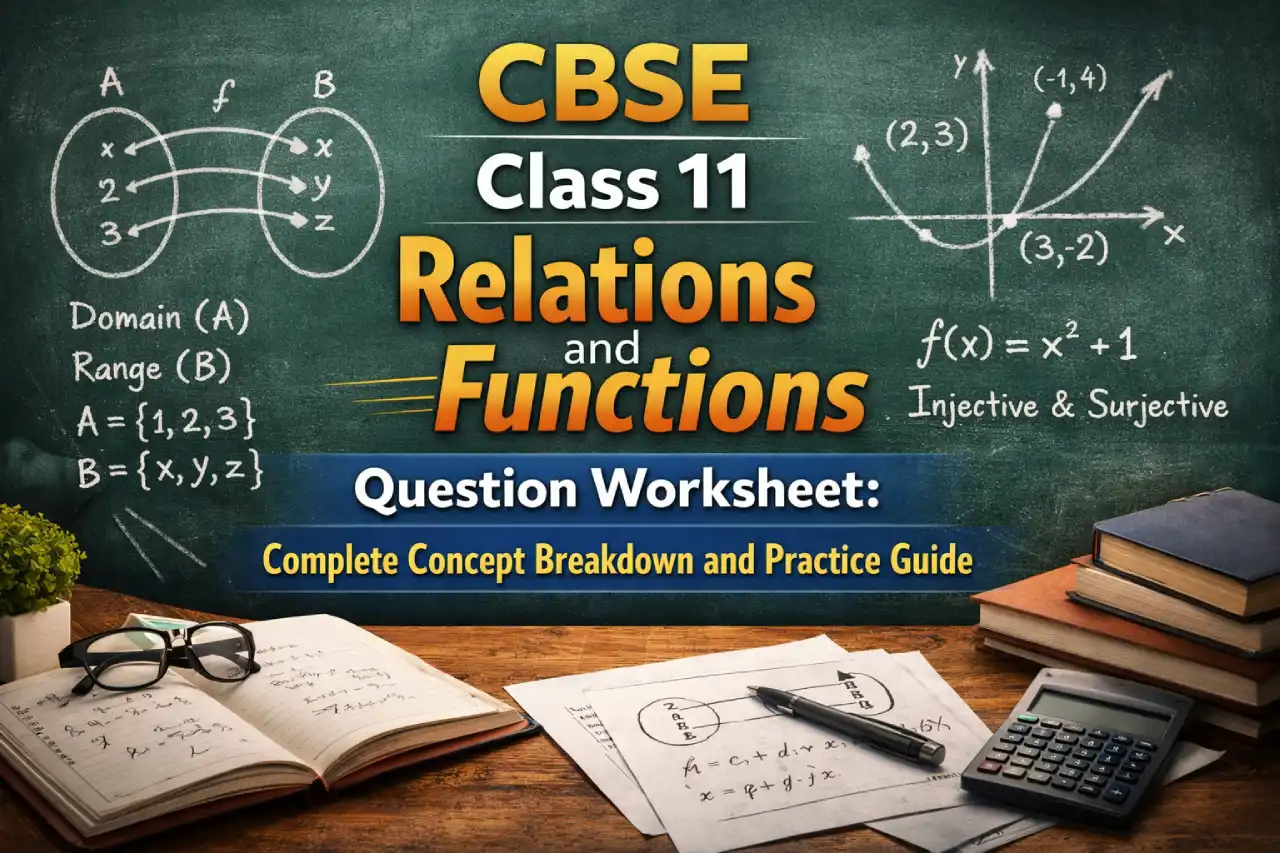
This mathematics worksheet on Relations and Functions, prepared for Class 11 CBSE students, is mainly aimed at strengthening fundamentals for school exams and future competitive preparation. It contains 75 multiple-choice questions, covering relations, functions, domain and range, inverse relations, and properties such as reflexive, symmetric, and transitive relations. The questions are framed directly from NCERT-based concepts and focus on logical reasoning rather than lengthy calculations. Overall, the worksheet reflects the type of concept-driven questions students regularly face in board examinations.
I am writing about this worksheet because Relations and Functions is often the chapter where students feel confident initially but end up losing marks due to small conceptual errors. Confusion between relations and functions, incorrect domain restrictions, or misunderstanding range values are very common. A well-structured worksheet like this helps students translate NCERT theory into exam-ready understanding. By carefully analysing the questions, one can clearly see which concepts are tested repeatedly and how simple definitions are converted into scoring MCQs Relations and Functions.
Structure of the Relations and Functions Worksheet
The worksheet consists of 75 MCQs, with each question carrying one mark. The questions are arranged in a way that starts with basic ideas and gradually moves towards more applied concepts. While many questions appear direct, the options are closely framed, which tests clarity of thought and careful reading rather than guesswork.
The overall difficulty level ranges from easy to moderate, making the worksheet suitable for both first-time practice and revision before exams.
Relations and Their Properties
Several questions in the worksheet focus on relations and their mathematical properties. Students are tested on identifying whether a relation is:
- Reflexive
- Symmetric
- Transitive
- An equivalence relation
Some questions use practical and geometric contexts, such as relations defined on sets of numbers, straight lines, or triangles. These questions check whether students truly understand the meaning of each property instead of memorising definitions Relations and Functions WS 1.
Cartesian Products and Set-Based Relations
The worksheet includes multiple questions based on Cartesian products of sets. Students are asked to:
- Identify valid ordered pairs
- Determine domains and ranges of relations
- Count the number of possible relations between two finite sets
These questions reinforce the idea that a relation is always a subset of a Cartesian product, which is a core concept in this chapter.
Functions and Their Classification
A major portion of the worksheet is dedicated to functions. Questions test whether a given relation qualifies as a function and whether it is:
- One-one
- Onto
- Both one-one and onto
- Neither one-one nor onto
There are also questions on counting the total number of functions between two finite sets, a topic that frequently appears in CBSE examinations.
Download this Relations and Functions Question PDF File: Click Here
Domain and Range-Based Questions
Domain and range form one of the most heavily tested areas in this worksheet. Questions involve functions containing:
- Square roots
- Logarithmic expressions
- Rational functions
- Modulus functions
- Trigonometric and inverse trigonometric functions
Students must correctly apply restrictions such as non-negative values under square roots, positive arguments for logarithms, and valid input ranges for inverse trigonometric functions. These questions clearly highlight common error areas faced by students in exams.
Modulus and Greatest Integer Functions
Several questions are based on modulus and greatest integer functions. These problems require interval-wise thinking and careful evaluation of expressions. Instead of direct substitution, students must analyse how the function behaves over different ranges, which helps in developing logical reasoning skills.
Composite and Inverse Functions
The worksheet also includes questions on composite functions and inverse relations. These questions test whether students can apply function rules correctly rather than just recall formulas. Such problems are important because they form the base for advanced topics in calculus studied later.
Trigonometric and Logarithmic Applications
Some MCQs combine trigonometric expressions with logarithmic functions. These questions are slightly tricky and demand step-by-step reasoning. They test conceptual clarity and attention to detail, making them useful not just for board exams but also for future competitive preparation.
What Students Can Learn from This Worksheet
From analysing this worksheet, a few important points become clear:
- NCERT definitions and examples are the foundation of most questions
- Domain and range mistakes are a major scoring risk
- Properties of relations must be clearly understood, not memorised
- Options are closely framed, so careless reading leads to errors
- Regular practice improves both speed and confidence
Overall, this Relations and Functions worksheet is a strong practice resource for Class 11 students. It closely reflects CBSE exam expectations and helps students build a solid conceptual base that will be essential for higher-level mathematics in Class 12.

















