JOIN WHATSAPP
STORIES

Delhi Government Awards ₹25 Crore Scholarships to Meritorious Students on National Youth Day

Delhi Government Awards ₹25 Crore Scholarships to Meritorious Students on National Youth Day

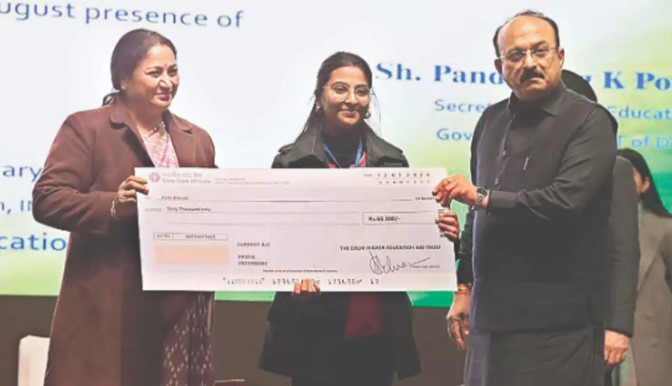
In a major boost for higher and technical education, the Delhi government on Monday distributed scholarships worth ₹25.25 crore to 1,709 meritorious students from economically weaker sections. The scholarship distribution coincided with the birth anniversary of Swami Vivekananda, which is observed as National Youth Day across the country. The initiative aims to support talented students who face financial challenges but have shown strong academic performance.

I am writing about this development because access to higher education remains a major concern for many families in urban India. Even capable students often struggle to continue their studies due to rising costs. When governments step in with targeted financial support, it not only helps individual students but also strengthens the broader education system. This announcement from Delhi highlights how public policy can directly impact young lives in a meaningful way.

Scholarship Distribution Event in Delhi

The scholarships were distributed by Rekha Gupta at a special programme organised to mark National Youth Day. The timing of the event was symbolic, linking financial support for students with the ideals of youth empowerment and self-reliance championed by Swami Vivekananda.

According to officials, the selected students come from economically weaker sections and have demonstrated merit in their respective courses, including higher education and technical programmes.

About the Delhi Higher and Technical Education Assistance Scheme

The scholarships were awarded under the Delhi Higher and Technical Education Assistance Scheme, which focuses on helping deserving students continue their education without financial stress. The scheme covers students enrolled in recognised higher education and technical institutions.

Key objectives of the scheme include:

  • Supporting meritorious students from low-income families
  • Reducing dropouts in higher and technical education
  • Encouraging students to pursue professional and skill-based courses

Who Benefited from the Scholarships

A total of 1,709 students received financial assistance under the scheme. These students are pursuing various undergraduate, postgraduate, and technical courses across institutions in Delhi.

The scholarship amount is intended to help with:

  • Tuition and academic expenses
  • Study materials and learning resources
  • Other education-related costs

For many students, this support can make the difference between continuing studies and dropping out.

Linking Education with Youth Empowerment

Speaking on the occasion, the Chief Minister highlighted the importance of investing in education to build a stronger future. Observing National Youth Day alongside the scholarship distribution reinforced the message that young people are central to the nation’s progress.

From my point of view, connecting welfare initiatives with such occasions gives them deeper meaning and helps students feel recognised and valued.

Why This Initiative Matters

Education costs continue to rise, especially in technical and professional fields. Without support, many capable students are forced to compromise on their ambitions. Schemes like this ensure that financial limitations do not block academic potential.

They also send a clear signal that merit and hard work are being recognised, regardless of economic background.

What This Means for Students and Families

For students, the scholarship brings relief and motivation. For families, it reduces financial pressure and builds confidence in public education support systems. Over time, such initiatives can help create a more inclusive and skilled workforce.


Leave a Comment

End of Article

UPSC Preparation Guide: Why Current Affairs Matter and How to Study Them Smartly

UPSC Preparation Guide: Why Current Affairs Matter and How to Study Them Smartly

UPSC current affairs form the backbone of Civil Services Examination preparation, influencing every stage from Prelims to the Interview. Whether it is national policy, international relations, economy, environment, science, or social issues, questions are increasingly linked to what is happening around us. Aspirants are expected not just to know the news, but to understand its background, impact, and relevance to governance. This is why current affairs are no longer a separate subject but an integrated part of the UPSC syllabus.

I am writing about UPSC current affairs because many aspirants struggle with how to approach them properly. Some read too many sources and feel overwhelmed, while others ignore depth and focus only on facts. Understanding the right way to read, connect, and revise current affairs can save time and improve answer quality significantly. This article explains what to study, how to study, and why current affairs can make or break a UPSC attempt.

Why Current Affairs Are Crucial for UPSC

The Civil Services Examination conducted by the Union Public Service Commission is designed to test awareness, analytical ability, and administrative understanding. Current affairs help the commission judge whether a candidate understands real-world issues that a civil servant will face.

Almost every paper, including Essay, General Studies, and Interview, draws heavily from contemporary developments.

Role of Current Affairs in Prelims

In the Preliminary Examination, current affairs questions are often direct or indirectly linked to news events. Topics such as government schemes, international organisations, environmental conventions, science and technology developments, and economic indicators are frequently asked.

Many static subjects like polity, economy, and geography are now framed around current issues, making daily news reading essential.

Importance in Mains Examination

In the Mains examination, current affairs play an even bigger role. Questions demand analysis, opinion, and solution-based answers linked to recent developments.

Examples include:

  • Policy reforms and their impact
  • International relations and diplomacy
  • Social justice and governance challenges
  • Environmental issues and sustainability

Without current examples, even well-written answers appear incomplete.

Current Affairs and the UPSC Interview

The interview stage tests personality, awareness, and balanced thinking. Candidates are often asked questions based on their background, optional subject, and recent national or global events.

From my experience, candidates who regularly follow current affairs appear more confident and thoughtful during the personality test.

What to Focus on While Studying Current Affairs

Not every news item is relevant for UPSC. Aspirants should focus on:

  • Government policies and schemes
  • Supreme Court and constitutional developments
  • International relations involving India
  • Economic reforms and reports
  • Environmental and climate-related issues
  • Science and technology with societal impact

Entertainment and political gossip can be safely ignored.

How to Study UPSC Current Affairs Effectively

A smart approach works better than excessive reading. Aspirants should:

  • Read one reliable newspaper daily
  • Link news with static syllabus topics
  • Make short, revision-friendly notes
  • Revise weekly and monthly
  • Practise answer writing using current examples

Consistency matters more than quantity.

Common Mistakes Aspirants Make

Some common errors include reading too many sources, ignoring revision, memorising facts without understanding context, and treating current affairs as a separate subject.

Current affairs should support your core preparation, not distract from it.

How Current Affairs Improve Answer Writing

Answers enriched with current examples stand out. They show awareness, relevance, and administrative thinking. Even simple answers score better when linked to recent reports, schemes, or judgments.

Leave a Comment

End of Article

Loading more posts...