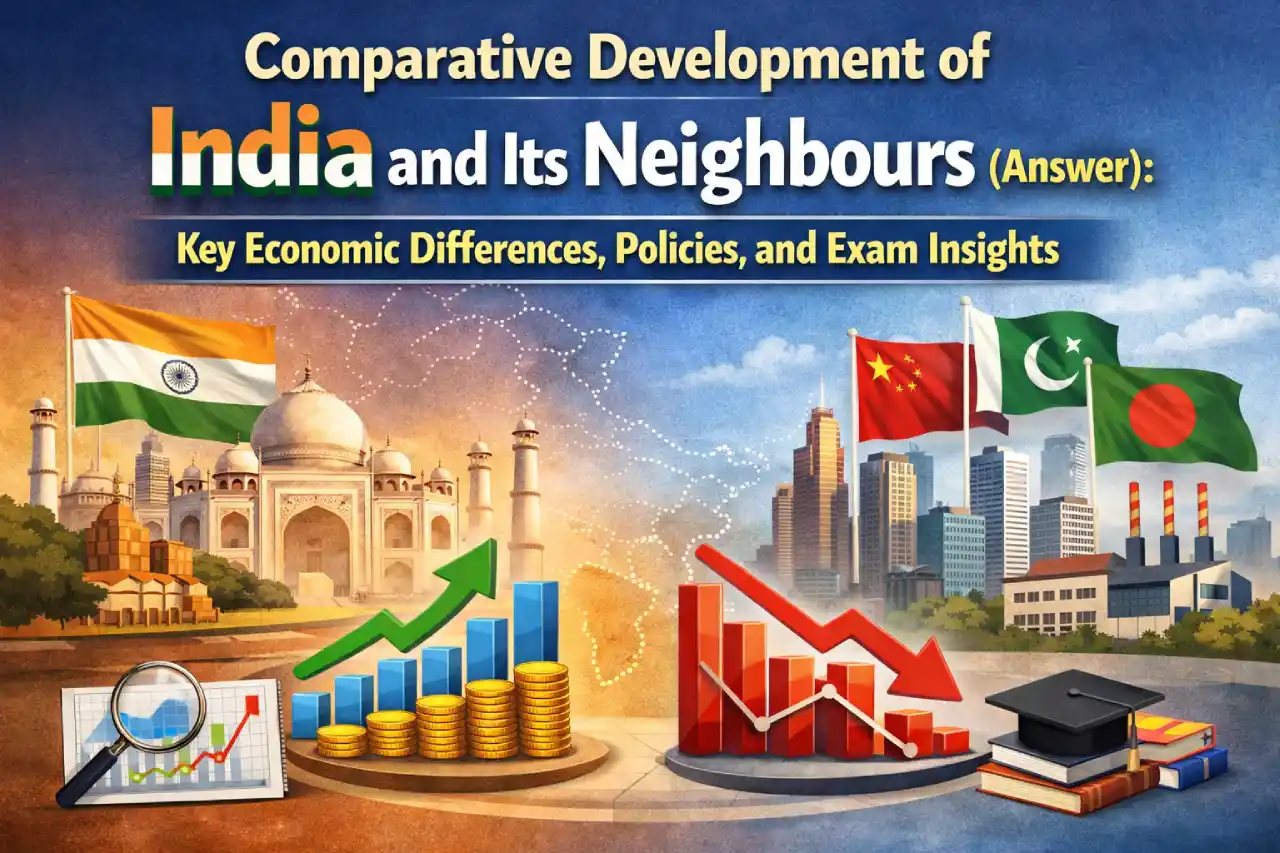
Comparative Development of India and Its Neighbours is an important Economics topic that examines how three neighbouring countries—India, China, and Pakistan—have progressed differently over time. The uploaded PDF is a detailed answer-based question set that focuses entirely on this comparison. It covers economic reforms, growth patterns, sectoral contribution to GDP, population trends, human development indicators, and major policy initiatives adopted by each country. The content is structured strictly around exam-oriented questions and factual explanations drawn from the syllabus.
I am writing about this PDF because students often find it difficult to remember comparative facts and timelines across countries. This document clearly highlights what is important from an examination point of view and repeatedly tests the same core ideas in different forms. Understanding what this PDF contains helps learners revise efficiently, avoid confusion between countries, and develop a clear picture of why development outcomes in India, China, and Pakistan have been so different despite similar starting points.
Countries Compared in the PDF
The PDF focuses on a comparative study of India, China, and Pakistan. It notes that all three countries began their development journey around the same time, with India and Pakistan becoming independent in 1947 and the People’s Republic of China being established in 1949. Despite these similarities, the PDF shows how different political systems, policies, and reform strategies shaped their economic outcomes.
Economic Reforms in China
A large portion of the PDF discusses China’s economic reforms, which were initiated in 1978. The initial phase focused on agriculture, foreign trade, and investment, while the later phase emphasised the private sector. Campaigns like the Great Leap Forward and policies such as Special Economic Zones are repeatedly referenced. The PDF highlights that China achieved very high GDP growth rates for several decades, mainly driven by rapid industrial expansion.
Download this Comparative Development Of India And Its Neighbours PDF File: Click Here
Economic Reforms in Pakistan
The PDF explains that Pakistan introduced economic reforms in 1988, largely under pressure from international agencies. It highlights factors such as political instability, dependence on foreign aid, and nationalisation of capital goods industries in the 1970s. These issues are presented as key reasons for Pakistan’s slower and more unstable economic growth compared to India and China.
Development Strategy of India
India’s development strategy is explained through its adoption of a mixed economy model and planned development using Five-Year Plans. The PDF repeatedly points out that India’s growth has been largely service-sector driven rather than manufacturing-led. Economic reforms came later and were more gradual, which influenced India’s pace of development.
Sectoral Contribution to GDP
The PDF compares sector-wise contributions across the three countries. China’s growth is shown as being driven mainly by the industrial sector, India’s by the service sector, and Pakistan’s by a mix of agriculture and services. It also highlights that services contribute the largest share to GDP in all three countries.
Population and Demographic Indicators
Several questions in the PDF focus on population indicators. China is shown to have the lowest fertility rate due to the one-child policy introduced in the late 1970s. Pakistan has the highest fertility rate and population growth, while India lies between the two on most demographic measures such as population density and growth rate.
Human Development Indicators
The PDF places strong emphasis on Human Development Index indicators like life expectancy, literacy rate, infant mortality rate, and per capita income. It clearly ranks China highest among the three, followed by India, with Pakistan at the lowest position. These indicators are repeatedly tested to show differences in quality of life.
Purpose of Comparing These Countries
According to the PDF, the main aim of comparison is to learn from the development experiences of neighbouring countries. It helps in understanding strengths and weaknesses, assessing relative development levels, and identifying policies that can improve overall human development.