JOIN WHATSAPP
STORIES

Google Expands AI in Education: AI-Enabled State University, Rs 85 Crore Grant and New Learning Tools Announced

Google Expands AI in Education: AI-Enabled State University, Rs 85 Crore Grant and New Learning Tools Announced

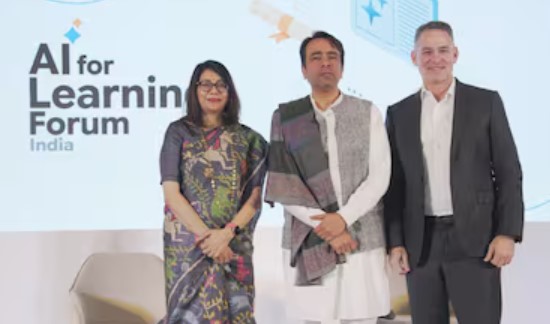
Google has announced a major push towards integrating artificial intelligence into India’s education ecosystem. The company revealed a set of partnerships and new product updates aimed at expanding AI-powered learning for students and teachers across the country. The announcements were made at Google’s AI for Learning Forum held in New Delhi, highlighting initiatives that range from establishing an AI-enabled university to supporting government education platforms and launching new AI-based learning tools.

I am writing about this announcement because it signals a clear shift in how large technology companies are engaging with India’s education and skill development space. AI is no longer limited to research labs or tech companies; it is steadily becoming part of classrooms, universities, and public education systems. Understanding these initiatives helps students, educators, and policymakers see where education and technology are headed in the coming years.

India’s First AI-Enabled State University

One of the biggest announcements is the plan to establish India’s first AI-enabled state university. This initiative is a collaboration between Google, the Ministry of Skill Development and Entrepreneurship, and Chaudhary Charan Singh University, Meerut.

The proposed university will focus on integrating AI across teaching, learning, and administration. The idea is to create an institution where AI is not treated as a separate subject alone, but as a core enabler across disciplines. This move is expected to strengthen skill development and prepare students for AI-driven job roles.

Rs 85 Crore Grant to Support Government Education Platforms

Google also announced an Rs 85 crore grant to Wadhwani AI, a non-profit organisation working on applying AI for social impact. The funding will be used to support and strengthen government education platforms using AI-based solutions.

According to the announcement, the grant aims to improve learning outcomes, personalise education delivery, and make public education systems more efficient. This initiative reflects Google’s focus on supporting scalable, government-led education programmes rather than isolated private solutions.

New AI-Powered Learning Tools for Students and Teachers

Along with partnerships and funding, Google introduced new AI-enabled learning tools designed specifically for Indian students and teachers. These tools are expected to help with personalised learning, content support, and classroom assistance.

For teachers, AI tools can help reduce administrative workload and offer insights into student progress. For students, they promise more interactive and adaptive learning experiences, especially in subjects where individual pace and understanding matter.

Why Google’s Education Push Matters

From my point of view, this announcement matters because it shows how AI is moving from optional add-ons to core education infrastructure. By working with government bodies and public universities, Google is influencing education at scale, not just at elite institutions.

The focus on skills, accessibility, and public platforms suggests a long-term approach rather than short-term pilots.

Role of Collaboration in AI Education

A key theme across all these initiatives is collaboration. Whether it is with a state university, a central ministry, or a non-profit organisation, Google has positioned itself as a technology partner rather than just a product provider.

Such collaborations are crucial because education systems are complex, and technology alone cannot drive change without policy support and institutional adoption.

What This Means for Students and Teachers

For students, these initiatives could open up new learning pathways aligned with future job markets. For teachers, AI tools may offer better support in lesson planning, assessment, and student engagement.

However, experts also point out that successful implementation will depend on training, infrastructure, and responsible use of AI in classrooms.


Leave a Comment

End of Article

Education for Viksit Maharashtra Meet on April 4–5: Key Discussions on NEP, Skills and Innovation

Education for Viksit Maharashtra Meet on April 4–5: Key Discussions on NEP, Skills and Innovation

A two-day national conference, “Education for Viksit Maharashtra,” will be held on April 4 and 5, bringing academicians, policymakers, and industry leaders onto a common platform. The discussions will centre on aligning the future of education with the vision of the National Education Policy (NEP) 2020. Scheduled at the Visvesvaraya National Institute of Technology (VNIT) auditorium, the event aims to examine how education can contribute to creating a progressive, knowledge-driven Maharashtra.

I am writing about this because discussions around education reforms are becoming increasingly important, especially as India moves towards the vision of Viksit Bharat 2047. From what I have observed, such conferences are not just formal events but platforms where real ideas and collaborations take shape. Understanding what is being discussed in these forums can give students, educators, and even parents a clearer picture of how the education system is evolving and what changes we can expect in the coming years.

Overview of the Conference

The conference is being organised under the banner of Maharashtra Gyan Sabha and aims to bring together key stakeholders in education.

  • Event Name: Education for Viksit Maharashtra
  • Dates: April 4 and April 5
  • Venue: VNIT Auditorium, Nagpur
  • Focus: Education reforms under NEP 2020

The event is expected to encourage meaningful discussions between academia and industry.

Organisers and Participating Institutions

This national meet is an initiative of Shiksha Sanskriti Utthan Nyas, New Delhi, and is being jointly organised by several reputed institutions.

Key organisers include:

  • Nagpur University
  • Gondwana University
  • Visvesvaraya National Institute of Technology (VNIT)
  • Indian Institute of Management (IIM) Nagpur

This collaboration highlights the importance of bringing different institutions together for a common goal.

Key Dignitaries and Leadership

The conference will be attended by several prominent leaders and officials.

  • Chief Minister Devendra Fadnavis will inaugurate the event
  • Union Minister Nitin Gadkari will attend the valedictory session
  • Revenue Minister Chandrashekhar Bawankule and Education Minister Chandrakant Patil will also be present
  • Minister of State Pankaj Bhoyar and other officials will join the discussions
  • The inaugural session will be presided over by Atul Kothari

Such participation shows the importance being given to education at the policy level.

Main Themes of Discussion

The conference will focus on several important themes related to education and development.

  • Aligning education with industry needs
  • Promoting skill-based and practical learning
  • Encouraging innovation and research
  • Integrating Indian knowledge systems into modern education
  • Ensuring holistic development of students

Experts will also share best practices and innovative models from different institutions.

Focus on NEP 2020 and Viksit Bharat Vision

One of the main goals of this conference is to align education with national priorities.

  • NEP 2020 focuses on flexibility, skill development, and multidisciplinary learning
  • The vision of Viksit Bharat 2047 aims for a developed and knowledge-driven nation
  • Education is seen as a key driver for economic and social progress

In my opinion, connecting education with real-world needs is essential for long-term growth.

Why This Conference Matters

Events like this play an important role in shaping the future of education.

  • They bring together different perspectives from academia and industry
  • Help identify gaps in the current education system
  • Encourage collaboration and policy improvements
  • Provide direction for future reforms

From what I see, such discussions can directly impact how students learn in the coming years.

Who Should Pay Attention to This

This conference is relevant for a wide range of people.

  • Students planning their careers
  • Teachers and educators
  • Policymakers and education authorities
  • Industry professionals

Even if you are not directly involved, understanding these developments can be useful.

Leave a Comment

End of Article

Loading more posts...

Important Video