JOIN WHATSAPP
STORIES

Google Expands AI in Education: AI-Enabled State University, Rs 85 Crore Grant and New Learning Tools Announced

Google Expands AI in Education: AI-Enabled State University, Rs 85 Crore Grant and New Learning Tools Announced

Google has announced a major push towards integrating artificial intelligence into India’s education ecosystem. The company revealed a set of partnerships and new product updates aimed at expanding AI-powered learning for students and teachers across the country. The announcements were made at Google’s AI for Learning Forum held in New Delhi, highlighting initiatives that range from establishing an AI-enabled university to supporting government education platforms and launching new AI-based learning tools.

I am writing about this announcement because it signals a clear shift in how large technology companies are engaging with India’s education and skill development space. AI is no longer limited to research labs or tech companies; it is steadily becoming part of classrooms, universities, and public education systems. Understanding these initiatives helps students, educators, and policymakers see where education and technology are headed in the coming years.

India’s First AI-Enabled State University

One of the biggest announcements is the plan to establish India’s first AI-enabled state university. This initiative is a collaboration between Google, the Ministry of Skill Development and Entrepreneurship, and Chaudhary Charan Singh University, Meerut.

The proposed university will focus on integrating AI across teaching, learning, and administration. The idea is to create an institution where AI is not treated as a separate subject alone, but as a core enabler across disciplines. This move is expected to strengthen skill development and prepare students for AI-driven job roles.

Rs 85 Crore Grant to Support Government Education Platforms

Google also announced an Rs 85 crore grant to Wadhwani AI, a non-profit organisation working on applying AI for social impact. The funding will be used to support and strengthen government education platforms using AI-based solutions.

According to the announcement, the grant aims to improve learning outcomes, personalise education delivery, and make public education systems more efficient. This initiative reflects Google’s focus on supporting scalable, government-led education programmes rather than isolated private solutions.

New AI-Powered Learning Tools for Students and Teachers

Along with partnerships and funding, Google introduced new AI-enabled learning tools designed specifically for Indian students and teachers. These tools are expected to help with personalised learning, content support, and classroom assistance.

For teachers, AI tools can help reduce administrative workload and offer insights into student progress. For students, they promise more interactive and adaptive learning experiences, especially in subjects where individual pace and understanding matter.

Why Google’s Education Push Matters

From my point of view, this announcement matters because it shows how AI is moving from optional add-ons to core education infrastructure. By working with government bodies and public universities, Google is influencing education at scale, not just at elite institutions.

The focus on skills, accessibility, and public platforms suggests a long-term approach rather than short-term pilots.

Role of Collaboration in AI Education

A key theme across all these initiatives is collaboration. Whether it is with a state university, a central ministry, or a non-profit organisation, Google has positioned itself as a technology partner rather than just a product provider.

Such collaborations are crucial because education systems are complex, and technology alone cannot drive change without policy support and institutional adoption.

What This Means for Students and Teachers

For students, these initiatives could open up new learning pathways aligned with future job markets. For teachers, AI tools may offer better support in lesson planning, assessment, and student engagement.

However, experts also point out that successful implementation will depend on training, infrastructure, and responsible use of AI in classrooms.
Leave a Comment

End of Article

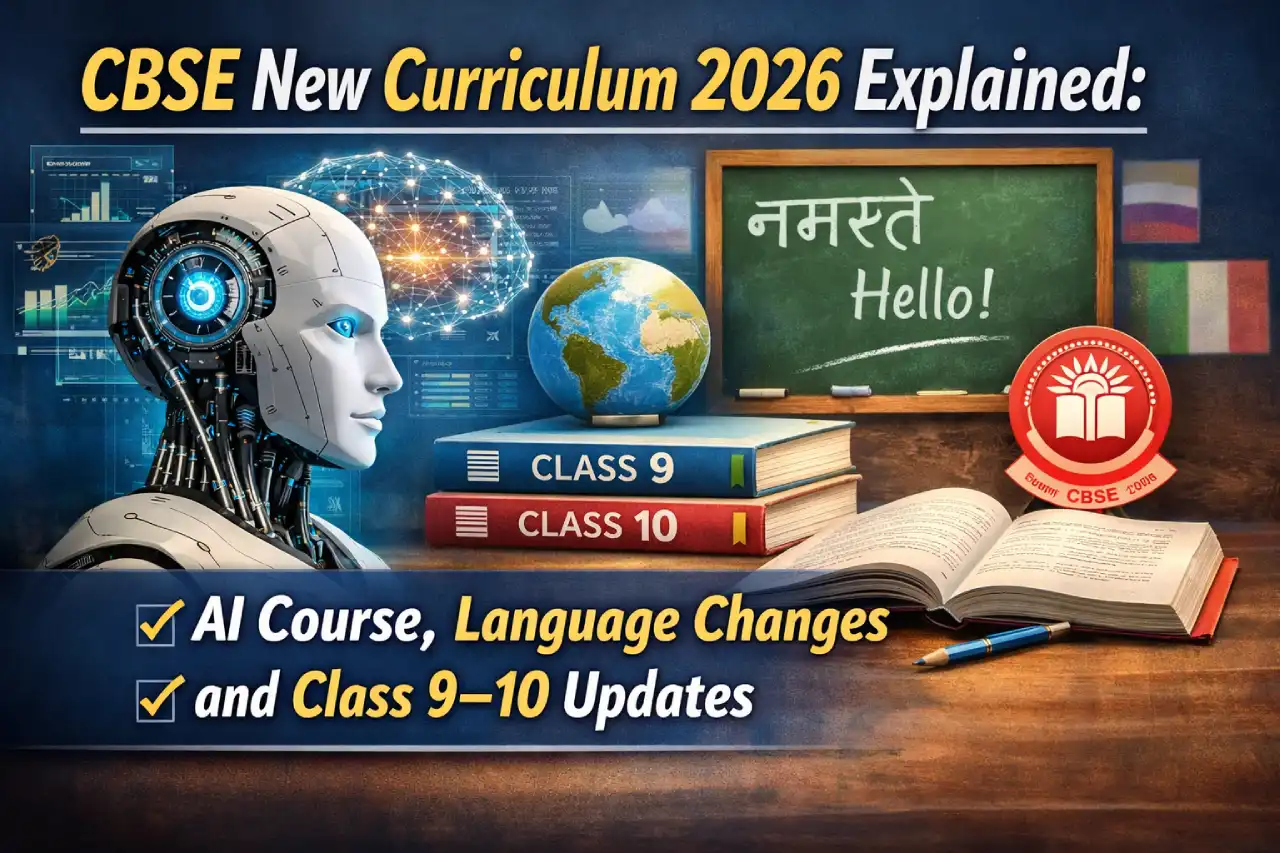
CBSE New Curriculum 2026 Explained: AI Course, Language Changes and Class 9–10 Updates

CBSE New Curriculum 2026 Explained: AI Course, Language Changes and Class 9–10 Updates

The Central Board of Secondary Education (CBSE) has introduced a major overhaul in its curriculum, which will be implemented in phases over the coming years. The new framework brings in several important changes, including the introduction of Artificial Intelligence (AI) and Computational Thinking (CT) as a compulsory subject from Class 9, a revised three-language system starting from Class 6, and optional advanced-level assessments in Mathematics and Science for Class 10 students. These reforms are aligned with the National Education Policy (NEP) 2020 and the National Curriculum Framework (NCF) 2023.

I am writing about this update because it directly affects lakhs of students, parents, and teachers across the country. From what I can see, these changes are not just about adding new subjects but about changing how students learn and think. With technology becoming a core part of education and careers, understanding these updates early can help students prepare better. It is also important for parents to know how the system is evolving so they can guide their children in the right direction.

What is Changing in the CBSE Curriculum

CBSE has redesigned the curriculum to make it more practical, skill-based, and future-ready. The focus is shifting from rote learning to conceptual understanding and real-world application.

Here are the major highlights:

  • Introduction of AI and Computational Thinking
  • New three-language system with proficiency levels
  • Optional advanced assessments in Class 10
  • Compulsory inclusion of art, physical education, and vocational subjects
  • Focus on interdisciplinary learning

These changes will not happen overnight but will be rolled out step by step.

AI and Computational Thinking from Class 9

One of the biggest updates is the introduction of AI and Computational Thinking as a compulsory subject.

  • This will begin from the 2027–28 academic session
  • Students will first appear for board exams in this subject in 2029
  • Textbooks for Class 9 are currently being prepared
  • AI learning has already been introduced for Classes 3 to 8 in a structured way

From my perspective, this is a much-needed step because digital skills are becoming essential in almost every field.

New Language System Explained

CBSE is restructuring language education through a three-language formula with different proficiency levels:

  • R1 – Highest level of proficiency
  • R2 – Intermediate level
  • R3 – Basic level

Key updates include:

  • A compulsory third language from Class 6 starting 2026–27
  • R3-level textbooks will be introduced first in Class 6
  • Students will gradually progress with this structure till Class 10
  • First board exam under this system will be in 2031

For students currently entering Class 9, revised R1 and R2 textbooks will be used, with the first board exams in 2028.

Optional Advanced Mathematics and Science

CBSE is also giving students the option to go deeper into subjects they are interested in.

  • Students can choose Advanced Mathematics, Advanced Science, both, or neither
  • Additional study material and higher-order questions will be provided
  • A separate one-hour assessment will be conducted after Class 10
  • Students scoring around 50% or more will get it mentioned in their mark sheet
  • No penalty if a student does not clear the advanced paper

The first batch for this advanced assessment will appear in 2028.

Compulsory Subjects for Holistic Development

The new curriculum also focuses on overall student development, not just academics.

The following subjects will now be compulsory:

  • Art Education
  • Physical Education and Wellbeing
  • Vocational Education
  • Interdisciplinary Studies

These will mainly be assessed through internal evaluations rather than board exams.

Expansion of Language Options

CBSE is also widening language choices for students.

New languages introduced at Class 9 level include:

  • Maithili
  • Santhali
  • Dogri
  • Konkani

This move ensures that more regional languages listed in the Constitution are available for students to study.

Implementation Timeline at a Glance

FeatureTimeline
Third Language (Class 6)2026–27
AI & CT (Class 9)2027–28
First AI Board Exam2029
Advanced Subject Assessment2028
New Language System Board Exam2031

What This Means for Students

In my opinion, this curriculum shift is clearly aimed at preparing students for the future. Instead of focusing only on marks, the system is encouraging skills, flexibility, and deeper understanding.

Students should:

  • Start getting comfortable with technology and logical thinking
  • Focus on understanding concepts instead of memorising
  • Explore subjects based on interest, especially advanced options
  • Take internal assessments seriously

Parents and teachers also need to adapt to this new approach and support students during the transition.

Leave a Comment

End of Article

Loading more posts...

Important Video