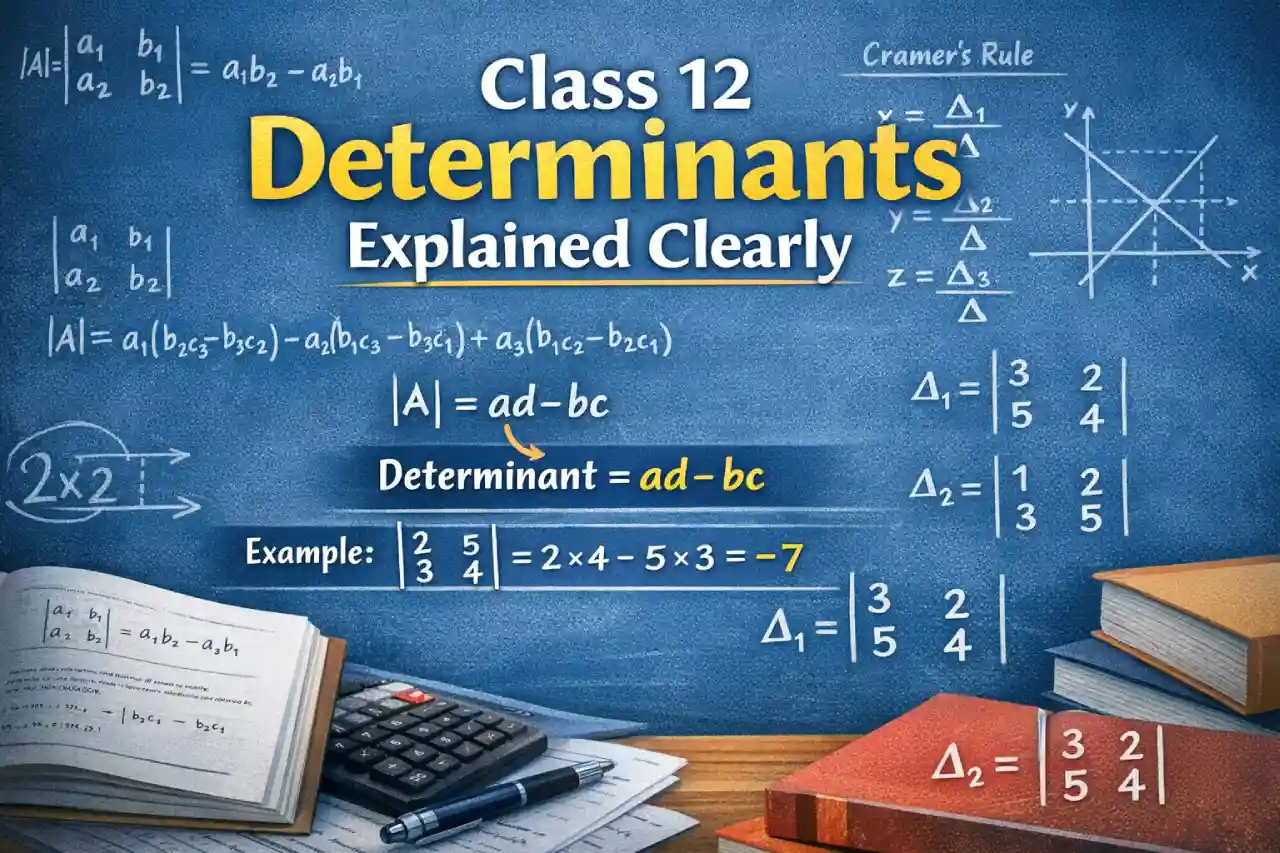
Determinants are one of the most important chapters in Class 12 Mathematics and form the base for solving systems of linear equations, understanding matrices, and handling higher-level algebra problems. The uploaded PDF follows the updated CBSE syllabus and provides a detailed, step-by-step explanation of determinants, starting from evaluation of second and third order determinants and moving towards minors, cofactors, properties, special determinants, and applications such as Cramer’s Rule. The material is supported with solved illustrations, objective questions, and proficiency tests.
I am writing about this topic because many students see determinants as a formula-heavy chapter and often try to memorise procedures without understanding the logic. This creates confusion during exams. If the fundamentals are clear, determinants become simple and highly scoring. This article explains the key ideas from the PDF in an easy, practical, and exam-focused way so that students can revise quickly and build strong conceptual clarity.
What Is a Determinant?
A determinant is a numerical value associated with a square matrix. It helps us understand whether a system of linear equations has a unique solution, no solution, or infinitely many solutions.
For a second order determinant:
| a₁ b₁ |
| a₂ b₂ |
Value = a₁b₂ − a₂b₁
For a third order determinant:
| a₁ b₁ c₁ |
| a₂ b₂ c₂ |
| a₃ b₃ c₃ |
Its value is obtained using expansion or Sarrus’ rule.
Evaluation of Determinants
Second Order Determinants
The value is found by:
(Product of principal diagonal) − (Product of secondary diagonal)
Example:
| 2 3 |
| 4 5 |
Value = (2×5) − (4×3) = 10 − 12 = −2
Third Order Determinants
A third order determinant is evaluated by:
a₁(b₂c₃ − b₃c₂) − b₁(a₂c₃ − a₃c₂) + c₁(a₂b₃ − a₃b₂)
The PDF also shows that expansion can be done along any row or column.
Minors and Cofactors
Minor
The minor of an element is the determinant obtained after deleting the row and column containing that element.
Cofactor
Cofactor = (−1)ⁱ⁺ʲ × Minor
If i + j is even → positive sign
If i + j is odd → negative sign
Cofactors are used for expanding a determinant along any row or column.
Expansion of Determinants
A determinant Δ can be expanded as:
Δ = a₁A₁ + b₁B₁ + c₁C₁
or
Δ = a₂A₂ + b₂B₂ + c₂C₂
This flexibility helps in choosing a row or column with zeros to simplify calculations.
Download this MATHS 12 – DETERMINANTS PDF File: Click Here
Important Properties of Determinants
Some key properties highlighted in the PDF:
- If two rows or two columns are identical, determinant = 0
- Interchanging two rows or columns changes the sign of determinant
- If a row is multiplied by k, determinant becomes k times
- If all elements of a row are zero, determinant = 0
- Adding a multiple of one row to another does not change the value
These properties are extremely useful in simplifying determinants.
Special Types of Determinants
Symmetric Determinant
If aᵢⱼ = aⱼᵢ, the determinant is symmetric.
Skew Symmetric Determinant
If aᵢⱼ = −aⱼᵢ, the determinant is skew symmetric.
For odd order, its value is always zero.
Circulant Determinant
Each row is obtained by cyclic shifting of the previous row.
Solving Linear Equations Using Determinants
Two Variables
For equations:
a₁x + b₁y = c₁
a₂x + b₂y = c₂
x = Δ₁ / Δ
y = Δ₂ / Δ
Where Δ is the determinant of coefficients.
Three Variables
For:
a₁x + b₁y + c₁z = p
a₂x + b₂y + c₂z = q
a₃x + b₃y + c₃z = r
x = d₁ / Δ
y = d₂ / Δ
z = d₃ / Δ
This method is known as Cramer’s Rule.
Conditions for Consistency of Equations
- If Δ ≠ 0 → Unique solution
- If Δ = 0 and d₁ = d₂ = d₃ = 0 → Infinitely many solutions
- If Δ = 0 and any of d₁, d₂, d₃ ≠ 0 → No solution
These conditions are frequently asked in board exams.
Differentiation of Determinants
If elements of a determinant are functions of x, then the derivative of the determinant is obtained by differentiating one row at a time and keeping other rows unchanged, then adding all such determinants.
This concept appears in higher-level problems.
Common Mistakes Students Make
- Forgetting sign while finding cofactor
- Expanding along a complicated row instead of choosing a simpler one
- Ignoring determinant properties
- Arithmetic errors in minor calculation
Avoiding these mistakes can save many marks.