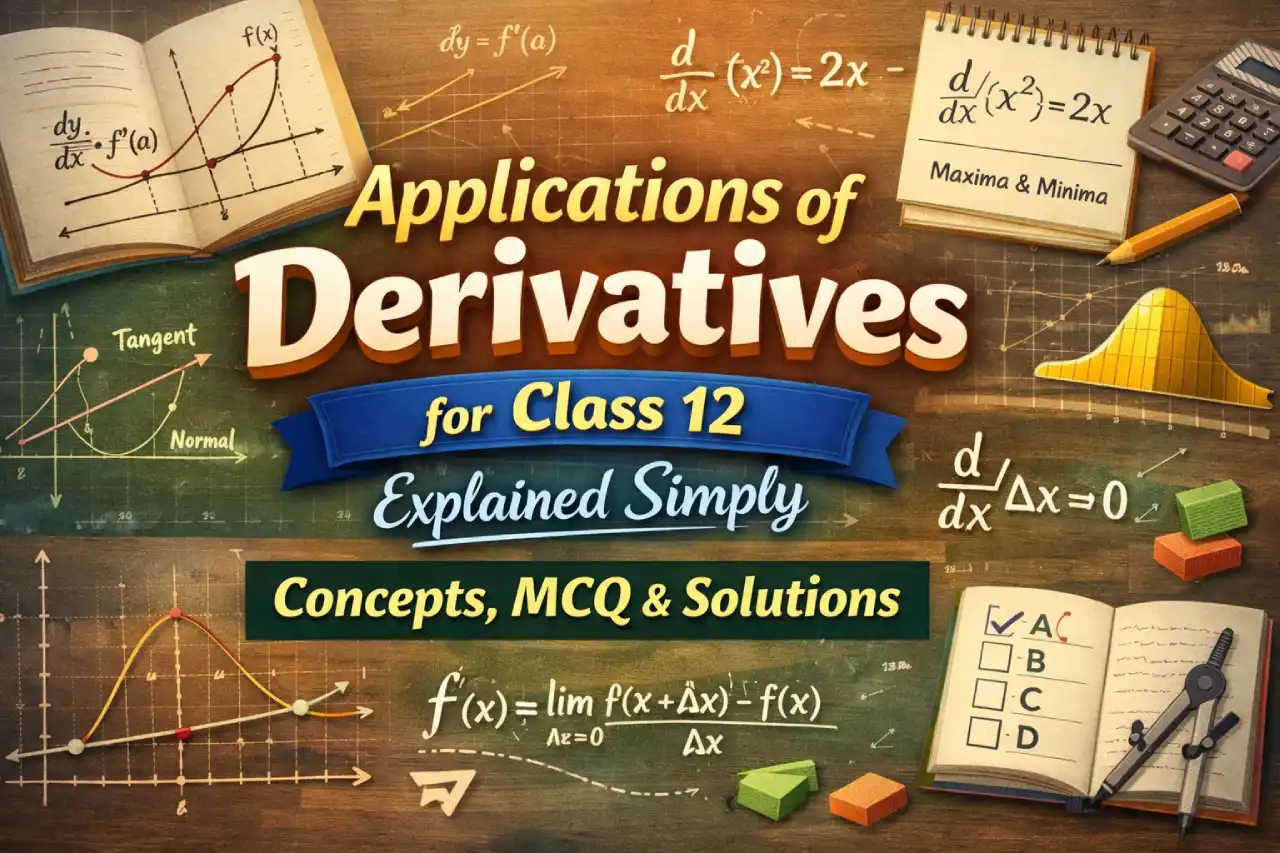
Applications of Derivatives is one of the most practical and high-weightage chapters in Class 12 Mathematics. The uploaded PDF is a comprehensive, exam-oriented resource that brings together NCERT-based theory, topic-wise MCQs, exemplar questions, and JEE Main level problems. It covers all major areas of the chapter, including rate of change of quantities, increasing and decreasing functions, tangents and normals, approximations, and maxima and minima. The structure of the PDF is designed to help students strengthen both conceptual understanding and problem-solving speed.
I am writing about this topic because many students feel comfortable with differentiation but get confused when they have to apply derivatives in real situations. This chapter is where calculus starts to feel meaningful, as it connects mathematics to motion, growth, optimisation, and geometry. By explaining the ideas from the PDF in a clear and simple way, I want to help learners see the logic behind each application and prepare more confidently for board and competitive exams.
What Are Applications of Derivatives?
Once a function is differentiated, the derivative tells us the rate at which one quantity changes with respect to another. Applications of Derivatives focuses on using this idea to solve real-life and mathematical problems.
In simple words, this chapter answers questions like:
- How fast is something changing?
- Where is a function increasing or decreasing?
- At which point is a quantity maximum or minimum?
- What is the slope of a curve at a given point?
Rate of Change of Quantities
This topic deals with finding how one physical quantity changes in relation to another.
Common examples include:
- Radius and volume of a sphere
- Height and volume of a cone
- Distance and time in motion
General approach:
- Write the formula relating the quantities
- Differentiate with respect to time
- Substitute the given values
Example idea from the PDF:
If the radius of a sphere increases at a certain rate, we can find how fast its volume is increasing using:
V = (4/3)πr³
dV/dt = 4πr² (dr/dt)
Increasing and Decreasing Functions
A function f(x) is:
- Increasing if f′(x) > 0
- Decreasing if f′(x) < 0
Steps followed:
- Find first derivative f′(x)
- Solve f′(x) = 0 to get critical points
- Check sign of f′(x) in different intervals
This concept is widely tested in MCQs in the PDF.
Tangents and Normals
The slope of the tangent at any point on a curve y = f(x) is:
dy/dx
Equation of tangent:
y − y₁ = m(x − x₁)
where m = dy/dx at (x₁, y₁)
Equation of normal:
y − y₁ = −1/m (x − x₁)
The PDF contains many questions on:
- Tangent parallel to x-axis or y-axis
- Normal perpendicular to a given line
- Tangents passing through a fixed point
Angle Between Two Curves
If m₁ and m₂ are slopes of two curves at a point, then
tan θ = |(m₁ − m₂) / (1 + m₁m₂)|
Used when curves intersect.
Download this APPLICATIONS OF DERIVATIVES PDF File: Click Here
Approximations
For small changes, we use differentials.
If y = f(x), then:
dy ≈ f′(x) dx
This helps in estimating errors in measurements and approximate values of functions.
Examples from the PDF include:
- Error in volume of sphere
- Approximate value of expressions like (1.02)⁵
Maxima and Minima
Used to find maximum or minimum values of a function.
Steps:
- Find f′(x)
- Set f′(x) = 0
- Find second derivative f′′(x)
- If f′′(x) < 0 → Maximum
- If f′′(x) > 0 → Minimum
These problems are very important for optimisation.
Real-Life Optimisation Problems
Common situations:
- Maximum area or volume
- Minimum cost or distance
- Best dimensions of shapes
The PDF includes problems such as:
- Cutting a wire to form shapes with minimum area
- Designing containers with maximum volume
Why This Chapter Is Important for Exams
- High weightage in CBSE boards
- Direct application-based questions
- Builds foundation for higher calculus
Regular practice from MCQs and numerical problems improves accuracy.
How to Study This Chapter Effectively
- Revise differentiation rules first
- Practise each type of problem separately
- Use sign chart method for monotonicity
- Focus on presentation in board exams