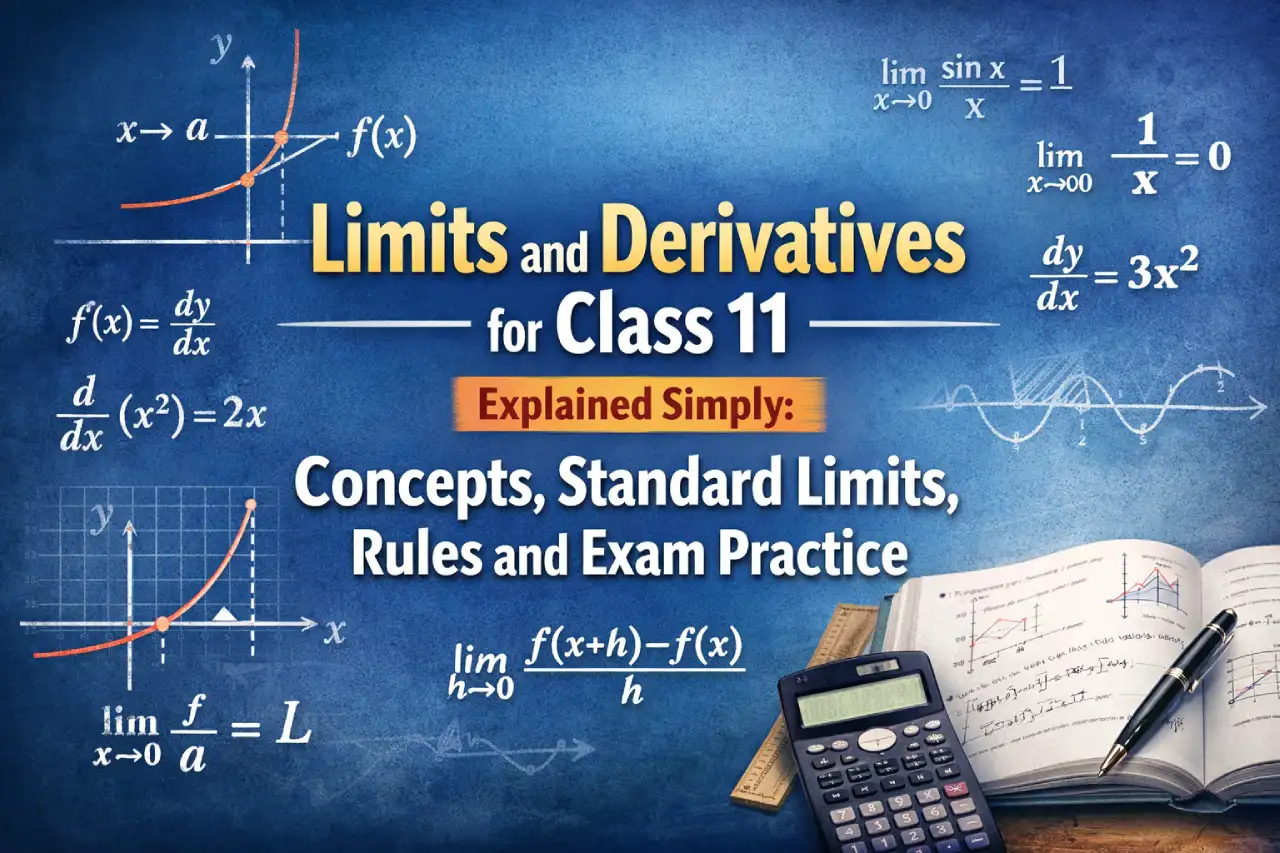
Limits and Derivatives is one of the most important introductory calculus chapters in Class 11 Mathematics. The uploaded PDF is a detailed NCERT-based study resource that covers the definition of limits, left-hand and right-hand limits, existence of limits, algebra of limits, standard limits, and the introduction of derivatives as a rate of change and as a geometric concept. It also explains differentiation from first principles, rules of differentiation, and derivatives of polynomial and trigonometric functions, along with a large collection of MCQs and solved examples.
I am writing about this topic because many students find calculus difficult at the beginning and develop fear around limits and derivatives. In reality, once the basic ideas are understood clearly, this chapter becomes logical and even interesting. This article presents the key concepts from the PDF in a simple and structured manner so that students can build a strong foundation for higher-level calculus and perform better in school and competitive exams.
What Is a Limit?
Let y = f(x) be a function. If the value of f(x) approaches a definite number when x approaches a, then that number is called the limit of f(x) at x = a.
Symbolically,
lim x→a f(x) = L
The PDF explains that limits help us find the value of a function near a point even when direct substitution is not possible.
Left-Hand and Right-Hand Limits
Left-hand limit (LHL):
lim x→a⁻ f(x)
Right-hand limit (RHL):
lim x→a⁺ f(x)
If LHL = RHL, then the limit exists and their common value is the limit of the function at x = a.
If LHL ≠ RHL, the limit does not exist.
Existence of Limit
A limit exists at x = a only when:
- Left-hand limit exists
- Right-hand limit exists
- Both are equal
This idea is repeatedly used in MCQs and short-answer questions in the PDF.
Algebra of Limits
If lim x→a f(x) and lim x→a g(x) exist, then:
- lim x→a [f(x) + g(x)] = lim f(x) + lim g(x)
- lim x→a [f(x) − g(x)] = lim f(x) − lim g(x)
- lim x→a [f(x)g(x)] = (lim f(x))(lim g(x))
- lim x→a [f(x)/g(x)] = (lim f(x))/(lim g(x)), provided lim g(x) ≠ 0
These rules simplify many limit problems.
Limits of Polynomial and Rational Functions
For a polynomial function f(x),
lim x→a f(x) = f(a)
For a rational function:
f(x) = g(x)/h(x)
If h(a) ≠ 0, then
lim x→a f(x) = g(a)/h(a)
If both numerator and denominator become zero, factorisation is used.
Download this CLASS 11 – LIMITS AND DERIVATIVES PDF File: Click Here
Some Important Standard Limits
The PDF highlights several standard limits that students must memorise:
- lim x→0 (sin x)/x = 1
- lim x→0 (tan x)/x = 1
- lim x→0 (1 − cos x)/x² = 1/2
- lim x→0 (eˣ − 1)/x = 1
- lim x→0 (aˣ − 1)/x = ln a
These limits are frequently used in problem solving.
Sandwich (Squeeze) Theorem
If f(x) ≤ g(x) ≤ h(x) and
lim x→a f(x) = lim x→a h(x)
Then,
lim x→a g(x) exists and equals that common value.
This theorem is especially useful for trigonometric limits.
Introduction to Derivatives
The derivative of a function represents the rate of change of the function with respect to the variable.
If y = f(x), then derivative of y with respect to x is written as:
dy/dx or f′(x)
Geometrically, the derivative represents the slope of the tangent to the curve at a point.
Derivative from First Principle
The derivative of f(x) at x is defined as:
f′(x) = lim h→0 [f(x + h) − f(x)] / h
This method is called differentiation from first principles and is mainly used to derive standard formulas.
Rules of Differentiation
Sum or Difference Rule
d/dx [f(x) ± g(x)] = f′(x) ± g′(x)
Product Rule
d/dx [f(x)g(x)] = f(x)g′(x) + g(x)f′(x)
Quotient Rule
d/dx [f(x)/g(x)] = [g(x)f′(x) − f(x)g′(x)] / [g(x)]²
Derivatives of Some Standard Functions
| Function | Derivative |
|---|---|
| xⁿ | nxⁿ⁻¹ |
| sin x | cos x |
| cos x | −sin x |
| tan x | sec²x |
| eˣ | eˣ |
These formulas form the backbone of differentiation.
Why This Chapter Is Important
- Foundation for all higher calculus topics
- High weightage in Class 11 exams
- Important for Class 12 calculus
Strong understanding here makes later chapters easier.