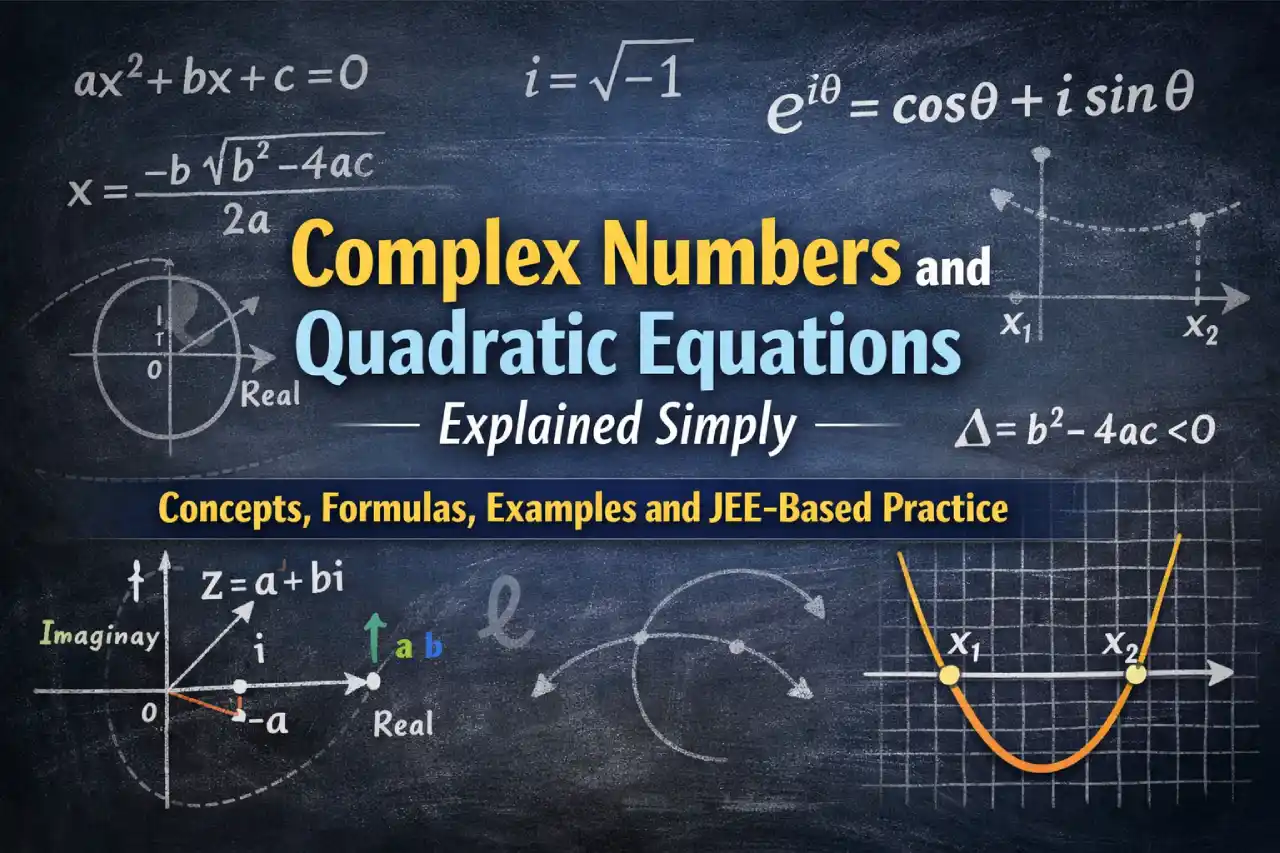
Complex Numbers and Quadratic Equations is a foundational chapter in Class 11 Mathematics and also one of the most important areas for JEE preparation. The uploaded PDF is a comprehensive, exam-oriented resource that combines theory, solved examples, and a large collection of JEE (Main) previous year questions. It covers representation of complex numbers, Argand diagram, modulus and argument, algebra of complex numbers, quadratic equations in real and complex number system, relation between roots and coefficients, nature of roots, and formation of quadratic equations with given roots.
I am writing about this topic because many students treat complex numbers and quadratic equations as two separate chapters, even though they are closely connected. Once students understand how complex numbers work and how quadratic equations behave in both real and complex domains, a large portion of algebra becomes much easier. This article simplifies the key ideas from the PDF and presents them in a structured, student-friendly way for better understanding and exam readiness.
What Are Complex Numbers?
A complex number is written in the form:
z = a + ib
where a and b are real numbers and i is the imaginary unit such that i² = −1.
Here:
- a is called the real part, Re(z)
- b is called the imaginary part, Im(z)
Examples:
- 3 + 2i
- −5 + i
- 7 − 4i
The PDF explains complex numbers as ordered pairs (a, b), which helps in visual representation.
Argand Plane Representation
In the Argand plane:
- The horizontal axis represents the real part
- The vertical axis represents the imaginary part
So, z = a + ib is represented by the point (a, b).
This geometric view is very helpful in understanding modulus, argument, and loci of complex numbers.
Modulus and Argument of a Complex Number
Modulus
The modulus of z = a + ib is:
|z| = √(a² + b²)
It represents the distance of the point from the origin.
Argument
Argument of z is the angle made by the line joining origin to z with the positive x-axis.
arg(z) = tan⁻¹(b / a)
The PDF emphasises using correct quadrant while finding argument.
Algebra of Complex Numbers
Basic operations:
- Addition
- Subtraction
- Multiplication
- Division
Important identity:
(a + ib)(c + id) = (ac − bd) + i(ad + bc)
Division is done by multiplying numerator and denominator by conjugate.
Download this COMPLEX NUMBERS AND QUADRATIC EQUATIONS PDF File: Click Here
Conjugate of a Complex Number
For z = a + ib, its conjugate is:
z̄ = a − ib
Important results:
- z z̄ = a² + b² = |z|²
- z + z̄ = 2a
- z − z̄ = 2ib
These results are widely used in problem solving.
Polar Form of Complex Numbers
A complex number can be written as:
z = r (cos θ + i sin θ)
where r = |z| and θ = arg(z)
This form is useful in powers of complex numbers and De Moivre’s theorem.
Quadratic Equations
General form:
ax² + bx + c = 0, a ≠ 0
Solutions are given by:
x = [−b ± √(b² − 4ac)] / 2a
The expression D = b² − 4ac is called discriminant.
Nature of Roots
- D > 0 → Two distinct real roots
- D = 0 → Equal real roots
- D < 0 → Complex conjugate roots
The PDF includes many MCQs based on identifying nature of roots.
Relation Between Roots and Coefficients
If α and β are roots of:
ax² + bx + c = 0
Then:
α + β = −b / a
αβ = c / a
These relations help in forming new equations.
Formation of Quadratic Equation with Given Roots
If roots are α and β, then required equation is:
x² − (α + β)x + αβ = 0
This concept appears frequently in competitive exams.
Quadratic Equations with Complex Roots
If one root is a + ib, then the other root is a − ib (since coefficients are real).
This idea is highlighted in several solved questions in the PDF.
JEE-Oriented Problem Types Covered
The PDF contains:
- JEE (Main) previous year MCQs
- Problems based on modulus and argument
- Locus of complex numbers
- Quadratic equations involving parameters
- Mixed problems combining complex numbers and quadratics
Each question is followed by answer key and explanation.
Common Mistakes Students Make
- Forgetting i² = −1
- Wrong quadrant while finding argument
- Sign mistakes in conjugate
- Arithmetic errors in discriminant
Avoiding these can improve accuracy.
How to Study This Chapter Effectively
- Practise algebra of complex numbers daily
- Memorise standard identities
- Solve JEE previous year questions
- Revise relations between roots and coefficients