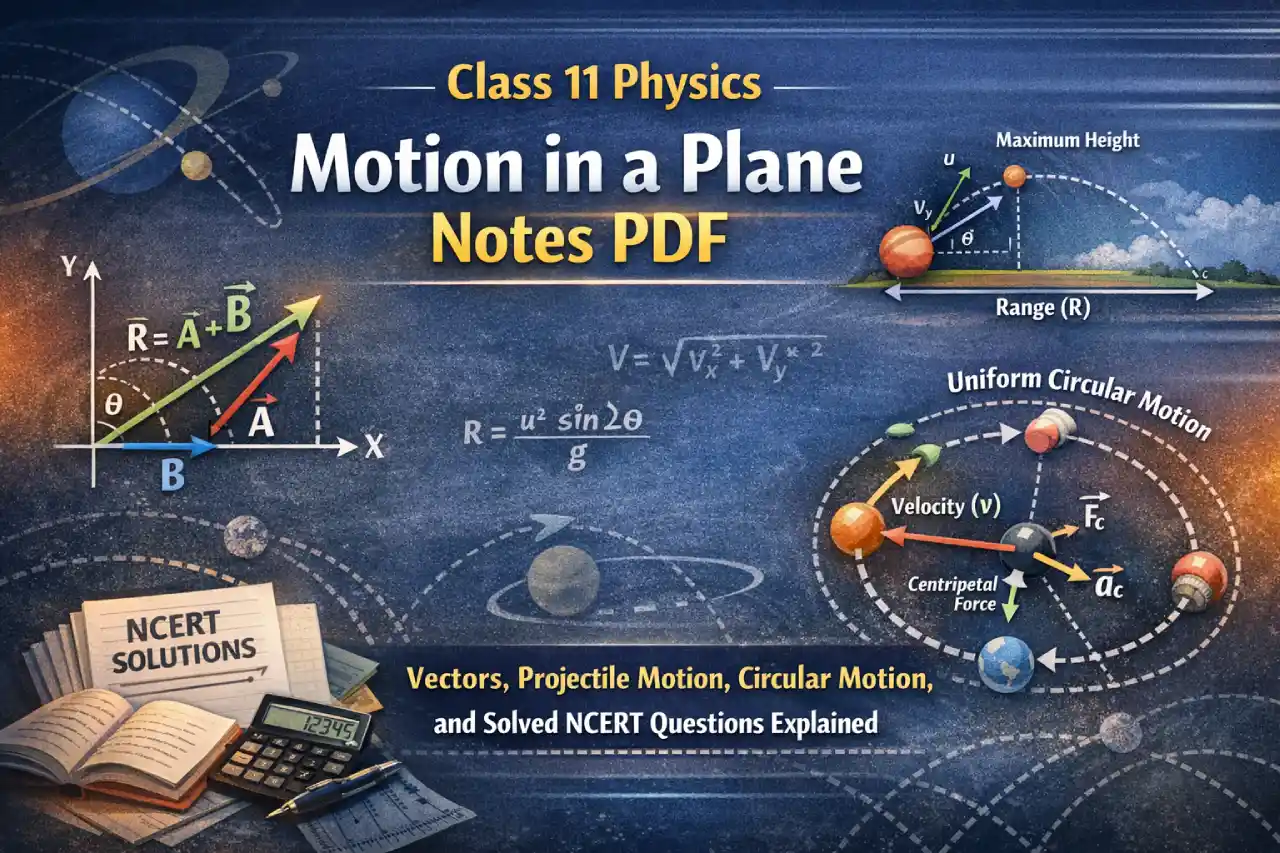
Motion in a Plane is a core chapter in Class 11 Physics that introduces students to vector quantities and two-dimensional motion. The uploaded PDF is a compact yet detailed notes document covering Chapter 3 in a structured manner. It explains scalars and vectors, vector laws, projectile motion, and circular motion, supported by key formulas, diagrams, mnemonics, and a strong NCERT question–answer section. The content is aligned with the Class 11 syllabus and focuses on both conceptual clarity and numerical application.
I am writing about this PDF because Motion in a Plane often becomes a turning point for students transitioning from one-dimensional to two-dimensional motion. Many learners struggle with vectors, direction-based reasoning, and graphical interpretation. This PDF brings theory, formulas, and NCERT problems together in one place, making it easier to revise and practise. Knowing how this resource is organised helps students use it effectively for school exams and competitive preparation.
What This Motion in a Plane PDF Covers
The PDF is divided into clear conceptual sections followed by formulas and solved questions. It acts as a quick-reference notes booklet as well as a practice guide.
Major sections included are:
- Scalars and vectors
- Vector types and vector laws
- Projectile motion
- Circular motion
- Key formulas and mnemonics
- NCERT exercise questions with solutions
This structure makes the document suitable for both learning and revision.
Scalars and Vectors Explained Clearly
The chapter begins by distinguishing between scalar and vector quantities. Scalars are defined as quantities having only magnitude, while vectors have both magnitude and direction and follow vector addition laws.
The PDF explains:
- Unit vectors and their properties
- Cartesian unit vectors î, ĵ, k̂
- Polar vectors like force and velocity
- Axial vectors like torque and angular momentum
These definitions are important for building a strong foundation in mechanics.
Vector Laws and Vector Operations
Several vector addition laws are explained with diagrams:
- Triangle law of vector addition
- Parallelogram law of vector addition
- General law of vector addition
- Lami’s theorem for equilibrium of three forces
The PDF also explains resultant vectors, equilibrant vectors, and conditions of equilibrium.
Components of Vectors and Vector Algebra
Vectors are resolved into components along x, y, and z axes using trigonometric relations.
The document explains:
- Vector representation in 2D and 3D
- Magnitude of a vector
- Addition and subtraction of vectors
- Dot product and cross product
- Physical meaning of dot and cross products
Mnemonic techniques are included to help remember formulas easily.
Projectile Motion
Projectile motion is explained as motion under gravity with horizontal and vertical components acting independently.
Key results covered include:
- Time of flight
- Maximum height
- Horizontal range
- Condition for maximum range
- Velocity at any point during flight
The PDF clearly explains why the path of a projectile is parabolic.
Download this CLASS 11 – MOTION IN A PLANE PDF File: Click Here
Circular Motion and Centripetal Acceleration
Uniform circular motion is explained with emphasis on direction of velocity and acceleration.
Important concepts include:
- Angular displacement, velocity, and acceleration
- Relation between linear and angular quantities
- Centripetal acceleration and centripetal force
- Tangential and radial acceleration
The PDF highlights that centripetal force does no work, which is a common conceptual question in exams.
Key Formulae Section
A consolidated formula section is provided for quick revision. This includes formulas related to:
- Resultant of two vectors
- Vector components
- Dot and cross products
- Projectile motion results
- Circular motion relations
This section is useful for last-minute exam preparation.
NCERT Corner with Solved Questions
One of the strongest parts of the PDF is the NCERT Corner. It includes:
- Conceptual true or false questions
- Scalar and vector identification questions
- Numerical problems based on displacement, velocity, and acceleration
- Projectile motion and circular motion numericals
Each question is followed by a step-by-step solution, helping students understand the reasoning process.
How Students Can Use This PDF
- Revise concepts before solving textbook problems
- Practise NCERT questions for exams
- Use formulas section for quick recall
- Strengthen vector fundamentals for future chapters