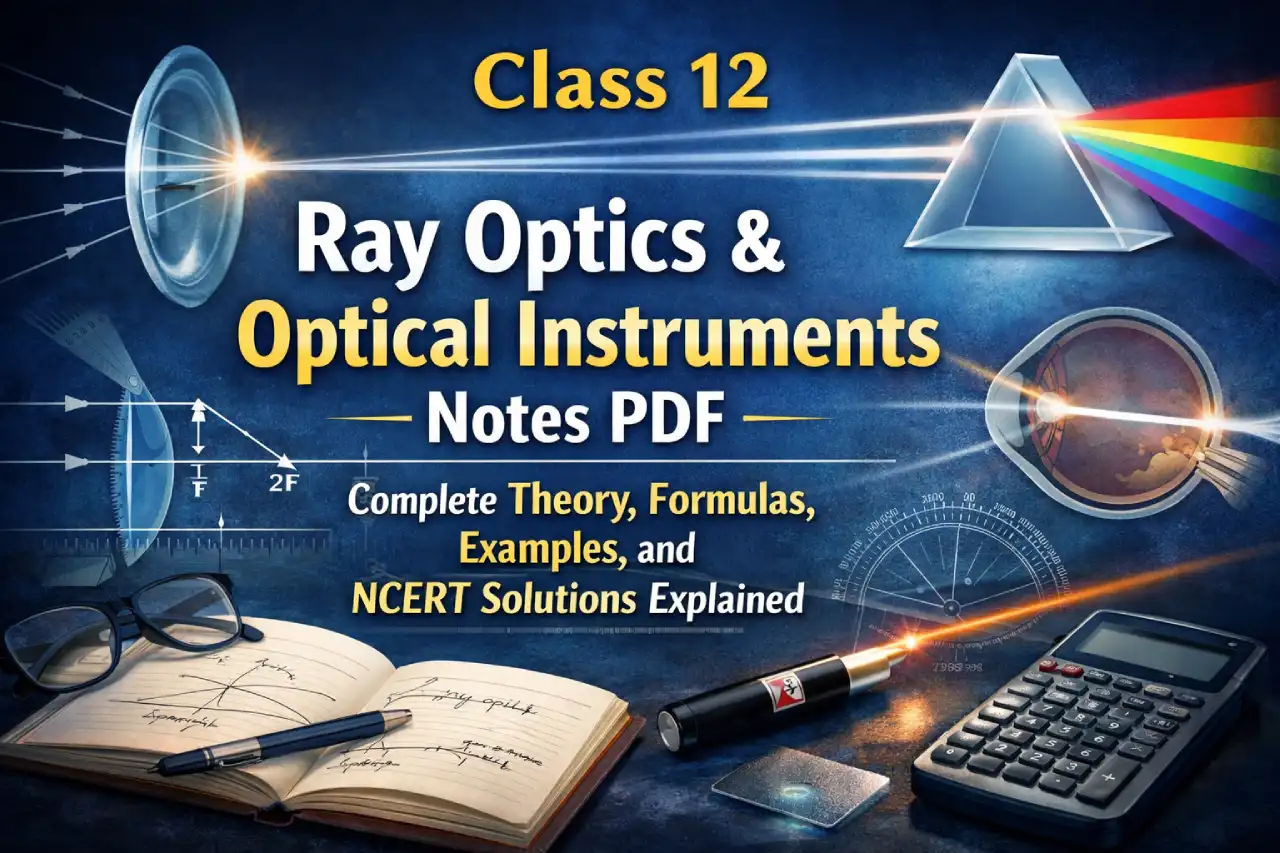
Ray Optics and Optical Instruments is one of the most detailed and application-oriented chapters in Class 12 Physics. It links basic ideas of reflection and refraction with advanced topics like lenses, prisms, microscopes, and telescopes. The uploaded PDF is a comprehensive notes and practice resource for Chapter 9, presenting theory, definitions, laws, formulas, solved examples, diagrams, and NCERT exercise questions in a systematic manner. It is designed to support both concept-building and exam-oriented preparation.
I am writing about this PDF because many students feel Ray Optics is lengthy and formula-heavy, which makes revision difficult close to exams. This document organises the entire chapter into clear sections and also provides worked NCERT problems, helping learners understand not just what the formulas are, but how to apply them correctly. Knowing what this PDF contains and how to use it can greatly improve confidence and performance in board and competitive exams.
What This Ray Optics & Optical Instruments PDF Contains
The PDF is structured like a compact chapter handbook. It includes:
- Basic concepts and definitions
- Laws of reflection and refraction
- Ray diagrams and image formation tables
- Important formulas and sign conventions
- Solved numerical examples
- NCERT exercise questions with solutions
This makes it useful for learning, revision, and practice.
Reflection of Light
The PDF begins with reflection of light and explains regular and diffused reflection. It states the two laws of reflection and introduces real and virtual images.
It then explains spherical mirrors, including:
- Concave and convex mirrors
- Pole, centre of curvature, principal axis, focus, and focal length
- Relation between focal length and radius of curvature (f = R/2)
The mirror formula and magnification formula are clearly given, along with sign conventions.
Image Formation by Spherical Mirrors
A detailed table shows image position, nature, and size for different object positions in concave and convex mirrors.
Solved examples explain how to calculate image distance, magnification, and image height using formulas, followed by ray diagram interpretation.
Refraction of Light
Refraction is defined as the change in direction of light when it passes from one medium to another.
The PDF covers:
- Laws of refraction (Snell’s law)
- Absolute refractive index
- Principle of reversibility of light
- Refraction through a glass slab and lateral shift
- Apparent depth and real depth relation
These topics are supported by diagrams and formula-based examples.
Total Internal Reflection
The conditions for total internal reflection are clearly listed.
Applications explained include:
- Optical fibres and their structure (core, cladding, jacket)
- Total internal reflection through prisms for 90° and 180° deviation
These concepts are important for conceptual questions.
Prism and Dispersion
The PDF explains refraction through a prism, angle of deviation, and minimum deviation condition.
It also covers:
- Dispersion of white light
- Angular dispersion
- Dispersive power
- Formation of primary and secondary rainbow
This helps students understand colour separation and atmospheric optics.
Download this CLASS 12 – RAY OPTICS & OPTICAL INSTRUMENTS PDF File: Click Here
Refraction at Spherical Surfaces
Formulas for refraction at a spherical interface are provided for light travelling from one medium to another.
These relations are important when deriving lens formulas.
Lenses and Lens Maker’s Formula
The PDF explains convex and concave lenses, important parts of a lens, and principal foci.
Lens maker’s formula and thin lens formula are given, along with magnification and sign conventions.
Tables show image formation by convex and concave lenses for different object positions.
Power and Combination of Lenses
Power of a lens is defined as reciprocal of focal length.
The PDF explains how to find equivalent focal length and equivalent power when lenses are in contact.
Solved examples show how image position shifts when object position changes.
Optical Instruments
A full section is dedicated to microscopes and telescopes.
It covers:
- Simple microscope and its magnifying power
- Compound microscope (image at distinct vision and infinity)
- Astronomical telescope (normal adjustment and least distance of vision)
- Characteristics, advantages, and limitations of refracting and reflecting telescopes
Formulas for magnifying power and tube length are clearly given.
NCERT Corner with Solved Questions
Towards the end, the PDF includes a large set of NCERT exercise questions with complete step-by-step solutions.
These questions cover mirrors, refraction, prisms, lenses, microscopes, and telescopes, making this section extremely useful for board exam preparation.
How Students Can Use This PDF
- Study theory topic-wise
- Revise formulas from highlighted sections
- Practise solved examples
- Attempt NCERT questions and verify solutions