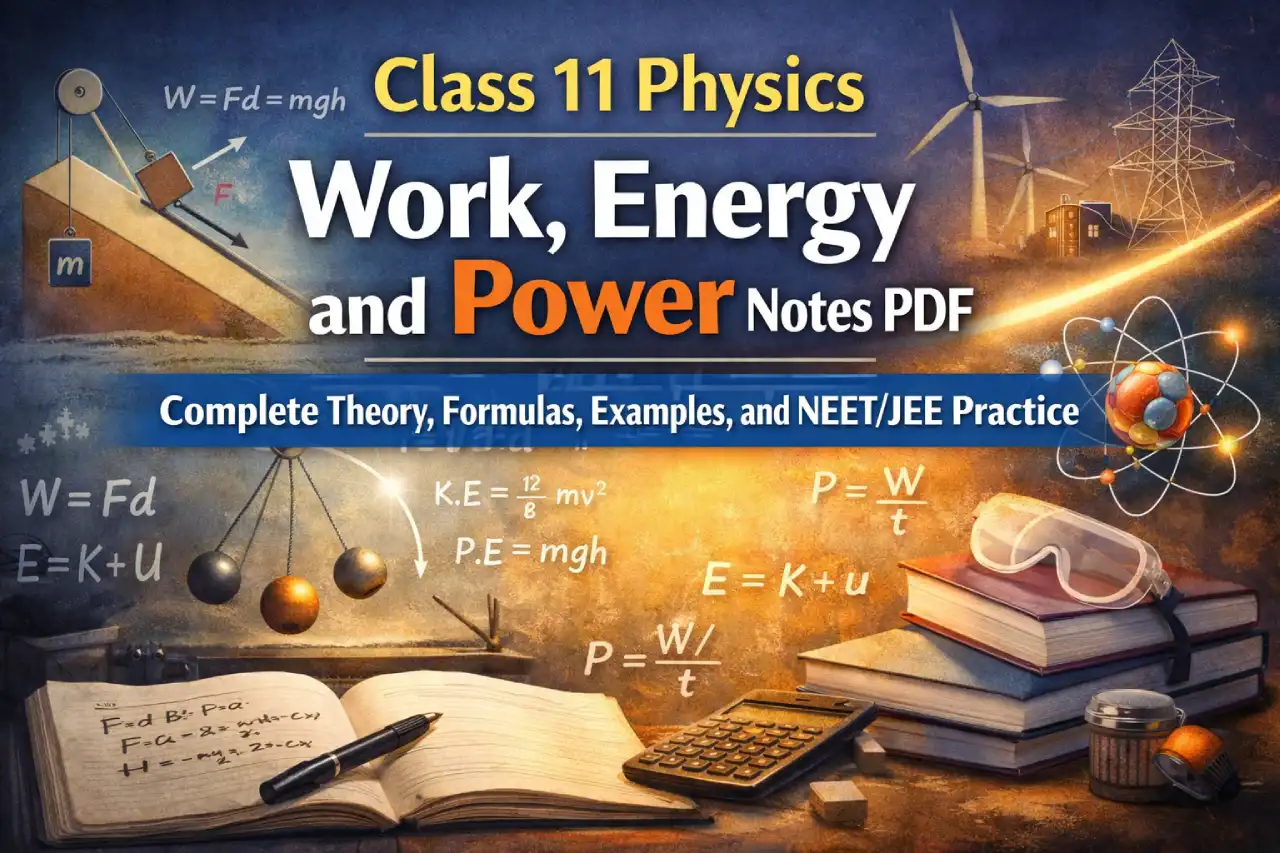
Work, Energy and Power is one of the most important chapters in Class 11 Physics and forms the backbone of mechanics. It explains how forces produce motion, how energy is transferred, and how fast work is done. The uploaded PDF is a well-structured study resource for Chapter 6 that covers concepts, derivations, formulas, diagrams, solved illustrations, and important numerical problems. It also includes sections on circular motion, collisions, conservative and non-conservative forces, and mass–energy equivalence, making it a complete revision package.
I am writing about this PDF because many students find this chapter lengthy and concept-heavy. There are multiple formulas and applications, and without proper organisation, revision can become confusing. This document arranges the entire chapter in a clear, step-by-step manner, helping students understand not only the theory but also how to apply concepts in problems. Knowing what this PDF contains and how to use it can make preparation more focused and effective.
What This Work, Energy and Power PDF Covers
The PDF is divided into concept-wise sections with definitions, formulas, and worked examples. It begins with the basic idea of work and gradually moves towards energy, power, circular motion, and collisions.
Major areas included are:
- Work done by constant and variable force
- Kinetic energy and work–energy theorem
- Potential energy (gravitational and spring)
- Conservative and non-conservative forces
- Mechanical energy and its conservation
- Power and instantaneous power
- Circular motion and conical pendulum
- Motion in a vertical circle
- Elastic and inelastic collisions
Concept of Work
Work is defined as the product of force and displacement in the direction of force.
The PDF explains that work can be written as a dot product of force and displacement:
W = F · s
It also discusses positive work, negative work, and zero work with examples such as:
- Falling body under gravity (positive work)
- Body thrown upward against gravity (negative work)
- Pushing a wall (zero work)
Units of work in SI and CGS systems are clearly given as joule and erg.
Work Done by Variable Force
Forces in real life often change with position. The PDF explains that work done by a variable force can be calculated by finding the area under the force–displacement graph.
In mathematical form:
W = ∫ F(x) dx
This concept is important for understanding springs and non-uniform forces.
Kinetic Energy and Work–Energy Theorem
Kinetic energy is defined as the energy possessed by a body due to its motion.
KE = ½ mv²
The PDF derives the work–energy theorem, which states that the work done by a net force on a body is equal to the change in its kinetic energy.
W = KEf – KEi
The relation between kinetic energy and linear momentum is also explained.
Download this CLASS 11 – WORK, POWER & ENERGY PDF File: Click Here
Potential Energy
Two types of potential energy are covered.
Gravitational Potential Energy
For an object of mass m raised to height h:
PE = mgh
The PDF explains that work done against gravity is stored as gravitational potential energy.
Potential Energy of a Spring
Using Hooke’s law, restoring force is proportional to displacement.
PE of spring = ½ kx²
This is derived using integration of variable force.
Conservative and Non-Conservative Forces
The PDF clearly differentiates between the two.
- Conservative forces: Work done depends only on initial and final positions (example: gravity).
- Non-conservative forces: Work done depends on path (example: friction).
It also explains that work done by a conservative force over a closed loop is zero.
Mechanical Energy and Law of Conservation
Mechanical energy is the sum of kinetic and potential energy.
ME = KE + PE
The PDF shows, with the example of a freely falling body, that total mechanical energy remains constant when only conservative forces act.
Power
Power is defined as the rate of doing work.
P = W / t
Instantaneous power is given by:
P = F · v
The SI unit of power is watt, and the relation 1 horsepower = 746 watt is also mentioned.
Circular Motion and Conical Pendulum
The PDF explains centripetal force required for circular motion:
Fc = mv² / r
For conical pendulum, relations between tension, angle, and angular speed are derived, along with expression for time period.
Motion in a Vertical Circle
Important results included are:
- Minimum velocity at top: v = √(gr)
- Minimum velocity at bottom: v = √(5gr)
These results are useful for numerical problems.
Collisions
Both elastic and inelastic collisions are discussed.
- In elastic collision, both momentum and kinetic energy are conserved.
- In inelastic collision, momentum is conserved but kinetic energy is not.
One-dimensional and two-dimensional collision cases are explained with equations.
How Students Can Use This PDF
- Study concepts topic-wise
- Revise formulas regularly
- Practise numerical examples
- Use it for quick revision before exams