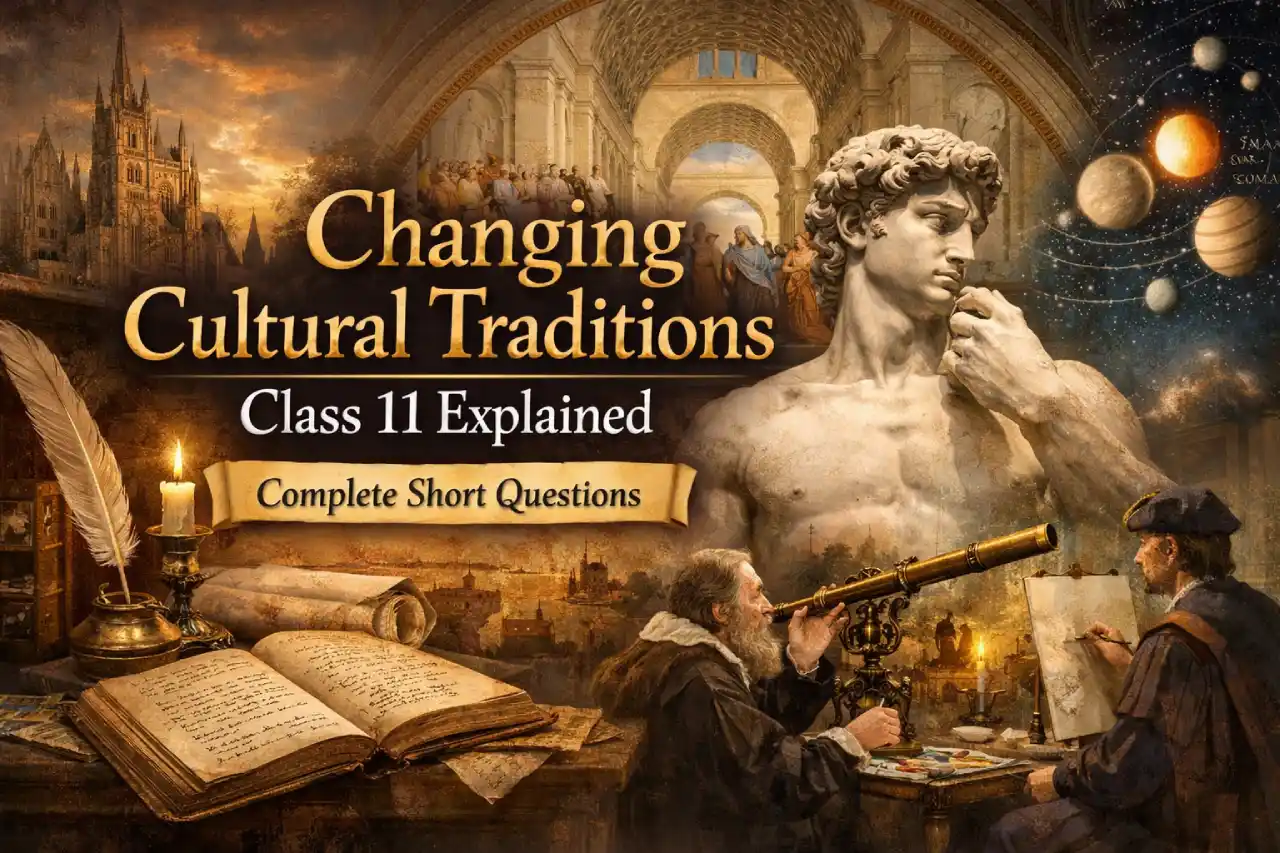
The Class 11 History chapter on Changing Cultural Traditions focuses on the Renaissance, Humanism, scientific developments, political transformation and the Protestant Reformation in Europe. The worksheet analysed here contains short-answer questions that cover almost every important personality and concept of the chapter. From Ibn Rushd and Petrarch to Martin Luther, Galileo, Michelangelo and Leonardo da Vinci, it highlights how Europe moved from the Middle Ages to the modern age.
I am writing about this because this chapter is packed with one-mark questions that students often take lightly. However, these small questions test your core understanding of concepts like mercantilism, nation-states, realism, indulgences, humanism and reformation. In my experience, if your short answers are clear, your long answers automatically improve. That is why revising the chapter through direct questions and crisp explanations makes preparation much stronger and more confident.
Renaissance and the Spirit of Rebirth
Renaissance means “rebirth.” It refers to the revival of classical Greek and Roman learning that began in Italy during the 14th century. Italian cities such as Venice and Genoa became powerful commercial centres, different from other parts of Europe because they were more urban, trade-oriented and politically independent.
The growth of trade and commerce led to the rise of wealthy merchant families. These families supported artists and scholars, which encouraged cultural growth. Florence, in particular, became famous due to the support of powerful families and talented artists.
Humanists made a clear distinction between the Middle Ages and the Modern Age. They believed that the medieval period was dominated by superstition, while the new age encouraged rational thinking and individual freedom.
Concept of Humanism
Humanism laid stress on the importance of man and his capabilities rather than focusing only on religious authority. It promoted dignity of individuals, freedom of thought and development of human potential.
Main features of humanist thought include:
- Importance of individual rights
- Emphasis on material and worldly life
- Close reading of classical Greek and Roman texts
- Encouragement of debate and reasoning
Petrarch is regarded as the Father of Humanism. Writers like Dante and Boccaccio also played important roles in reviving classical literature.
Humanist ideas first flourished in Italian cities because these cities were economically prosperous and intellectually active.
Renaissance Art and Realism
Realism refers to representing life and nature as they actually appear. Renaissance artists studied anatomy and geometry to make paintings and sculptures more realistic.
Leonardo da Vinci was a painter, scientist and inventor. His famous works include Mona Lisa and The Last Supper. He studied anatomy, botany and even designed a flying machine.
Michelangelo Buonarroti was a great sculptor, painter and architect. His work contributed significantly to Italian art.
Raphael also made important contributions through his paintings, which reflected harmony and balance.
Leon Batista Alberti believed that an architect should combine knowledge of mathematics, design and aesthetics.
Printing Press and Spread of Ideas
Johannes Gutenberg is believed to be the inventor of the printing press. The first printed book in Europe was the Bible.
Before printing, students had to rely on hand-written manuscripts, which were rare and expensive. Printing allowed ideas to spread more rapidly across Europe in the fifteenth century.
The printing press:
- Spread humanist ideas
- Encouraged scientific awareness
- Supported religious reform movements
It played a major role in shaping modern Europe.
Download this Changing Cultural Traditions WS PDF File: Click Here
Scientific Developments
Ptolemy’s Almagest dealt with astronomy and supported the geocentric theory. Christians believed that the earth stood at the centre of the universe and remained immobile.
Copernicus challenged this belief by declaring that the earth revolves around the sun. Galileo supported this heliocentric theory through his scientific observations.
Andreas Vesalius contributed to modern anatomy by studying the human body scientifically.
These scientific discoveries marked a shift from blind belief to logical reasoning.
Protestant Reformation and Religious Change
The leader of the Protestant Reformation Movement was Martin Luther. He opposed corruption in the Catholic Church and criticised the sale of indulgences, which were letters issued by the Church promising forgiveness of sins.
Luther believed that faith alone could guide a person to salvation and that priests were not necessary intermediaries between God and people.
The Reformation Movement resulted in:
- Weakening of the authority of the Pope
- Establishment of Protestant churches
- Religious wars in Europe
English reformer William Tyndale translated the Bible into English to make it accessible to common people.
The Counter-Reformation was the Catholic Church’s response to reform movements, aiming to remove corruption and restore faith.
Rise of Nation-States
Nation-states emerged due to the decline of feudalism, growth of trade and stronger centralised monarchies.
Causes of origin of nation-states include:
- Decline of feudal system
- Growth of commerce
- Rise of powerful kings
- Development of common national identity
Nation-states marked progress because they brought political unity and administrative efficiency.
Political Thought and Machiavelli
Niccolo Machiavelli wrote The Prince and argued that rulers should be practical and realistic. He believed that human beings are driven by self-interest.
The Renaissance period depicted political values like secularism and realism. Despotism refers to absolute rule by a single authority.
These ideas influenced modern political thought.
Status of Women and Society
In business families, women sometimes participated in managing household affairs and trade-related matters. However, their public role was still limited.
Humanist culture influenced education, but opportunities for women remained restricted compared to men.