
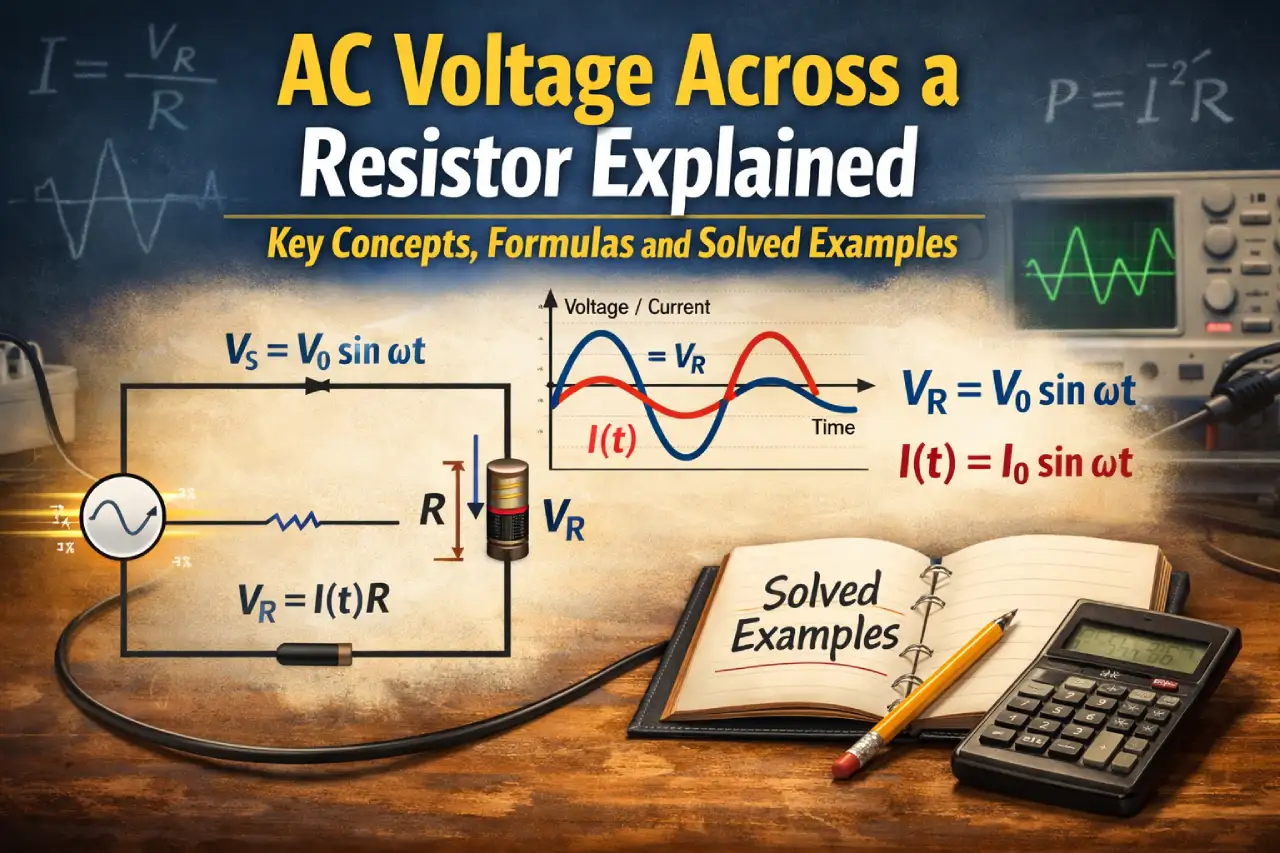
Alternating current plays a central role in modern electrical systems, and one of the simplest ways to understand it is by studying what happens when alternating voltage is applied across a resistor. In such a circuit, both voltage and current vary sinusoidally with time, and their relationship follows the basic laws of electricity. By studying this concept, students learn about important quantities such as peak value, RMS value, instantaneous current and the heating effect of current in a resistive circuit.
I am writing about this topic because many students often memorise formulas related to alternating current without fully understanding how they apply in real circuits. From my experience, once we examine the behaviour of current in a simple resistive circuit, the entire idea of alternating current becomes easier to grasp. This topic forms the foundation for studying more advanced electrical circuits, so it is important to understand the basic principles clearly and logically.
What Is Alternating Current?
Alternating current (AC) is an electric current that changes both its magnitude and direction periodically with time. Unlike direct current, which flows steadily in one direction, alternating current reverses its direction at regular intervals.
The instantaneous value of alternating current can be expressed mathematically as:
I = I₀ sin(ωt)
Where:
- I₀ is the peak value of current
- ω is the angular frequency
- t represents time
This sinusoidal variation is the fundamental characteristic of alternating current.
Standard Domestic Electrical Supply
In most countries, household electricity is supplied in the form of alternating current.
Typical values used in domestic supply systems include:
| Quantity | Standard Value |
|---|---|
| Voltage | 220 V |
| Frequency | 50 Hz |
This means the current changes direction fifty times every second. The frequency of the supply plays an important role in determining the behaviour of electrical devices connected to the power source.
Behaviour of Current in a Pure Resistive Circuit
When alternating voltage is applied across a resistor, the resulting current follows the same sinusoidal pattern as the voltage.
Important features of this type of circuit include:
- Voltage and current remain in phase
- Both reach their maximum and minimum values at the same time
- Electrical energy is converted into heat inside the resistor
Because the circuit contains only resistance, Ohm’s law remains valid throughout the cycle.
Instantaneous Voltage and Current
The instantaneous voltage applied to a resistor in an alternating circuit can be written as:
V = V₀ sin(ωt)
The current flowing through the resistor is then given by:
I = (V₀ / R) sin(ωt)
Where R is the resistance of the circuit.
These equations show that current varies in the same way as voltage when only resistance is present in the circuit.
Download this Alternating Current WS 1 sol PDF File: Click Here
RMS Value of Alternating Current
The root mean square (RMS) value is used to represent the effective value of alternating current or voltage.
The RMS value is defined as the value of direct current that would produce the same heating effect in a resistor as the alternating current.
The formulas are:
Irms = I₀ / √2
Vrms = V₀ / √2
Electrical appliances are rated according to RMS values because these values represent the actual energy delivered to the device.
Average Value of Alternating Current
When alternating current is averaged over a complete cycle, the result is zero. This occurs because the positive half of the cycle cancels the negative half.
However, when the average value is calculated over half a cycle, the value becomes useful and is approximately:
Average current = 0.637 × Peak current
This concept is frequently used in electrical analysis.
Heating Effect in Resistive Circuits
When alternating current passes through a resistor, electrical energy is converted into heat. The amount of heat generated depends on the resistance of the circuit and the RMS value of the current.
For example, if a bulb operates at a certain power and voltage rating, we can determine:
- The resistance of the filament
- The RMS current flowing through it
These calculations help explain how electrical appliances consume power in everyday life.
Difference Between Alternating Current and Direct Current
Understanding the difference between AC and DC is important for students studying electrical circuits.
| Feature | Alternating Current | Direct Current |
|---|---|---|
| Direction of flow | Changes periodically | Constant |
| Frequency | Usually 50 or 60 Hz | Zero |
| Source | Power stations | Batteries |
Alternating current is widely used in power transmission because it can easily be transformed to higher or lower voltages using transformers.

















