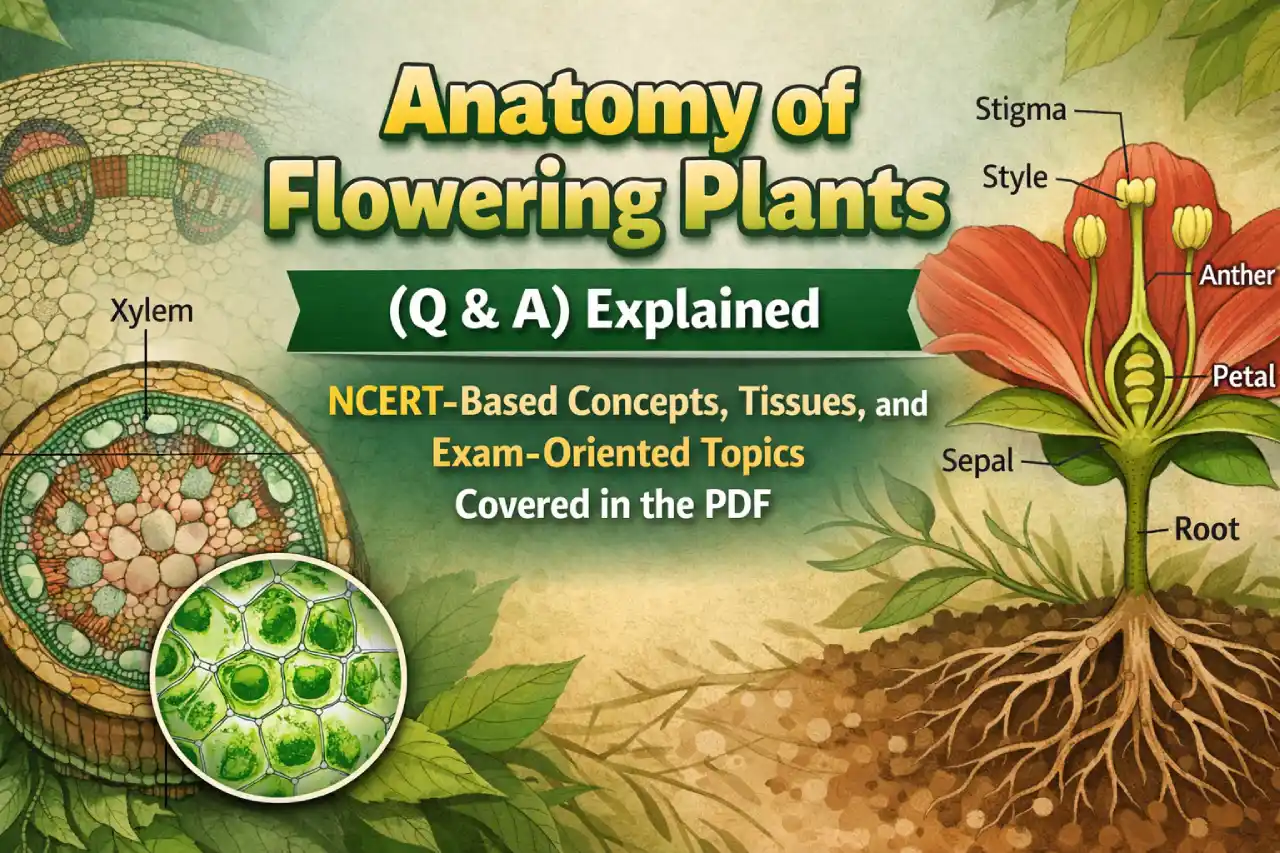
This PDF is a detailed, NCERT-aligned study and practice resource on the chapter “Anatomy of Flowering Plants” from Class 11 Biology. It is structured mainly as a topic-wise and exam-focused question bank, supported by explanations and answer keys. The PDF covers plant tissues, tissue systems, internal structure of roots, stems, and leaves, and differences between monocotyledonous and dicotyledonous plants. All questions and explanations are strictly based on NCERT content, making the document highly relevant for CBSE board exams and NEET preparation.
I am writing about this PDF because Anatomy of Flowering Plants is one of those chapters where students often get confused between definitions, structures, and diagrams. This PDF clearly shows which areas are repeatedly tested in exams and how NCERT frames questions from this chapter. Understanding what this PDF contains helps students focus on core concepts like tissues, vascular bundles, and anatomical differences instead of memorising unnecessary details, making preparation more effective and exam-oriented.
Scope of the Chapter Covered in the PDF
The PDF strictly follows Chapter 6: Anatomy of Flowering Plants from NCERT Class 11 Biology. It does not include any extra or out-of-syllabus topics and focuses entirely on anatomy-related concepts through MCQs, matching questions, assertion–reason questions, and NEET-based problems.
Plant Tissues Explained in the PDF
A major portion of the PDF is dedicated to plant tissues, beginning with the definition of tissue as a group of cells similar in origin and function.
Meristematic Tissues
The PDF explains:
- Apical meristem for increase in length
- Intercalary meristem for elongation in grasses and bamboo
- Lateral meristem for increase in girth
Questions clearly differentiate meristems based on position, function, and role in primary and secondary growth.
Permanent Tissues
Permanent tissues are discussed in detail, including:
- Simple tissues: parenchyma, collenchyma, sclerenchyma
- Functions like storage, photosynthesis, and mechanical support
- Structural features such as lignified walls, presence or absence of protoplasm, and wall thickening
Examples like sclereids in nut shells and collenchyma beneath the epidermis are repeatedly tested.
Complex Tissues: Xylem and Phloem
The PDF thoroughly covers complex permanent tissues.
Xylem
Key concepts include:
- Components such as tracheids, vessels, xylem fibres, and xylem parenchyma
- Role in conduction of water, minerals, hormones, and organic nitrogen
- Difference between protoxylem and metaxylem
- Endarch and exarch conditions
Special emphasis is placed on vessels as a characteristic feature of angiosperms.
Phloem
The PDF explains:
- Sieve tube elements, companion cells, phloem parenchyma, and phloem fibres
- Absence of sieve tubes and companion cells in gymnosperms
- Role of companion cells in controlling sieve tube functions
These points are frequently tested through assertion–reason questions.
Download this ANATOMY OF FLOWERIGN PLANTS PDF File: Click Here
Tissue Systems in Plants
The PDF divides tissue systems into three major categories:
- Epidermal tissue system
- Ground tissue system
- Vascular tissue system
It explains components like epidermis, stomata, guard cells, trichomes, cortex, endodermis, pericycle, and pith. Concepts such as cuticle, Casparian strips, and subsidiary cells are included as important factual points.
Anatomy of Dicotyledonous and Monocotyledonous Plants
A large section of the PDF focuses on internal structure comparisons.
Dicot and Monocot Roots
The PDF explains:
- Radial vascular bundles
- Exarch xylem
- Presence of Casparian strips in endodermis
- Well-developed pith in monocot roots
- Secondary growth in dicot roots
Dicot and Monocot Stems
Key features discussed include:
- Arrangement of vascular bundles
- Presence or absence of cambium
- Open vascular bundles in dicot stems
- Scattered vascular bundles in monocot stems
The PDF also highlights water-containing cavities and absence of phloem parenchyma in monocot stems.
Leaf Anatomy
The PDF explains:
- Dorsiventral leaves in dicots
- Isobilateral leaves in monocots
- Presence of bulliform cells in grasses
- Mesophyll differentiation in dicots and its absence in monocots
These topics are often tested using diagram-based and reasoning questions.
Special Anatomical Structures
The PDF includes detailed questions on:
- Bulliform cells and their role in leaf rolling
- Lenticels in woody stems
- Bark, sapwood, heartwood, and cambium
- Stele and its components
Each concept is linked directly to NCERT statements.
Exam-Oriented Question Pattern
The PDF is heavily exam-focused and includes:
- NCERT-based topic-wise MCQs
- Matching-type questions
- Two-statement and assertion–reason questions
- NCERT Exemplar and NEET questions with answer keys
This makes it a revision and testing tool rather than just theory notes.