JOIN WHATSAPP
STORIES

Animal Kingdom NEET Worksheet Explained: Important Questions, Concepts, and Exam Patterns

Animal Kingdom NEET Worksheet Explained: Important Questions, Concepts, and Exam Patterns

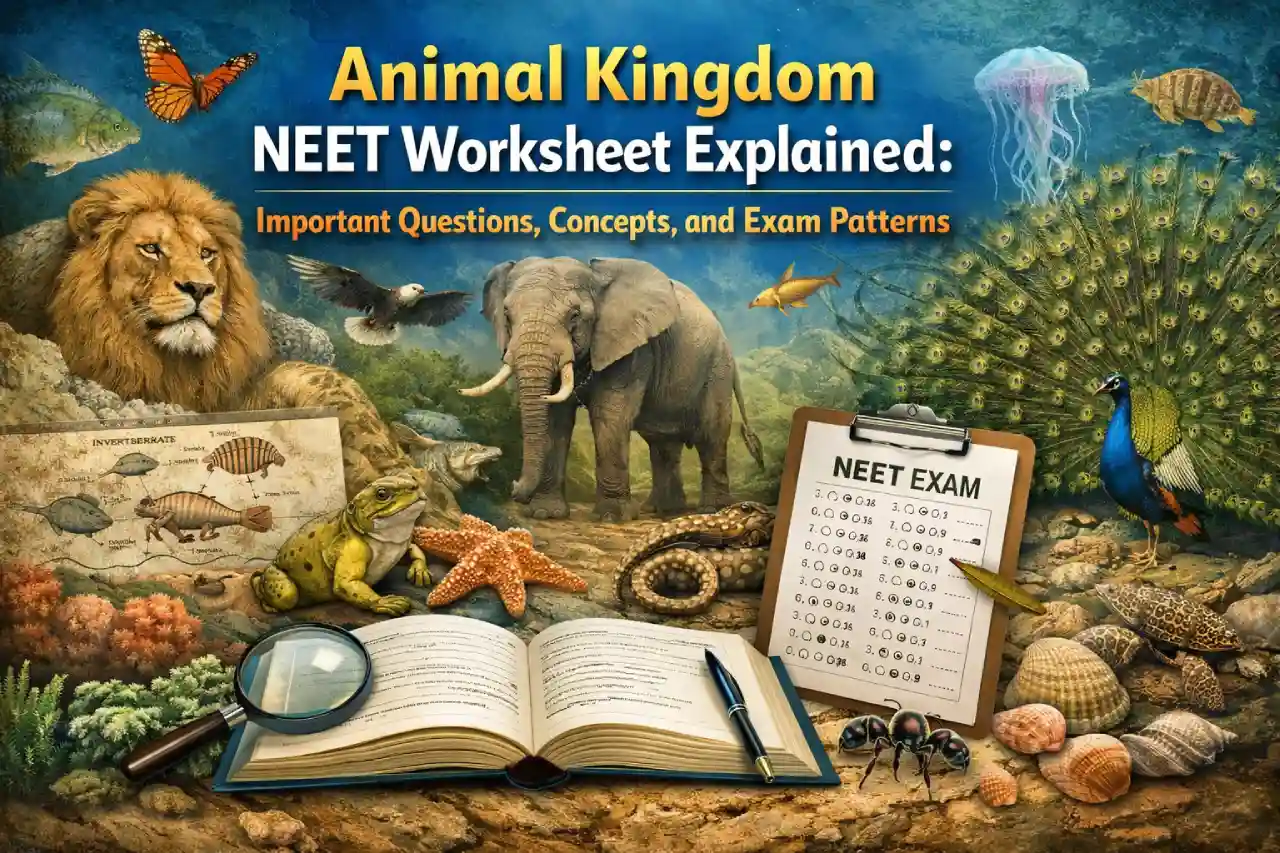
The uploaded PDF is a Class 11 Biology worksheet on the Animal Kingdom, complete with 75 multiple-choice questions and detailed explanations. It covers a wide range of topics from non-chordates to chordates, including classification, body organisation, excretion, circulation, reproduction, and evolutionary features. The worksheet is clearly designed for NEET-level preparation, with questions framed directly from NCERT facts and commonly tested biological concepts.

I am writing about this worksheet because the Animal Kingdom chapter often feels bulky and factual to students, yet it is one of the most scoring chapters in NEET Biology. Worksheets like this help convert static NCERT content into exam-ready knowledge. By analysing the questions and explanations, students can understand which facts matter most, how options are twisted in exams, and where conceptual clarity is required instead of blind memorisation. This article explains only what is present in the uploaded worksheet Animal Kingdom WS.

What This Animal Kingdom Worksheet Covers

The worksheet includes 75 MCQs, each followed by a short explanation. The questions span across:

  • Basis of classification
  • Evolutionary relationships
  • Excretory products and organs
  • Circulatory system types
  • Reproductive strategies
  • Special organs and adaptations

The explanations are concise and aligned with NCERT terminology, making the worksheet ideal for quick revision and self-evaluation.

Evolutionary and Classification-Based Questions

Several questions test evolutionary links and classification logic. For example, the worksheet highlights that mammals evolved from Therapsida, and that the presence of a notochord is the defining feature of chordates.

There are also direct classification questions asking students to identify the correct phylum, class, or order of organisms like lancelet, octopus, crocodile, bat, and platypus. Such questions are common in NEET and require exact recall of NCERT classification tables.

Chordates and Their Key Features

A major portion of the worksheet focuses on chordates. Important concepts covered include:

  • Cyclostomata having a jawless, circular sucking mouth
  • Reptiles generally having a three-chambered heart, with crocodile as an exception
  • Birds and mammals being warm-blooded with four-chambered hearts
  • Presence of mammary glands as the defining feature of mammals

Questions also test similarities between groups, such as crocodiles, birds, and mammals sharing a four-chambered heart.

Excretion and Nitrogenous Wastes

The worksheet strongly tests types of nitrogenous excretion, which is a favourite NEET area. Examples include:

  • Ammonotelic animals excreting ammonia
  • Uricotelic animals like birds and reptiles excreting uric acid
  • Malpighian tubules as excretory organs in insects
  • Proboscis gland as the excretory organ in hemichordates

These questions check whether students can correctly link animals with their excretory products and organs.

Download this PDF File: Click Here

Circulatory System and Heart Structure

Multiple questions are based on heart chambers and circulation types. The worksheet explains:

  • Double circulation as blood passing twice through the heart
  • Two-chambered heart in fishes like sharks
  • Three-chambered heart in amphibians and most reptiles
  • Four-chambered heart in birds, mammals, and crocodiles

Such questions often appear as assertion–reason or matching-type MCQs in NEET.

Reproduction and Development

Reproductive strategies are tested through questions on:

  • External fertilisation in amphibians
  • Self-fertilisation in liver fluke
  • Oviparous mammals like platypus
  • Larval forms such as tadpole in urochordates

These questions require conceptual clarity about life cycles rather than rote learning.

Non-Chordates and Their Identifying Features

The worksheet includes strong coverage of non-chordate phyla:

  • Porifera with cellular level of organisation
  • Coelenterata being diploblastic
  • Platyhelminthes as acoelomates
  • Annelida showing metamerism
  • Arthropoda having the highest number of species
  • Mollusca being the second-largest phylum

Special structures like radula in molluscs and comb plates in ctenophores are also tested.

Ecology, Conservation, and Applied Biology

Some questions move beyond pure classification and test applied knowledge, such as:

  • Project Tiger being launched in 1973
  • Giant panda facing extinction due to low reproductive rate
  • Lac being a secretion of lac insects
  • Tasar silk being produced by Antheraea species

These questions show how Animal Kingdom links with ecology and human use of animals.

What This Worksheet Teaches NEET Aspirants

From this worksheet, it is clear that:

  • Animal Kingdom questions are NCERT-driven and factual
  • Small details like exceptions are extremely important
  • Classification tables must be revised repeatedly
  • Understanding “why” helps retain facts better than memorising lists

Practising such worksheets improves speed and accuracy in Biology.
Leave a Comment

End of Article

Class 11 Sets Question Worksheet: Concept Breakdown, Question Pattern and Why It Matters for Exams

Class 11 Sets Question Worksheet: Concept Breakdown, Question Pattern and Why It Matters for Exams

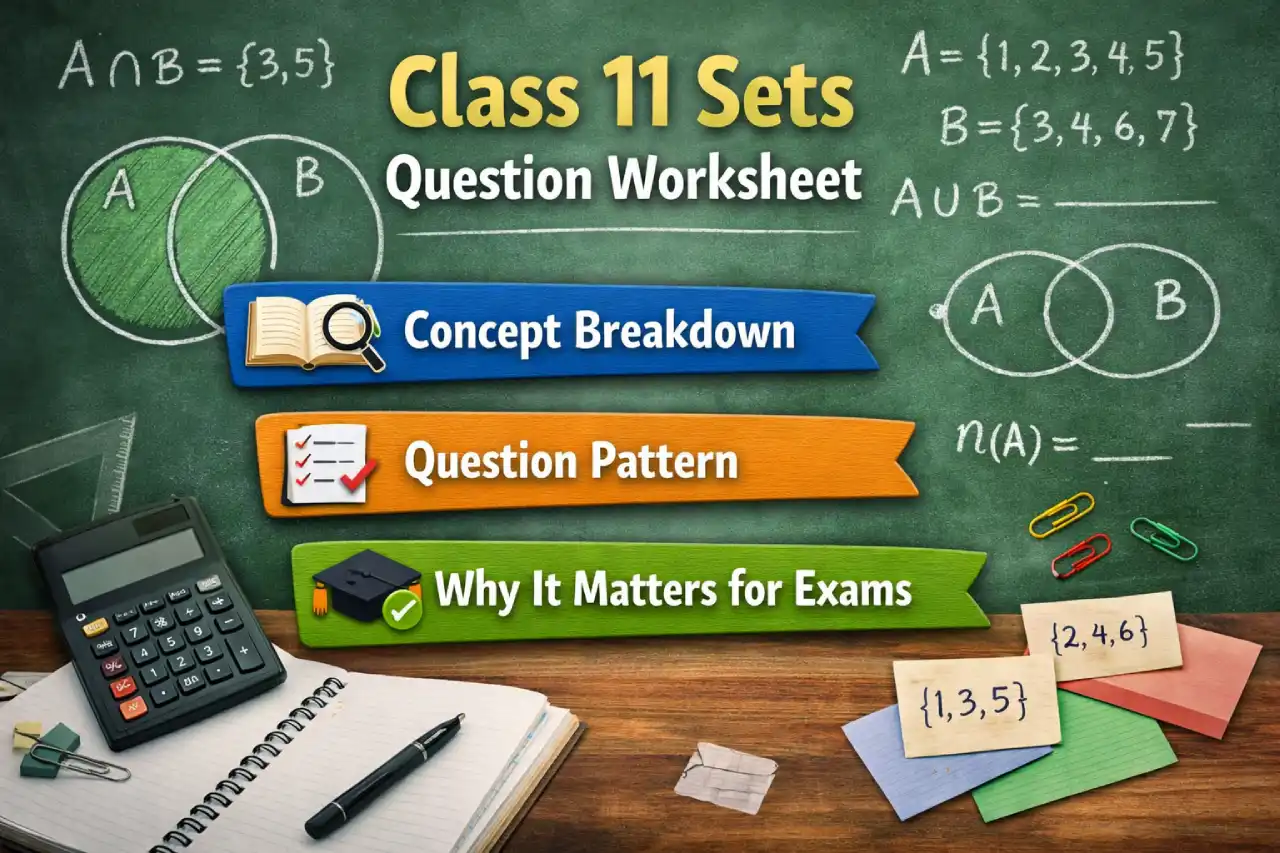
This mathematics worksheet on Sets, prepared for Class 11 CBSE students, is designed mainly for board exam preparation and for building a strong foundation for higher mathematics. It contains 50 multiple-choice questions, all framed directly from NCERT concepts. The worksheet covers basic ideas like representation of sets, subsets, power sets, operations on sets, complements, and Venn diagram logic. Overall, it reflects the kind of factual yet concept-based questions students regularly face in school examinations Sets WS.

I am writing about this worksheet because the chapter on Sets often feels simple at first but becomes tricky due to logical conditions, symbols, and formula-based questions. Many students lose easy marks due to confusion between subset relations, complements, and set operations. A structured worksheet like this helps convert theory into exam-ready understanding. By analysing the questions carefully, students can clearly identify which areas are repeatedly tested and how basic definitions are turned into scoring MCQs.

Structure of the Sets Worksheet

The worksheet consists of 50 MCQs, with each question carrying one mark. The questions are a mix of direct concept checks and logical application-based problems. While many questions look straightforward, the options are closely framed, which tests clarity and careful reading rather than guesswork.

The overall difficulty level ranges from easy to moderate, making this worksheet suitable for both revision and self-assessment before exams.

Basics of Sets and Representation

Several questions focus on the fundamentals of sets, including:

  • Well-defined collections
  • Roster form and set-builder form
  • Identification of valid and invalid sets
  • Null set and singleton set

These questions ensure that students clearly understand what qualifies as a set and how sets are represented mathematically, which is the starting point of the chapter Sets WS.

Subsets, Proper Subsets and Power Sets

A large part of the worksheet tests understanding of subsets and power sets. Questions include:

  • Finding the number of subsets of a given set
  • Identifying proper and improper subsets
  • Comparing number of subsets between two sets
  • Questions based on formulas like 2ⁿ and 2ⁿ − 1

These are high-scoring areas in exams but require clarity in applying formulas correctly.

Operations on Sets

The worksheet strongly focuses on operations on sets such as:

  • Union
  • Intersection
  • Difference of sets
  • Complement of a set

Many questions are based on standard identities like
A ∩ (A ∪ B) = A
and conditions such as A ∪ B = A or A ∩ B = B. These questions test whether students understand identities logically rather than memorising them.

Download this Sets Question PDF File: Click Here

Complement and Universal Set Concepts

Several MCQs involve complements of sets with respect to a universal set. Students are asked to evaluate expressions involving A′, (A′)′, and combined operations with complements.

Such questions are important because small mistakes in complement logic can lead to incorrect answers even when the concept is known.

Set-Builder Logic and Interval-Based Sets

The worksheet includes questions written in set-builder notation and interval form, especially involving real numbers. These questions test the ability to translate mathematical conditions into correct set notation and vice versa.

Understanding these problems is essential for later chapters involving relations, functions, and coordinate geometry.

Counting and Application-Based Questions

Some questions go beyond direct definitions and involve counting techniques, such as:

  • Comparing number of subsets of different sets
  • Finding values of variables based on subset conditions
  • Questions involving overlapping sets and element distribution

These problems improve logical reasoning and are often used to test deeper understanding in exams.

What Students Can Learn from This Worksheet

From this worksheet, it becomes clear that:

  • NCERT definitions are the backbone of exam questions
  • Set identities must be understood logically
  • Subset and power set formulas need careful application
  • Complement-based questions require attention to detail
  • Regular practice reduces silly mistakes in easy chapters

Overall, this Class 11 Sets worksheet is a strong practice resource that helps students secure marks from a scoring chapter. It builds clarity, confidence, and accuracy, which are essential for performing well in board examinations and future mathematical studies.

Leave a Comment

End of Article

Loading more posts...