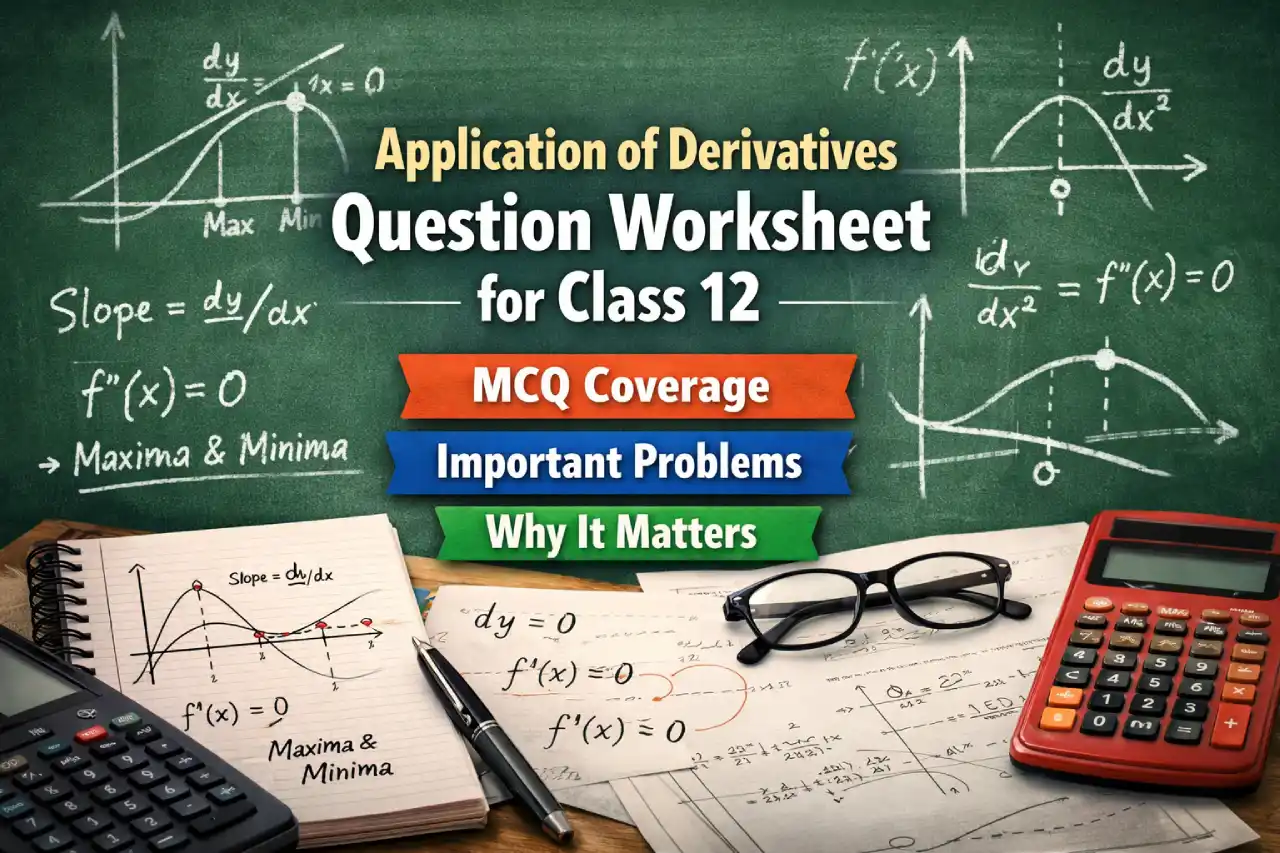
This Class 12 Mathematics worksheet on Application of Derivatives is designed mainly for CBSE board exam preparation and objective-based practice. The worksheet contains 75 MCQ-type questions, all aligned with NCERT concepts. It covers monotonic functions, increasing and decreasing intervals, maxima and minima, critical points, angle of intersection of curves, tangents and normals, rate of change problems, optimisation questions, and real-life applications of derivatives. Overall, the worksheet mirrors the exact level and variety of one-mark questions students usually face in board exams.
I am writing about this worksheet because Application of Derivatives is a chapter where students often understand formulas but struggle with interpretation. Small mistakes in sign, interval selection, or derivative conditions can easily lead to wrong answers. A comprehensive worksheet like this helps convert theoretical understanding into exam-ready clarity. By carefully analysing these MCQs, students can identify common question patterns and improve accuracy in scoring sections of the paper.
Structure of the Application of Derivatives Worksheet
The worksheet consists of 75 MCQs, each carrying one mark. The questions are a mix of direct concept checks, interval-based reasoning, and application-oriented problems. Many questions look straightforward but require clear understanding of derivative tests and logical interpretation.
The difficulty level ranges from moderate to high, making this worksheet suitable for revision after completing the chapter.
Increasing and Decreasing Functions
A large number of questions focus on finding intervals where a function is increasing or decreasing. These questions test:
- Use of first derivative test
- Sign of f′(x) in different intervals
- Behaviour of polynomial, trigonometric, logarithmic, and exponential functions
- Monotonicity on given intervals
Such questions are among the most frequently asked MCQs in board exams.
Maxima and Minima Problems
The worksheet strongly emphasises maxima and minima. Students are tested on:
- Finding critical points using f′(x) = 0
- Identifying maximum and minimum values
- Absolute maxima and minima on closed intervals
- Interpretation of results from first and second derivative tests
These questions often combine calculus with algebraic simplification.
Download this Application of Derivatives PDF File: Click Here
Tangents, Normals and Angle of Intersection
Several MCQs are based on tangents and normals, including:
- Slope of tangent at a given point
- Equation-based reasoning using derivatives
- Angle of intersection of two curves
- Conditions for perpendicular or parallel tangents
These problems test both conceptual understanding and formula application.
Rate of Change and Related Rates
The worksheet includes application-based questions on rates of change, such as:
- Rate of change of area and volume
- Problems involving cones, circles, and spheres
- Simultaneous increase and decrease of related quantities
These questions help students connect calculus with geometry and real-life situations.
Optimisation and Word Problems
Optimisation problems form an important section of the worksheet. Questions include:
- Maximum and minimum values in real-life contexts
- Shortest distance and least value problems
- Maximising area, volume, or profit-type expressions
These MCQs require clear interpretation of the given situation before differentiation.
Trigonometric and Exponential Function Behaviour
Many questions test monotonicity and extremum of functions involving:
- Trigonometric expressions
- Exponential and logarithmic functions
- Combined algebraic-trigonometric forms
Such questions check whether students can handle derivatives beyond simple polynomials.
Absolute Value and Modulus Functions
The worksheet also includes MCQs on functions involving modulus, testing:
- Piecewise analysis
- Increasing or decreasing nature
- Identification of monotonic intervals
These questions often confuse students if not practised properly.
What Students Can Learn from This Worksheet
From analysing this worksheet, a few key points become clear:
- Sign of the first derivative is crucial in most questions
- Interval-based thinking is more important than final answers
- Maxima and minima problems need systematic steps
- Related rates questions test conceptual clarity, not speed
- Regular MCQ practice reduces silly mistakes
Overall, this Class 12 Application of Derivatives worksheet is a strong revision and practice resource. It helps students strengthen conceptual understanding, improve logical reasoning, and gain confidence in handling one-mark calculus questions in board examinations.