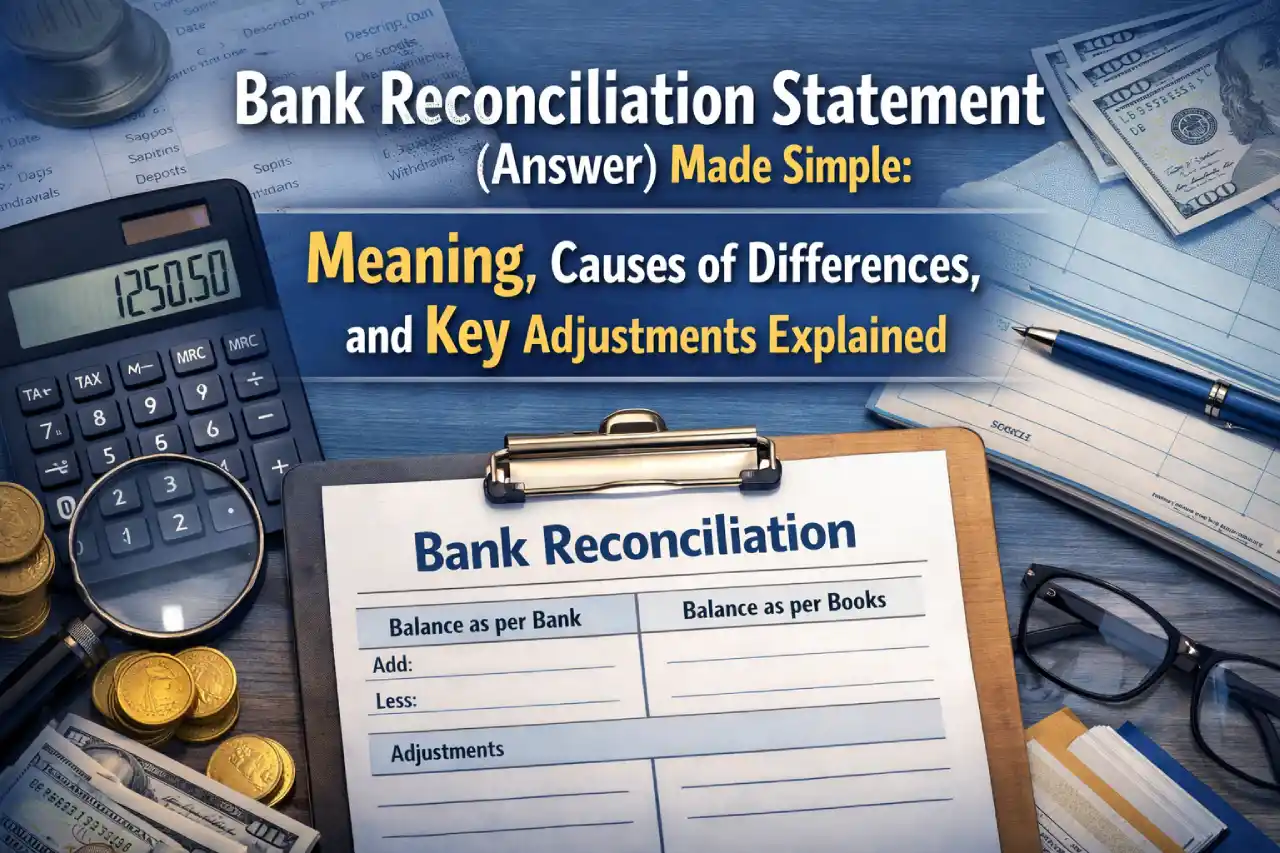
A Bank Reconciliation Statement is one of the most important topics in Accountancy, especially for students who are learning how cash and bank transactions are recorded and verified. The uploaded PDF is entirely focused on this topic and presents it through a large set of objective questions with answers and explanations. It explains what a Bank Reconciliation Statement is, why it is prepared, and how differences arise between the Cash Book and the Pass Book. The PDF also covers practical adjustment logic in a very exam-oriented manner.
I am writing about this PDF because Bank Reconciliation Statement is a chapter where students often lose marks due to confusion over additions, deductions, and starting points. This PDF clearly shows what examiners actually test by repeating similar situations in different question forms. Understanding the exact scope and coverage of this PDF helps learners focus only on relevant concepts, improve accuracy, and gain confidence while solving numerical and theoretical questions.
Meaning of Bank Reconciliation Statement as Covered in the PDF
The PDF defines a Bank Reconciliation Statement as a statement prepared on a particular date to reconcile the balance shown by the bank column of the Cash Book with the balance shown by the Pass Book. It clearly states that this statement is prepared by the account holder or business entity, not by the bank.
It is also emphasised that the Bank Reconciliation Statement is a separate statement and not a part of the double entry system.
Purpose of Preparing a Bank Reconciliation Statement
According to the PDF, the main purposes of preparing a Bank Reconciliation Statement are:
- To identify the reasons for differences between Cash Book and Pass Book balances
- To correct errors made either by the business or by the bank
- To ascertain the true bank balance
- To detect omissions, delays, and incorrect postings
The PDF also points out that non-reconciliation leads to non-reflection of the true cash balance with the bank.
Cash Book and Pass Book Relationship
The PDF explains that:
- The Cash Book is maintained by the business
- The Pass Book is an extract of the customer’s account maintained by the bank
A debit balance in the Cash Book represents a favourable balance, while a credit balance represents a bank overdraft. In contrast, a credit balance in the Pass Book indicates bank balance, and a debit balance indicates overdraft.
Causes of Difference Between Cash Book and Pass Book
A major portion of the PDF focuses on causes of differences, which are grouped into two main categories.
Timing Differences
These include:
- Cheques issued but not presented for payment
- Cheques deposited but not yet credited by the bank
- Deposits in transit
- Direct deposits by customers
These items are recorded at different times in the Cash Book and Pass Book.
Errors and Omissions
The PDF covers:
- Errors in recording transactions by the firm
- Errors committed by the bank
- Wrong casting or posting
- Entries recorded with incorrect amounts
- Omission of entries in one of the books
It clearly states that errors are not timing differences.
Download this Bank Reconciliation Statement PDF File: Click Here
Favourable Balance and Overdraft
The PDF repeatedly tests the concept of favourable and unfavourable balances:
- Favourable balance as per Cash Book means debit balance
- Favourable balance as per Pass Book means credit balance
- Debit balance in Pass Book indicates overdraft
Understanding these terms is essential before attempting reconciliation questions.
Starting Point of Bank Reconciliation Statement
The PDF clearly explains that a Bank Reconciliation Statement can be prepared by taking:
- Balance as per Cash Book, or
- Balance as per Pass Book
The treatment of items depends entirely on which balance is taken as the starting point. The same item may be added in one case and deducted in another.
Treatment of Common Items in Reconciliation
The PDF extensively covers adjustment logic for:
- Cheques issued but not presented
- Cheques deposited but not cleared
- Bank charges and interest charged by bank
- Interest allowed by bank
- Direct payments made by bank
- Dishonour of cheques and bills
- Errors like double debit or wrong posting
It clearly distinguishes between items requiring Cash Book adjustment and those adjusted only in the reconciliation statement.
Nature of Bank Reconciliation Statement
According to the PDF:
- It is a memorandum statement
- It is not a ledger account
- It is not part of final accounts
- It is prepared whenever a bank statement is received
Its purpose is verification, not record-keeping.