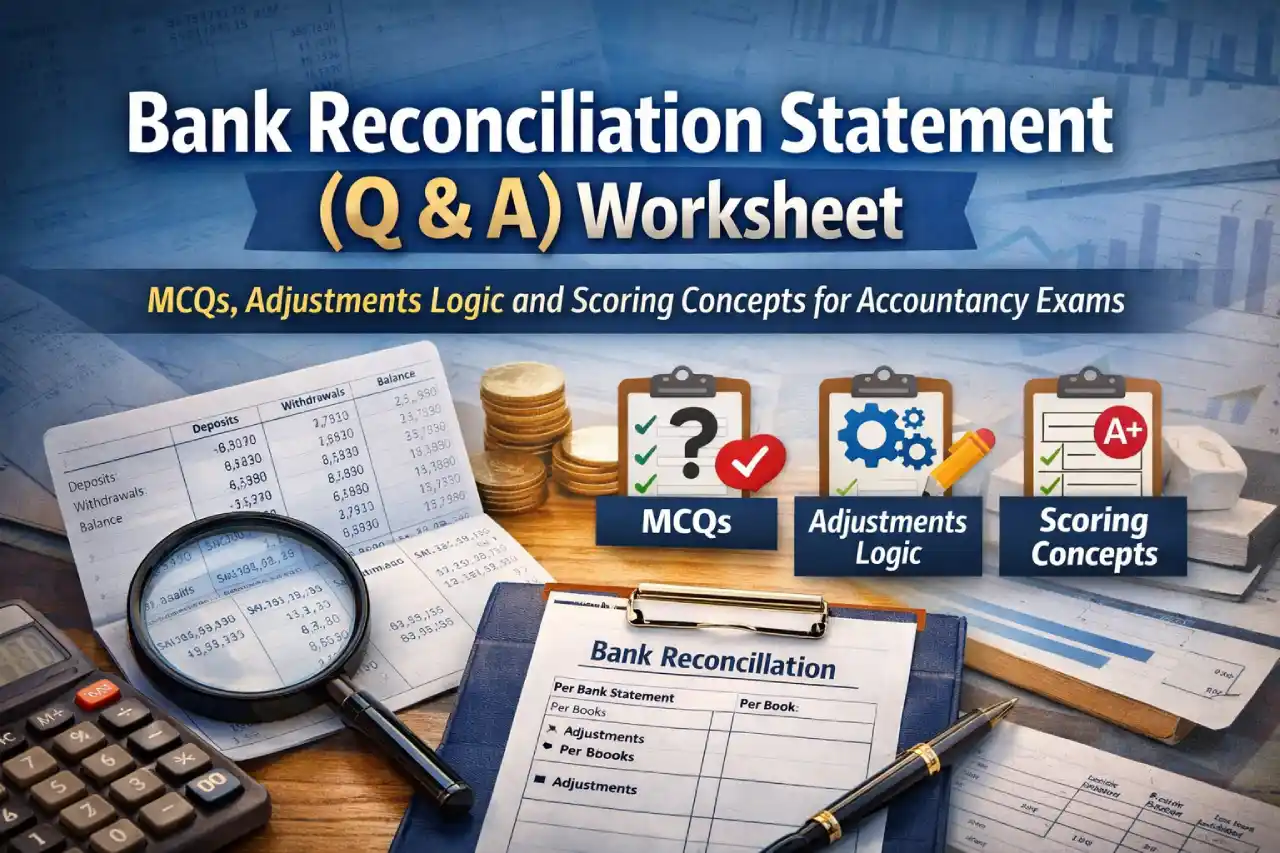
This Bank Reconciliation Statement worksheet with answers is designed mainly for Class 11 and Class 12 Accountancy students preparing for board exams and objective-type assessments. The PDF contains a large set of one-mark MCQs, each followed by clear explanations. The questions cover core areas such as meaning of bank reconciliation, causes of differences between cash book and pass book, favourable and unfavourable balances, overdraft treatment, timing differences, errors by bank and business, and adjustments required while preparing the reconciliation statement. Overall, the worksheet mirrors the exact logic-based MCQs that frequently appear in school examinations.
I am writing about this worksheet because Bank Reconciliation Statement is one of those chapters that looks easy in theory but becomes confusing during exams. Students often mix up additions and deductions, especially when the starting point changes between cash book and pass book. Small conceptual errors can turn an otherwise simple MCQ into a wrong answer. A detailed MCQ worksheet like this helps students practise adjustment logic repeatedly and understand why a particular item is added or deducted, instead of memorising rules blindly.
Structure of the Bank Reconciliation Statement Worksheet
The worksheet contains more than 100 MCQs, each carrying one mark, along with step-by-step explanations. The questions are framed in a repetitive and exam-oriented manner so that students clearly understand patterns.
The difficulty level ranges from easy to moderate, making it ideal for concept building, revision, and last-minute practice.
Meaning and Purpose of Bank Reconciliation Statement
Several MCQs test the basic understanding of the chapter, including:
- Meaning of Bank Reconciliation Statement
- Why it is prepared
- Who prepares it
- Whether it is part of the double entry system
These questions strengthen the theoretical foundation and are often asked directly in exams.
Cash Book and Pass Book Perspective
A large portion of the worksheet focuses on understanding the opposite nature of cash book and pass book, such as:
- Debit balance in cash book meaning credit balance in pass book
- Credit balance in cash book meaning overdraft
- Debit and credit entries from bank’s point of view
These MCQs help students avoid the most common conceptual mistakes.
Causes of Difference Between Cash Book and Pass Book
Many questions revolve around identifying causes of difference, including:
- Cheques issued but not presented
- Cheques deposited but not credited
- Direct deposits by customers
- Bank charges and interest charged by bank
- Dishonour of cheques and bills
These are core exam areas and are tested repeatedly.
Timing Differences vs Errors
The worksheet clearly distinguishes between timing differences and errors, with MCQs based on:
- Transactions recorded earlier in one book
- Errors committed by bank
- Errors committed by business
- Items not considered as timing differences
This helps students answer tricky conceptual MCQs accurately.
Starting Point Logic in Reconciliation
A very strong focus is given to adjustment logic based on the starting point, such as:
- When balance as per cash book is the starting point
- When balance as per pass book is the starting point
- Treatment of cheques, bank charges, interest, and direct deposits
These questions train students to apply logic instead of memorising tables.
Treatment of Cheques
Several MCQs deal specifically with cheque-related adjustments, including:
- Cheques issued but not presented
- Cheques deposited but not cleared
- Cheques recorded wrongly
- Cheques dishonoured
These are among the most frequently asked numerical MCQs.
Bank Charges, Interest and Direct Entries
The worksheet includes many MCQs on items recorded only by the bank, such as:
- Bank charges
- Interest allowed or charged
- Notes collected by bank
- Direct payments by bank
Students learn when these items require adjustment and when they do not.
Download this Bank Reconciliation Statement PDF File: Click Here
Overdraft and Favourable Balance Questions
A good number of questions test understanding of:
- Overdraft as per cash book and pass book
- Meaning of favourable balance
- Debit balance versus credit balance logic
These MCQs are simple but scoring if concepts are clear.
Application-Based and Numerical MCQs
The worksheet also contains practical MCQs where students must:
- Calculate revised balances
- Identify correct adjustment amounts
- Choose the correct reconciliation option
These questions improve speed and accuracy.