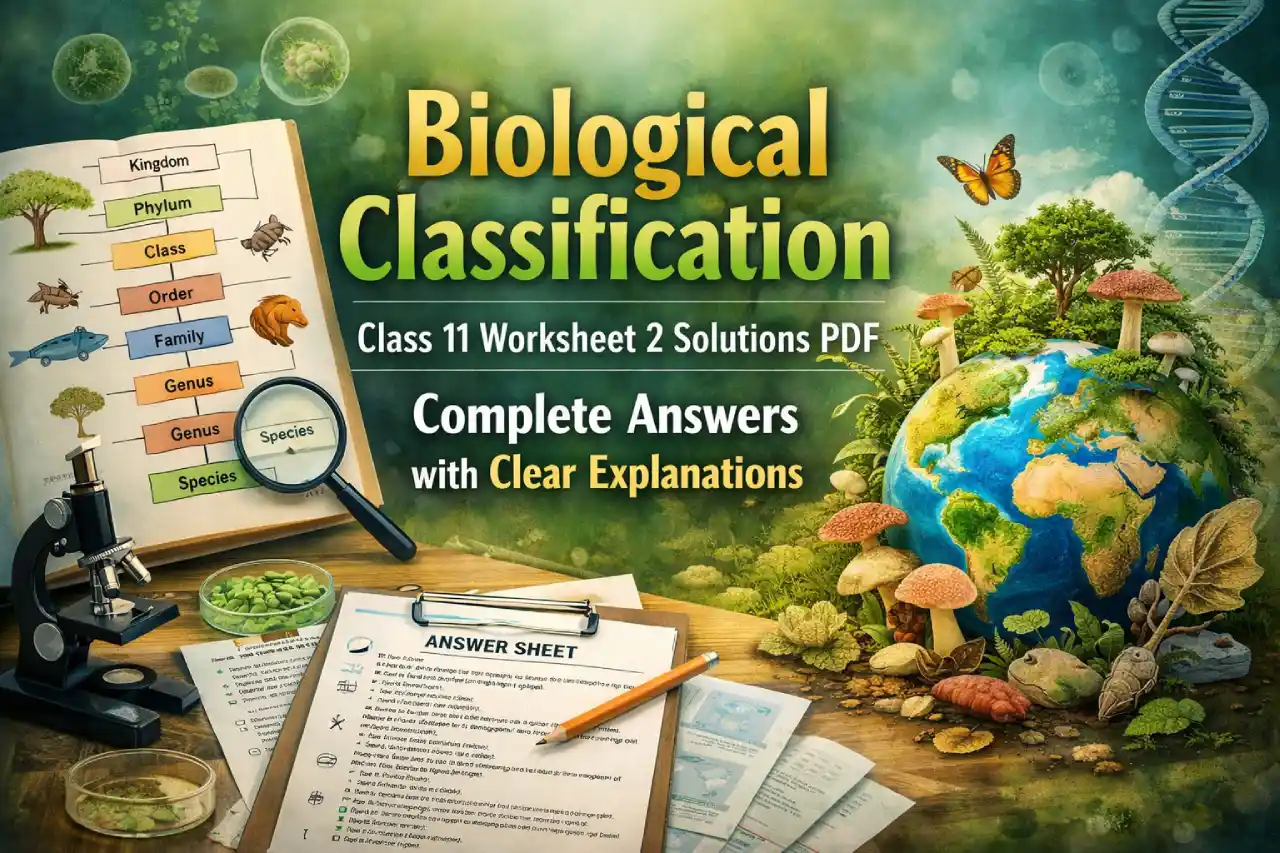
Biological Classification is a foundational chapter in Class 11 Biology that explains how living organisms are grouped based on their structure, organisation, and evolutionary relationships. The uploaded Ch-2 Biological Classification WS 2 SOL PDF is a detailed solutions booklet prepared to help students verify their answers and understand concepts in a simple and logical way. It covers MCQs, assertion–reason questions, short answers, long answers, and case-based questions, all aligned with the NCERT syllabus.
I am writing about this solutions PDF because many students practise worksheets but still remain unsure about the correctness of their responses. A well-structured solution set becomes extremely important at this stage, as it not only provides correct answers but also explains the logic behind them. This helps students strengthen weak areas, revise efficiently, and gain confidence before school exams and competitive tests like NEET.
What the WS 2 Solutions PDF Covers
The PDF is organised into multiple sections, each addressing a specific type of question pattern.
It includes:
- MCQs with explanations
- Assertion–Reason answers
- Very short and short answer solutions
- Long answer explanations
- Case-based and matching-type questions
This ensures complete chapter-level preparation.
Solutions for MCQs (Section A)
The MCQs focus mainly on fungi, plants, and animals.
Some key answers explained in this section include:
- Dikaryotic stage occurs in ascomycetes and basidiomycetes
- Asexual reproduction in fungi takes place by conidia, sporangiospores, or zoospores
- Alternation of generations occurs between gametophyte and sporophyte stages in plants
- Drosera is a partially heterotrophic (insectivorous) plant
- Downy mildew is a fungal disease of plants
- Organisms with haemoglobin in blood are called enaima
Each answer is followed by a short explanation for clarity.
Assertion–Reason Question Solutions
Several assertion–reason questions deal with:
- Phycomycetes and oospore formation
- Karyochorisis (non-mitotic nuclear division in fungi)
- Wilt diseases caused by Fusarium species
- Gibberellins produced by Gibberella fujikuroi
- Metaphyta and photosynthetic organisms
- Parasitic protozoans such as Eimeria and Monocystis
The correct option is given along with reasoning.
Short Answer Solutions
Important short answers explained in the PDF include:
- Saprotrophic basidiomycetes decompose plant matter because they possess enzymes for cellulose and lignin
- Pseudoparenchyma in fungi is formed by closely packed hyphae
- Neurospora is used as a genetic model because it grows fast, is easy to culture, and survives on minimal media
- Mycorrhiza is a mutually beneficial association between fungi and plant roots
- Ringworm, candidiasis, and dandruff are fungal diseases
These answers build conceptual understanding.
Download this Ch -2 Biological classification WS 2 SOL PDF File: Click Here
Long Answer Questions on Fungi
Detailed explanations are provided for:
- Types of ascocarps: cleistothecium, perithecium, and apothecium
- Differences between ascomycetes and basidiomycetes
- Structure of fungal cell (chitin cell wall, lomasomes, chitosomes, glycogen as food reserve)
- Differences between ascocarp and basidiocarp
These are important for theory-based exams.
Algae and Protists Explained
The PDF explains pigments in algae:
- Chlorophyceae – chlorophyll a and b (green)
- Phaeophyceae – chlorophyll a, c and fucoxanthin (brown)
- Rhodophyceae – chlorophyll a, d and phycoerythrin (red)
It also discusses dinoflagellate blooms, red tide, and toxins released by them.
Protozoans and Locomotion
Students can find answers related to:
- Flagellated protozoans such as Trypanosoma
- Locomotory organs: cilia, flagella, pseudopodia
- Ciliates having macronucleus and micronucleus
These topics are frequently asked in NEET.
Commercial Importance of Algae and Fungi
The PDF lists:
- Agar, algin, and carrageenan from algae
- Biofuels and fertilizers from algae
- Penicillin from Penicillium notatum
- Yeast used in fermentation
- Edible mushrooms like Agaricus
This connects theory with real-life applications.
Why This Solutions PDF Is Useful
- Helps in self-assessment
- Saves revision time
- Improves conceptual clarity
- Covers all question formats
- Useful for board and competitive exams