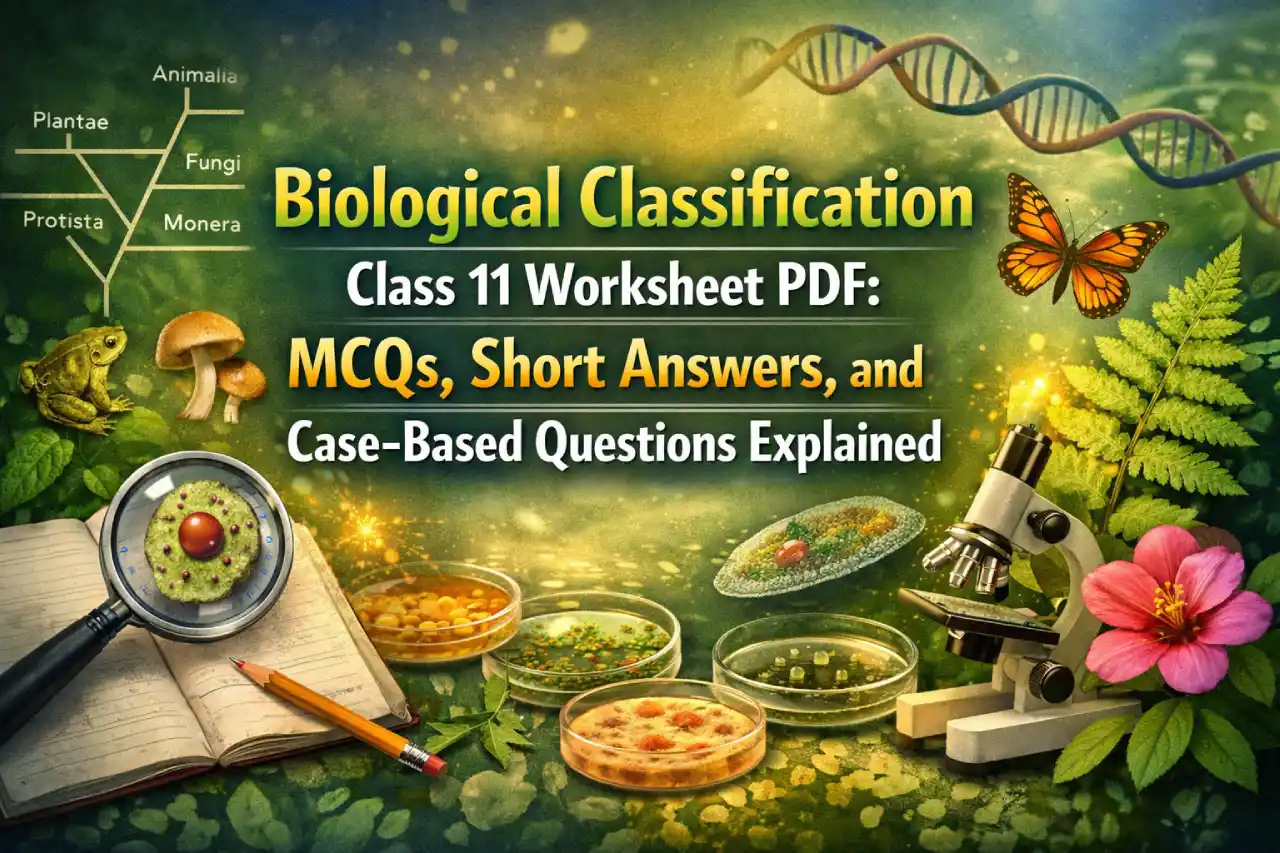
Biological Classification is the second chapter of Class 11 Biology and forms the base for understanding diversity among living organisms. The uploaded Ch-2 Biological Classification WS 1 QUESTIONS PDF is a comprehensive worksheet that contains objective questions, short-answer questions, assertion–reason items, and long answer questions based strictly on the NCERT syllabus. It focuses on different systems of classification, five-kingdom classification, three-domain system, and characteristics of major kingdoms like Monera, Protista, Fungi, Plantae, and Animalia.
I am writing about this worksheet because this chapter is highly conceptual and memory-based. Students often mix up features of different kingdoms and classification systems. A well-designed worksheet like this helps in systematic revision and self-assessment. Knowing what types of questions are included and how they are framed can greatly improve preparation for school exams as well as competitive tests like NEET.
What This Biological Classification Worksheet PDF Contains
The worksheet is divided into multiple sections (A to F), covering all difficulty levels.
It includes:
- Multiple-choice questions
- Assertion–Reason questions
- Very short answer questions
- Short answer questions
- Long answer and case-based questions
This variety helps students practise both theory and application.
Section A – MCQs on Basic Concepts
This section tests fundamental knowledge such as:
- First scientist to classify living beings
- Most acceptable system of classification
- Kingdom in which all prokaryotes are placed
- Five-kingdom classification proposed by R. H. Whittaker
- Blue-green algae also called cyanobacteria
These MCQs strengthen understanding of basic terminology.
Section B and C – Short Answer Questions
These sections include questions like:
- Difference between prokaryotes and eukaryotes
- Difference between bacteria and protozoa
- Criteria used for five-kingdom classification
- Beneficial uses of bacteria
- Role of methanogens
- Mesosomes and their functions
These questions focus on conceptual clarity.
Download this Ch-2 Biological classification WS 1 QUESTIONS PDF File: Click Here
Classification Systems Covered
The worksheet includes questions on:
Two-Kingdom Classification
Proposed by Linnaeus, dividing organisms into Plantae and Animalia.
Drawbacks highlighted include:
- No distinction between prokaryotes and eukaryotes
- Fungi grouped with plants
- Unicellular and multicellular organisms kept together
Three-Kingdom and Four-Kingdom Systems
Questions ask students to compare three-kingdom and four-kingdom classifications and understand why they were inadequate.
Five-Kingdom Classification
Proposed by R. H. Whittaker in 1969.
Based on:
- Cell structure
- Body organisation
- Mode of nutrition
- Reproduction
- Phylogenetic relationships
Three-Domain System
Divides living organisms into Archaea, Bacteria, and Eukarya.
The worksheet asks about features and importance of this system.
Kingdom Monera
Questions focus on:
- Prokaryotic nature
- Cell envelope components
- Types of bacteria (autotrophic and heterotrophic)
- Cyanobacteria and heterocysts
- Mycoplasma
Students are asked to describe structure of bacterial cell and differences between bacteria and algae.
Kingdom Protista
Important features tested include:
- Unicellular eukaryotes
- Presence of both plant-like and animal-like forms
- Examples such as Euglena, Paramecium, Amoeba, Chlamydomonas
Kingdom Fungi
Questions include:
- Heterotrophic mode of nutrition
- Cell wall made of chitin
- Saprophytic and parasitic forms
Assertion–Reason and Case-Based Questions
The worksheet includes assertion–reason questions based on:
- Basis of five-kingdom classification
- Features of plants and protists
- Grouping of organisms under different systems
Case-based questions present short passages on Whittaker’s system and ask related questions.
Why This Worksheet Is Useful
- Covers entire chapter comprehensively
- Includes exam-oriented questions
- Helps in quick revision
- Improves conceptual clarity
- Suitable for self-practice