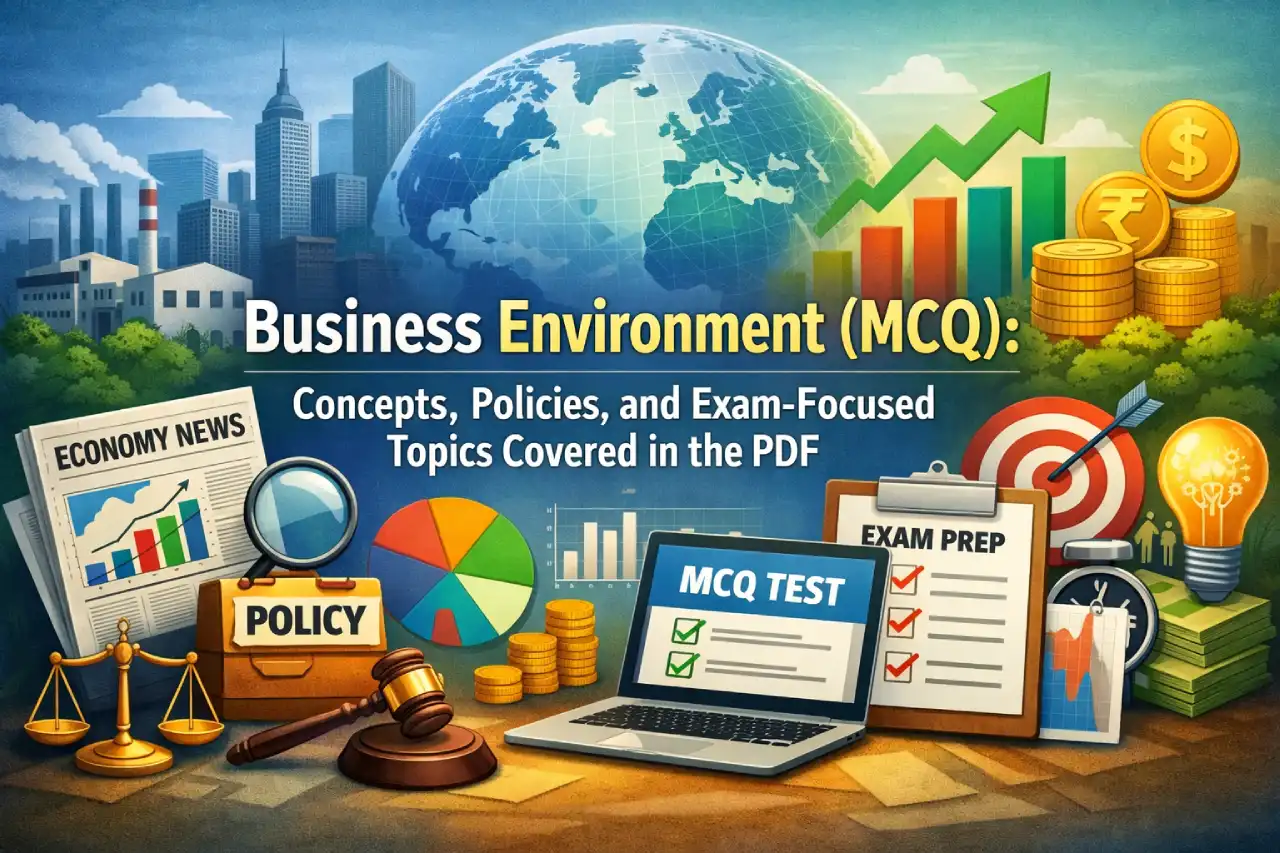
This PDF is a detailed question-based study material on Business Environment from Business Studies. It is structured entirely around objective questions and covers the full scope of the chapter as prescribed in the syllabus. The PDF focuses on the meaning and features of business environment, micro and macro environment, dimensions of business environment, economic reforms, industrial policies, liberalisation, privatisation, globalisation, and the role of government in shaping business decisions. Every topic is tested through multiple-choice questions, making the document highly exam-oriented.
I am writing about this PDF because it clearly reflects what students are actually expected to know for exams. Instead of long explanations, it breaks the chapter into precise concepts and factual points that are repeatedly asked. For anyone preparing for Business Studies exams, understanding exactly what this PDF covers helps in focused preparation and avoids wasting time on topics outside the syllabus. It also helps learners see how business environment concepts are applied to real economic and policy situations in India.
Meaning of Business Environment as Covered in the PDF
The PDF defines business environment as the sum total of all external forces such as institutions, individuals, policies, and conditions that influence business activities. It repeatedly stresses that businesses do not operate in isolation and are constantly affected by changes around them. Several questions test this basic definition directly.
Features and Nature of Business Environment
According to the PDF, business environment has the following characteristics:
- It is dynamic and keeps changing
- It is complex because many factors operate together
- It is uncertain and unpredictable
- It is a relative concept that differs from country to country
- It affects all business enterprises, though in different ways
Questions in the PDF often ask students to identify which option does not characterise the business environment.
Micro and Macro Environment
The PDF clearly divides external business environment into:
- Micro environment, which directly affects an individual firm
- Macro environment, which affects all businesses
Customers are highlighted as the most important element of the micro environment. Several questions test the distinction between specific forces and general forces.
Download this Business Enviroment PDF File: Click Here
Dimensions of Business Environment
A large portion of the PDF focuses on the dimensions of the macro environment.
Economic Environment
Includes economic system, economic policies, inflation, income levels, planning, and economic reforms.
Social Environment
Covers social values, customs, traditions, family structure, education, literacy rates, population trends, and consumer preferences.
Political Environment
Includes political stability, government decisions, elections, policies, and political events affecting business confidence.
Legal Environment
Covers laws, acts, court judgments, statutory warnings, and government regulations such as consumer protection and advertising laws.
Technological Environment
Includes research and development, innovation, automation, digitalisation, ATMs, online services, and changes in production technology.
Global Environment
Refers to integration of the domestic economy with the world economy through trade, investment, and technology.
Liberalisation, Privatisation, and Globalisation
The PDF strongly focuses on LPG policies introduced under the New Economic Policy, 1991.
- Liberalisation refers to reduction of government controls
- Privatisation refers to transfer of ownership or management to private sector
- Globalisation refers to integration of Indian economy with the world economy
Many questions test objectives, benefits, challenges, and policy changes related to LPG.
Industrial Policies and Economic Planning
The PDF includes extensive coverage of:
- Industrial Policy Resolutions of 1948, 1956, and 1991
- New Industrial Policy, 1991
- Public sector reservation
- Industrial licensing and delicensing
- MRTP Act and its replacement by competition law
It also covers Five Year Plans, perspective plans, rolling plans, and planning models like Harrod-Domar and Mahalanobis.
Environment Scanning
Environment scanning is defined in the PDF as the process of analysing the business environment to identify factors affecting business. Tools like PESTLE analysis are included and tested through direct questions.
Importance of Business Environment
According to the PDF, understanding business environment helps businesses:
- Identify opportunities and threats
- Cope with rapid changes
- Improve performance
- Assist in planning and policy formulation
- Gain first mover advantage
Several case-based questions test these benefits.
Internal and External Environment
The PDF clearly distinguishes between:
- Internal environment, including mission, objectives, resources, management structure, and capabilities
- External environment, which is non-controllable and includes micro and macro factors
Questions often ask students to identify which element belongs to which category.