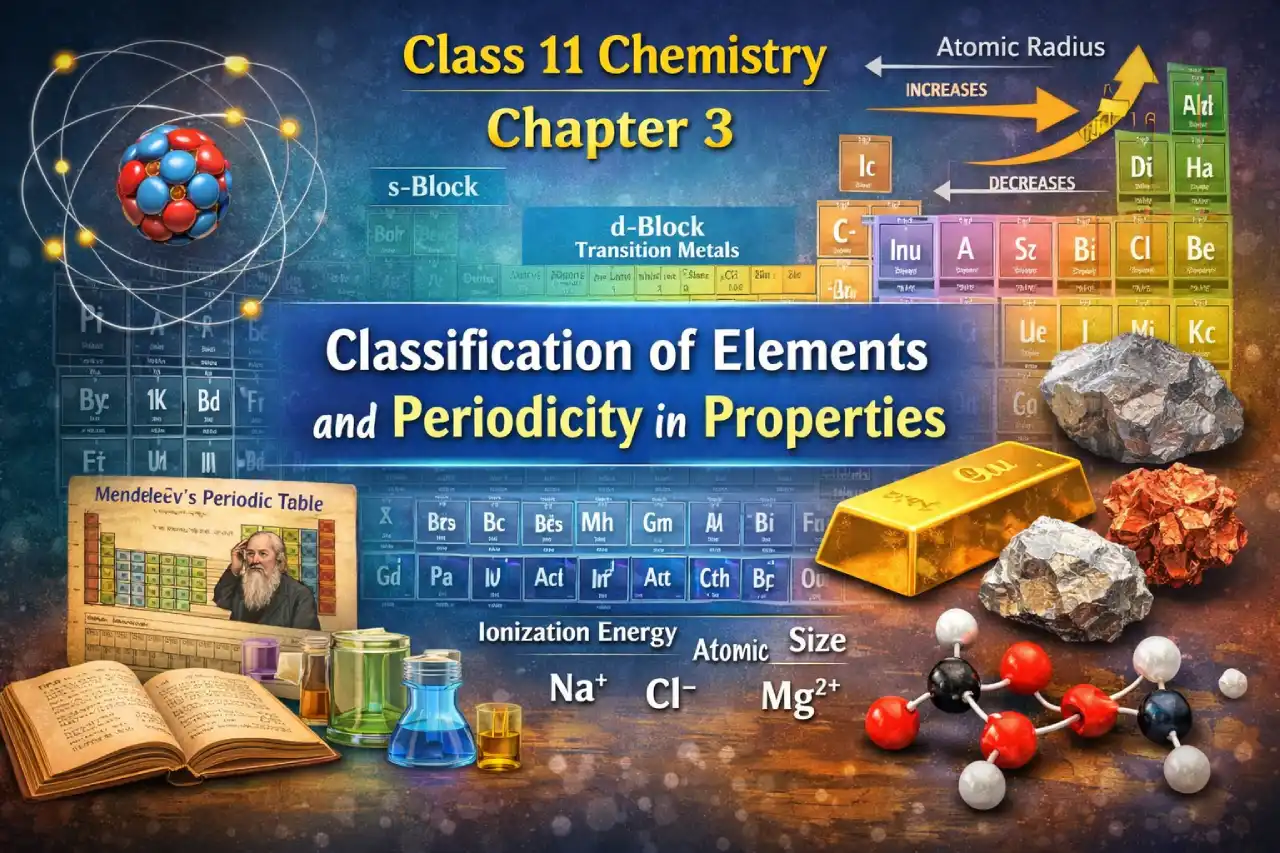
The uploaded PDF contains a well-structured worksheet based on Chapter 3, Classification of Elements and Periodicity in Properties, for Class 11 Chemistry. This worksheet focuses on the historical development of the periodic table, Mendeleev’s periodic law, the modern periodic law, trends in properties, IUPAC nomenclature of elements, and reasoning-based questions. It is designed to help students practise both conceptual and application-based questions in a systematic way.
I am writing about this worksheet because Chapter 3 is one of the most important theory-oriented chapters in Class 11 Chemistry. It explains why elements are arranged in a particular order and how their properties change across periods and groups. A clear understanding of this chapter helps students predict chemical behaviour and perform better in both school exams and competitive tests.
Overview of the Worksheet
According to the uploaded worksheet PDF Ch-3 Classification of elements…, the questions are arranged into multiple sections covering different difficulty levels.
The worksheet includes:
• Section A – Multiple-choice questions
• Section B – Very short answer questions
• Section C – Short answer questions
• Section D – Long answer and reasoning questions
This structure closely matches the CBSE examination pattern.
Mendeleev’s Periodic Table
Many questions in the worksheet focus on Mendeleev’s contribution to the classification of elements.
Key ideas covered include:
• Mendeleev arranged elements in increasing order of atomic mass
• Elements with similar properties were placed in the same vertical column
• Mendeleev left gaps for undiscovered elements
• He predicted properties of eka-aluminium and eka-silicon
Students are also asked to identify which elements later matched these predictions, such as gallium and germanium.
Dobereiner’s Triads
The worksheet tests understanding of Dobereiner’s triads.
Important points include:
• Elements were grouped in threes based on similar properties
• Atomic mass of the middle element is approximately the average of the other two
• Example triads include Li, Na, K and Cl, Br, I
This concept shows early attempts at classification.
Modern Periodic Law
Several MCQs and short answers focus on the modern periodic law.
Key statement:
• The physical and chemical properties of elements are periodic functions of their atomic numbers
This law corrected the limitations of Mendeleev’s atomic mass-based arrangement.
Download this Ch-3 Classification of elements and periodicity in properties PDF File: Click Here
Periods and Groups in the Modern Periodic Table
Students are tested on identification of periods and groups.
Important concepts:
• Horizontal rows are called periods
• Vertical columns are called groups
• Groups are numbered from 1 to 18 as per IUPAC
Questions also ask students to locate elements based on atomic number.
Periodic Trends
The worksheet includes questions on trends such as:
• Atomic radius
• Electropositive and electronegative character
• Valency
• Bond dissociation energy
Understanding these trends helps in predicting behaviour of elements.
IUPAC Nomenclature of New Elements
Several MCQs and short answers test IUPAC naming rules for elements with atomic number greater than 100.
Key points:
• Roots like un, bi, tri, quad, pent, hex, sept, oct, enn, nil are used
• Temporary systematic names and symbols are formed
Students practise identifying atomic numbers from names and vice versa.
Assertion–Reason and True/False Questions
The worksheet includes reasoning-based questions such as:
• Mendeleev’s law based on atomic mass
• Modern periodic law based on atomic number
• Zero group not present in original Mendeleev table
These questions check conceptual clarity.
Long Answer and Descriptive Questions
Students are asked to write about:
• Need for classification of elements
• Main features of Mendeleev’s periodic table
• Drawbacks of Mendeleev’s table
• Advantages of long form periodic table
• Why sixth period contains 32 elements
These questions are important for theory exams.
Why This Worksheet Is Important
From my experience, this worksheet is very useful because:
• It covers the entire chapter comprehensively
• It includes different question formats
• It strengthens theoretical understanding
• It prepares students for board-style questions
Regular practice builds confidence.
How to Use This Worksheet Effectively
• Read the NCERT chapter carefully
• Revise periodic laws and trends
• Solve MCQs first
• Attempt short and long answers next
• Review mistakes and revise weak areas
Consistency is more important than speed.