JOIN WHATSAPP
STORIES

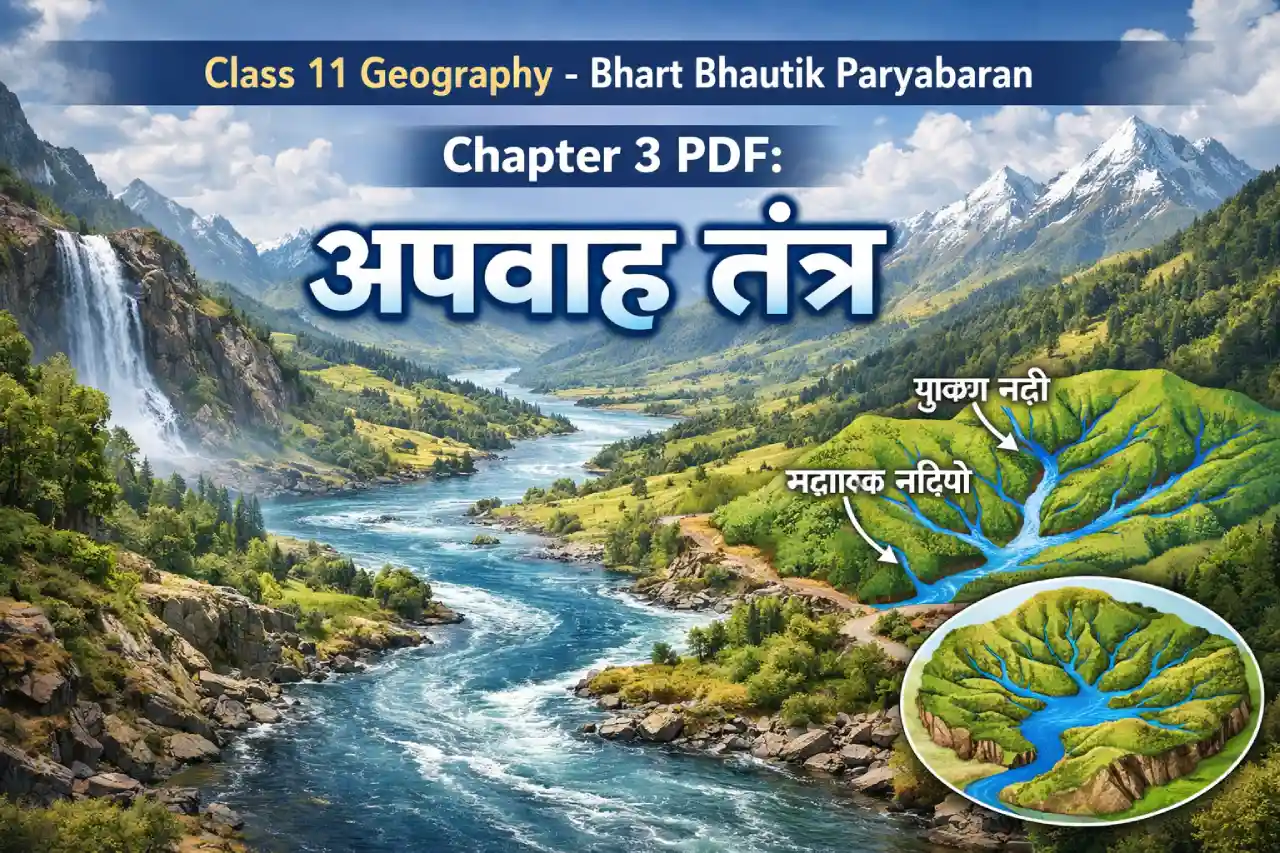
Class 11 Geography – Bhart Bhautik Paryabaran Chapter 3 PDF: अपवाह तंत्र

Class 11 Geography - Bhart Bhautik Paryabaran Chapter 3 PDF: अपवाह तंत्र

NCERT Class 11 Geography, India Physical Environment Chapter 3 अपवाह तंत्र (Drainage System) explains how rivers and their tributaries form networks and shape the landscape of India. The chapter introduces students to different drainage patterns, major river systems, and the factors that control the flow of rivers. It also helps in understanding why certain regions have dense river networks while others have very few streams.

I am writing about this chapter because drainage systems are closely linked to agriculture, settlements, floods, and water availability in India. Many students read this chapter only from an exam point of view, but it actually explains everyday realities like why some areas face frequent flooding and why others depend heavily on groundwater. Knowing these concepts not only improves exam performance but also builds a better understanding of India’s physical geography.

What This Chapter Covers

Chapter 3 focuses on the concept of drainage and river systems.

  • Meaning of drainage basin and watershed
  • Major drainage patterns
  • Himalayan river systems
  • Peninsular river systems
  • Factors affecting drainage

Meaning of Drainage System

A drainage system refers to the network of rivers and streams in a particular area.

  • Drainage basin – Area drained by a river and its tributaries
  • Watershed – High land separating two drainage basins

These terms are often asked in short-answer questions.

Major Drainage Patterns

Different patterns develop due to relief, slope, and rock structure.

  • Dendritic pattern
  • Trellis pattern
  • Rectangular pattern
  • Radial pattern

Understanding these patterns helps in identifying landforms.

Himalayan River Systems

The Himalayan rivers are long and perennial.

  • Indus River system
  • Ganga River system
  • Brahmaputra River system

These rivers receive water from glaciers and rainfall.

Peninsular River Systems

Most Peninsular rivers are seasonal.

  • Narmada
  • Tapi
  • Godavari
  • Krishna
  • Kaveri

They mainly depend on monsoon rainfall.

Why This Chapter Is Important for Students

  • Forms base for Indian physical geography
  • Useful for map work
  • Important for board and competitive exams
  • Helps understand water resources

How to Download NCERT Class 11 Geography Chapter 3 PDF

Students can download the official chapter PDF from the NCERT website by following these steps:

Always use the official source to ensure accuracy.

Leave a Comment

End of Article

Class 11 Sanskrit Shashwati Chapter 11 PDF: नवद्रव्याणि Explained

Class 11 Sanskrit Shashwati Chapter 11 PDF: नवद्रव्याणि Explained

NCERT Class 11 Sanskrit Shashwati Chapter 11, titled “नवद्रव्याणि”, introduces students to an important concept from Indian philosophy—the nine fundamental substances that make up the universe. The chapter explains these elements in a simple and structured way, helping students understand how ancient thinkers tried to explain the nature of reality through observation and logic.

I am writing about this chapter because many students search for the official NCERT PDF along with a simple explanation before exams. In my experience, topics like “नवद्रव्याणि” may feel slightly abstract at first, but once you understand the list and their meanings, it becomes quite easy to remember and revise. This chapter is important not only for Sanskrit exams but also for gaining a basic idea of traditional Indian philosophy. It helps students connect language learning with deeper concepts. Studying from the official NCERT book and revising regularly can make this chapter scoring and easy to handle.

About the Chapter: नवद्रव्याणि

The term “नवद्रव्याणि” means “nine substances.” These are considered the basic elements that exist in the universe according to classical Indian thought.

The chapter explains each of these substances and their role in the functioning of the world.

The Nine Substances Explained

Here is a simple table to understand the nine dravyas:

Sanskrit TermMeaning (Simple English)
पृथ्वी (Prithvi)Earth
आपः (Apah)Water
तेजः (Tejas)Fire
वायु (Vayu)Air
आकाश (Akasha)Space
काल (Kala)Time
दिशा (Disha)Direction
आत्मा (Atma)Soul
मनः (Manas)Mind

These elements together explain the physical and non-physical aspects of existence.

Key Ideas in the Chapter

1. Understanding the Universe

The chapter explains how everything in the world is made up of basic substances.

2. Physical and Non-Physical Elements

Some substances like earth and water are physical, while others like time and soul are abstract.

3. Connection Between Mind and Body

The inclusion of “मनः” (mind) and “आत्मा” (soul) shows the importance of inner consciousness.

Why This Chapter Is Important for Students

  • Helps understand basic philosophical concepts
  • Improves Sanskrit reading and comprehension
  • Important for exam questions and explanations
  • Builds logical and conceptual thinking

Students who understand the list properly can easily score marks.

Study Tips for Chapter 11

  • Memorise the nine dravyas and their meanings
  • Understand the difference between physical and abstract elements
  • Practise writing short explanations
  • Revise regularly using a table format

This makes the chapter easier to revise before exams.

How to Download NCERT Class 11 Sanskrit Shashwati Chapter 11 PDF

Students can download the official chapter PDF from the National Council of Educational Research and Training website by following these steps:

Always use the official NCERT website to ensure you get the correct and updated version.

Leave a Comment

End of Article

Loading more posts...