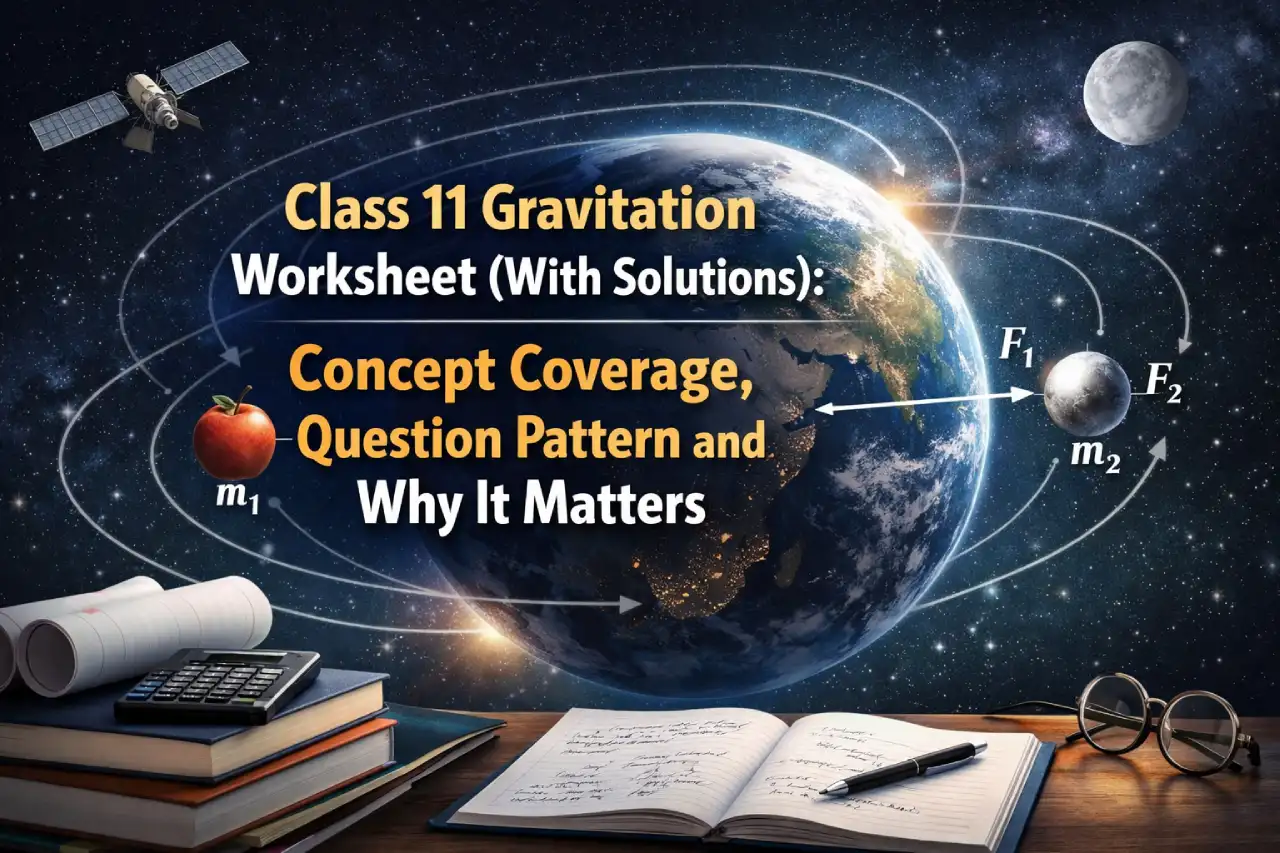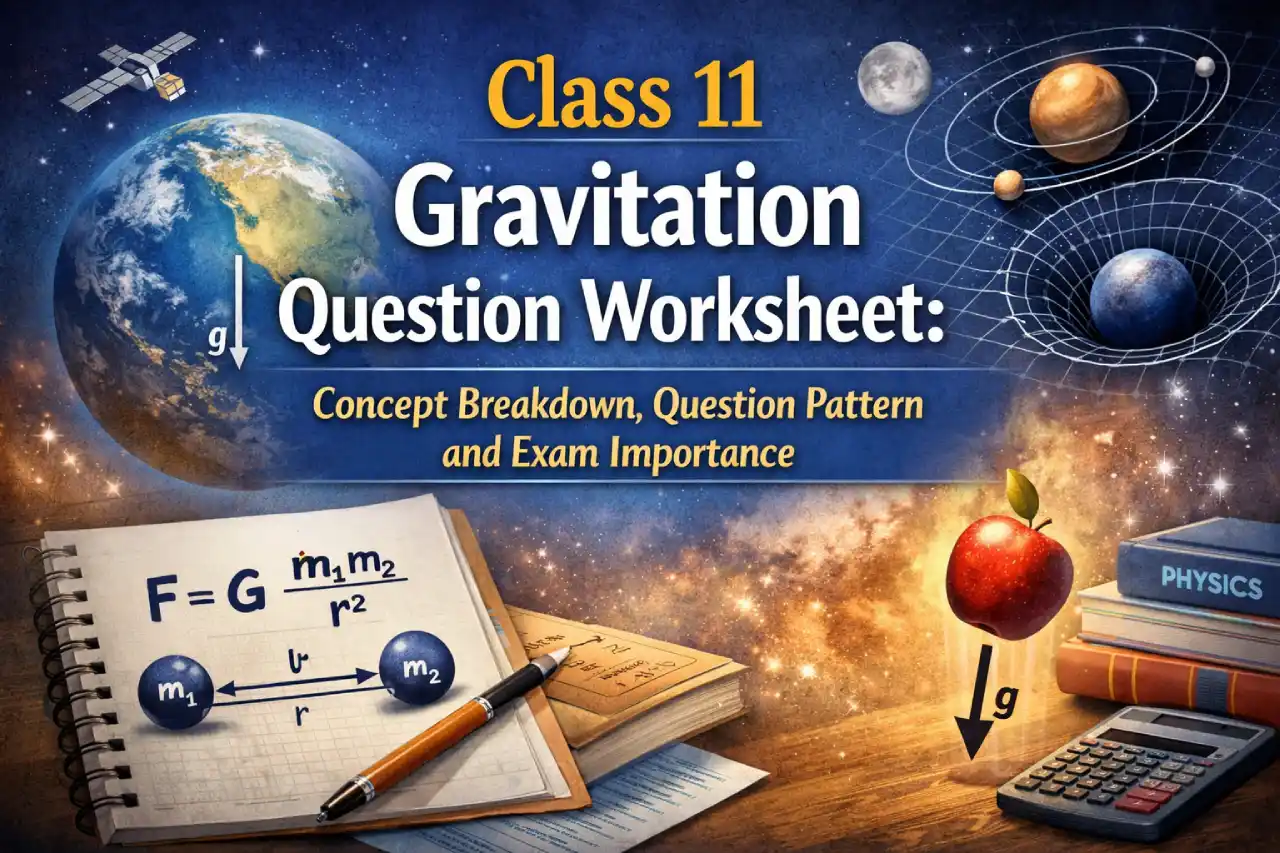
This physics worksheet on Gravitation, prepared for Class 11 CBSE students, is mainly designed for board exam preparation and conceptual strengthening. It contains 75 multiple-choice questions covering Newton’s law of gravitation, acceleration due to gravity, escape velocity, orbital motion, satellites, Kepler’s laws, gravitational potential energy, and real-life applications involving planets, moons, asteroids, and spacecraft. The questions are clearly framed from NCERT concepts and reflect the analytical and formula-based MCQs students regularly face in school exams Gravitation WS 1.
I am writing about this worksheet because Gravitation is one chapter where students often struggle to connect formulas with physical meaning. Small misunderstandings related to radius, mass, height, depth, or orbital motion can easily lead to wrong answers. A well-structured worksheet like this helps bridge the gap between theory and numerical application. By carefully analysing the questions, students can identify which gravitation formulas are frequently tested and how conceptual clarity directly translates into marks.
Structure of the Gravitation Worksheet
The worksheet consists of 75 MCQs, with each question carrying one mark. The questions range from direct formula-based problems to conceptual reasoning and application-oriented situations. While many questions appear numerical, most of them test understanding of proportionality, dependence on radius or mass, and physical interpretation rather than lengthy calculations.
The overall difficulty level ranges from moderate to challenging, making it suitable for revision as well as concept reinforcement.
Newton’s Law of Gravitation and Basic Concepts
Several questions focus on Newton’s law of gravitation and its consequences. Students are tested on:
- Dependence of gravitational force on mass and distance
- Comparison of gravitational force in different media
- Gravitational interaction between planets, satellites, and rings
- Identification of smallest gravitational force between given systems
These questions strengthen the idea that gravitation is universal and independent of the surrounding medium Gravitation WS 1.
Acceleration Due to Gravity and Its Variations
A large portion of the worksheet deals with acceleration due to gravity. Questions cover variations of g:
- At height above the earth’s surface
- At depth below the earth’s surface
- Due to change in earth’s radius or mass
- At poles and equator
- On other planets and moons
Such questions are important because they require students to apply proportional reasoning rather than memorising values.
Escape Velocity and Orbital Velocity
Escape velocity is one of the most frequently tested topics in this worksheet. Students encounter questions based on:
- Escape velocity of earth and other planets
- Effect of change in radius and mass on escape velocity
- Escape velocity from different heights
- Motion of objects projected with speed greater than escape velocity
Orbital velocity questions test understanding of satellites moving close to the earth’s surface and at higher orbits.
Download this Gravitation PDF File: Click Here
Motion of Satellites and Circular Orbits
The worksheet includes several MCQs related to satellites revolving around earth. Key areas tested include:
- Time period of satellites
- Dependence of orbital speed on radius
- Effect of change in orbital radius on time period
- Energy of satellites in circular or elliptical orbits
These questions help students connect gravitation with circular motion and energy concepts.
Gravitational Potential Energy and Mechanical Energy
Many questions test gravitational potential energy in different situations, such as:
- Raising a body to a certain height
- Energy of satellites in orbit
- Total mechanical energy of earth satellites
- Work required to shift satellites between orbits
Understanding these questions is crucial because they combine gravitation with energy conservation.
Kepler’s Laws and Planetary Motion
Kepler’s laws form another important section of the worksheet. Students are tested on:
- Law of areas and angular momentum
- Relation between time period and orbital radius
- Motion of planets and comets in elliptical orbits
- Comparison of orbital parameters of different planets
These questions emphasise conceptual understanding rather than direct substitution.
Application-Based and Real-World Problems
The worksheet also includes applied physics questions involving:
- Astronauts jumping on moon
- Gravitational field on asteroids
- Cavendish experiment
- Behaviour of satellites if gravitational force disappears
- Nature of black holes
Such questions show how gravitation extends beyond textbook theory into real-world physics.
What Students Can Learn from This Worksheet
From analysing this worksheet, a few clear takeaways emerge:
- NCERT formulas form the base of almost all questions
- Understanding proportional relationships is crucial
- Escape velocity and satellite motion are high-weight topics
- Conceptual clarity reduces calculation errors
- Regular MCQ practice improves confidence and speed
Overall, this Class 11 Gravitation worksheet is a strong practice resource that closely matches CBSE exam expectations. It helps students build a solid conceptual foundation and prepares them for more advanced physics topics in Class 12.