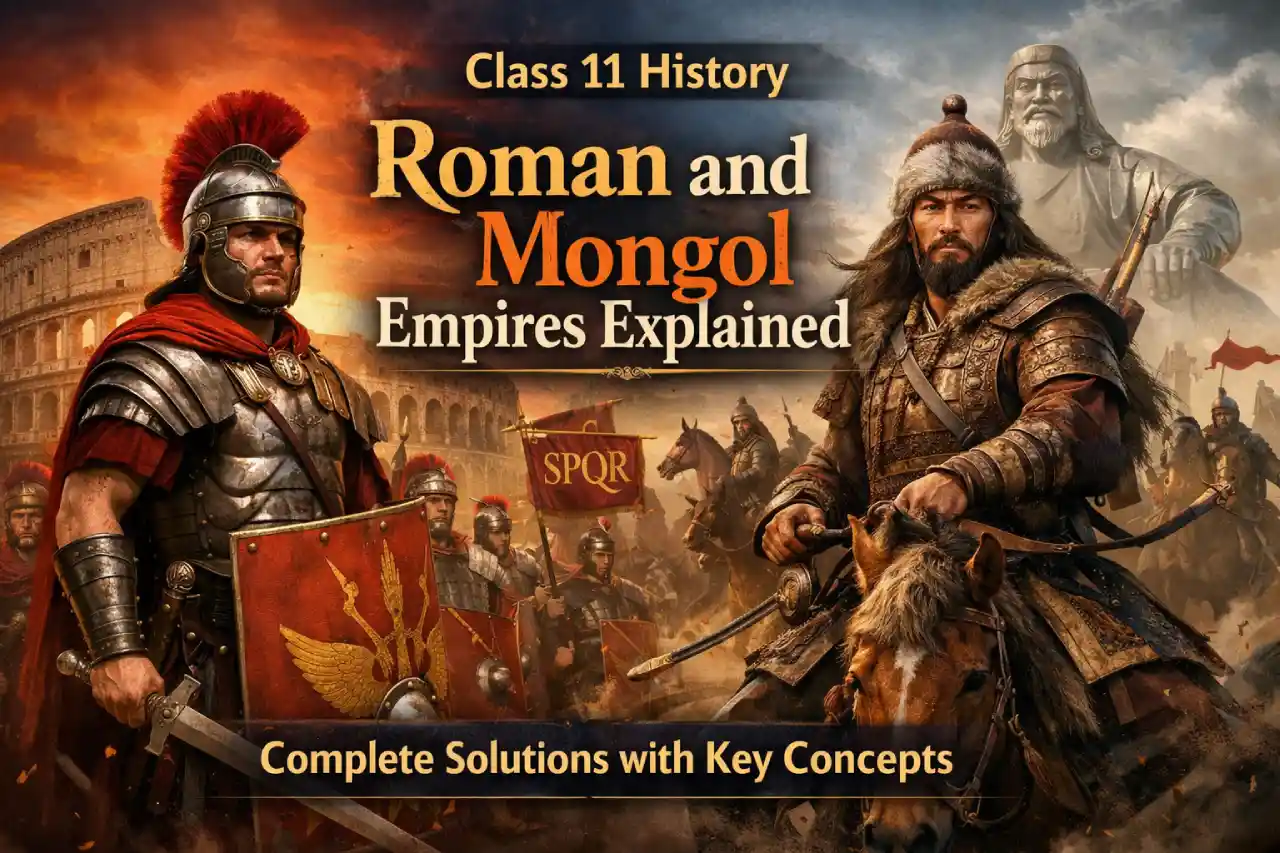
The Class 11 History chapter that covers the Roman Empire and the Mongol Empire is one of the most detailed and concept-heavy portions of the syllabus. It explains how Rome expanded across three continents and how the Mongols, under Genghis Khan, built one of the largest land empires in history. The material analysed here includes solved MCQs, assertion-reason questions, map work and source-based answers that clarify key themes such as Pax Romana, Roman law, slavery, Yasa, Mongol expansion and administrative reforms.
I am writing about this because many students find this chapter overwhelming. There are multiple rulers, unfamiliar terms and a long timeline stretching from ancient Rome to the Mongol conquests. But when the content is organised into political, economic, religious and military themes, it becomes much easier to understand. This structured set of questions and explanations works as a powerful revision tool and helps students prepare confidently for exams.
Roman Empire: Power Across Three Continents
The Roman Empire is described as an empire across three continents because it stretched over Europe, North Africa and West Asia. Its boundaries were marked by natural features such as the Rhine and Danube rivers in the north, the Sahara Desert in the south and the Euphrates in the east.
One of the most important phases in Roman history was Pax Romana, meaning “Roman Peace.” This period began under Augustus and brought political stability after years of civil war. Augustus established the Principate and took the title Princeps, meaning “leading citizen.” Although Rome had earlier been a republic, real authority gradually shifted to the emperor after 27 BCE.
Understanding this political transition is crucial for exam answers.
Roman Administration and Law
Roman administration was highly organised. Over time, provincial elites became powerful and formed a new ruling class. The army was one of the strongest institutions, and emperors depended heavily on military support.
By the fourth century, Roman law had developed into a strong legal system. Even emperors were not completely above the law. This legal tradition acted as a brake on absolute power and is considered one of Rome’s greatest contributions to world civilisation.
Economy and Slavery in Rome
The Roman economy depended largely on agriculture, taxation and trade. Wealthy households earned income from large estates. Gold became increasingly important in the later period when silver supplies declined.
Slavery was deeply embedded in Roman society. However, slaves were treated as economic investments. Maintaining them throughout the year was expensive, which is why free wage labour was often preferred for public works. This shift shows that Roman economic decisions were guided by practicality rather than moral considerations.
Roman society was divided into different social groups such as senators, equites, middle classes and lower classes. Slaves formed the lowest and most exploited section.
Religion and Cultural Change
Originally, Roman religion was polytheistic, with gods like Jupiter, Juno and Mars being worshipped in temples across the empire. Over time, Christianity spread and eventually became dominant.
Christian bishops played a major role in shaping religious discipline and challenging imperial authority. The period known as Late Antiquity marked significant changes in religion, administration and social life, eventually leading to the fragmentation of the western empire.
Rise of the Mongol Empire
The second major theme deals with the Mongol Empire. Genghis Khan, originally named Temujin, was born in 1162 in present-day Mongolia. In 1206, he was proclaimed supreme ruler at an assembly of Mongol chiefs.
He built a disciplined military force and introduced the Yasa, a legal code that symbolised authority and unity among the Mongols. His leadership transformed scattered nomadic tribes into a powerful empire.
Mongol Expansion and Warfare
Mongol campaigns were known for their speed and brutality. Cities such as Bukhara, Nishapur and Herat faced large-scale destruction during invasions. Persian chroniclers described enormous casualties, although historians believe some numbers may have been exaggerated.
Genghis Khan justified his actions as divine punishment for the sins of the conquered people. This psychological warfare added to the fear surrounding Mongol expansion.
Download this An Empire Three Continents and Nomadic Empires WS PDF File: Click Here
Ghazan Khan and Administrative Adaptation
Later Mongol rulers, such as Ghazan Khan, introduced reforms. He converted to Islam and emphasised the protection of obedient peasants while punishing rebels. This shows how Mongol rulers gradually shifted from plunder to structured governance in settled regions.
Nomads and Trade Relations
The Mongols and other Central Asian nomads traded with China because the steppe region had limited resources. Horses and animal products were exchanged for agricultural goods and iron tools. This trade relationship was mutually beneficial but could turn hostile during times of political instability.
Importance of Map Work and Source-Based Questions
Map-based questions focus on marking important cities and regions related to both empires. Source-based questions test analytical skills by asking students to interpret historical passages.
Practising these regularly improves answer-writing ability and strengthens conceptual clarity.
Why This Chapter Matters
From my experience, this chapter is not just about memorising names and dates. It explains:
- How empires are formed and governed
- How economies adapt to changing resources
- How religion influences politics
- How nomadic and settled societies interact
When students understand these themes, the chapter becomes far more interesting