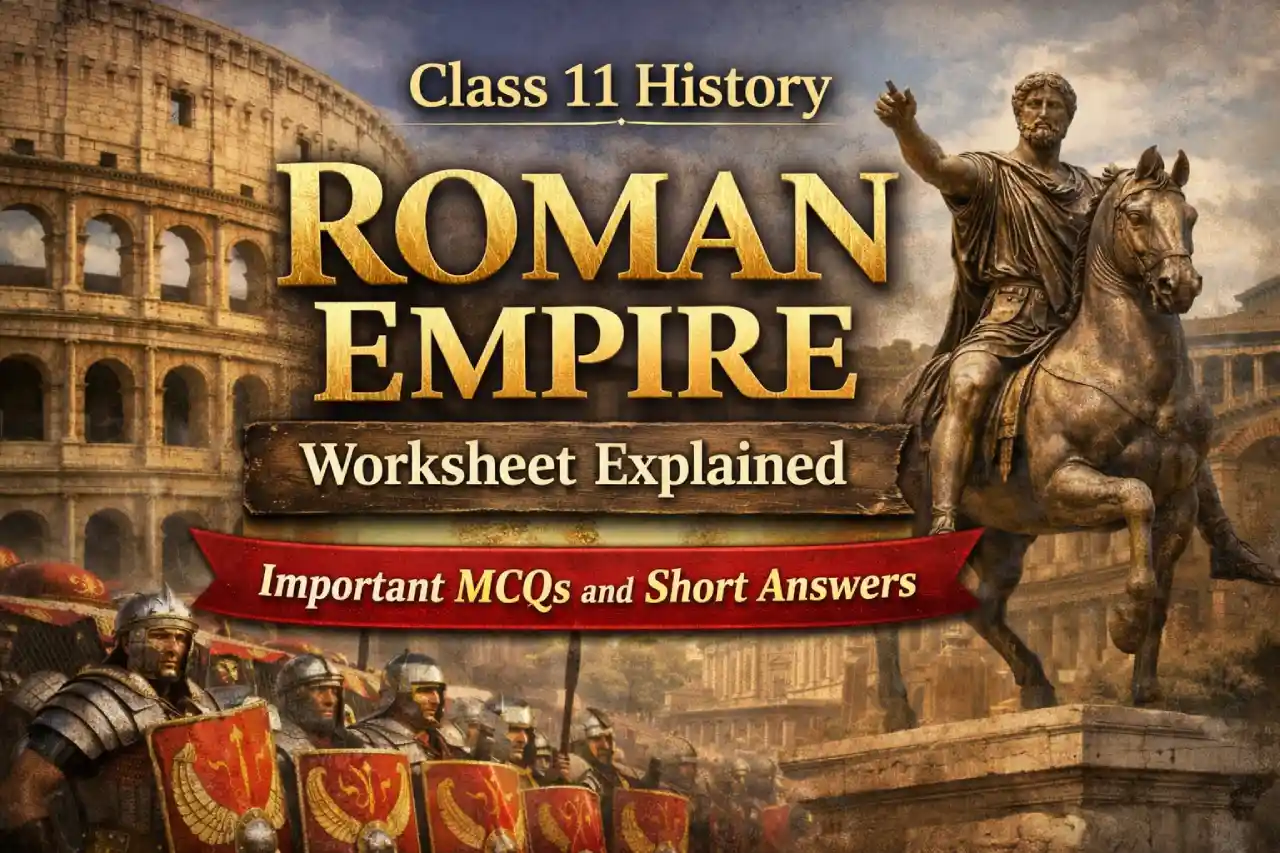
The Roman Empire chapter in Class 11 History explains how a powerful state expanded across three continents and shaped politics, economy and religion for centuries. The worksheet based on this chapter includes multiple-choice questions, one-mark answers and concept-based queries covering topics like Pax Romana, Augustus, Constantine, Roman army, slavery, taxation, Christianity and Late Antiquity. It is designed to test both factual knowledge and conceptual clarity in a structured way.
I am writing about this because many students find the Roman Empire chapter lengthy and confusing. There are too many emperors, reforms, military terms and dates to remember. But when we break the content into themes like administration, economy, religion and society, everything starts making sense. This set of questions works as a smart revision tool. If students practise it properly, they can easily improve their confidence and score better in exams.
Pax Romana and the Rise of Augustus
One of the most important terms students must understand is Pax Romana, which means “Roman Peace.” It refers to the long period of stability that began under Augustus after years of civil war.
Augustus was originally Octavian and was given the title Princeps, meaning “first citizen.” The political system he created is known as the Principate. Rome remained a Republic until 27 BCE, after which imperial rule began. The Battle of Actium in 31 BCE played a major role in establishing his authority.
These are not just dates to memorise. They mark the transformation of Rome from a republic to a powerful empire.
Expansion Across Three Continents
The Roman Empire stretched across:
- Europe
- North Africa
- West Asia
This is why it is described as an empire across three continents. It controlled large parts of the Mediterranean world.
Important geographical boundaries included:
- The Rhine and Danube rivers in the north
- The Euphrates as a boundary with Iran
- The Mediterranean Sea separating Europe and Africa
Map-based understanding is very important here. Students should always visualise these boundaries.
Roman Administration and Army
The Roman political system included consuls who were elected for a fixed term. Over time, the emperor became the central authority.
Important features of the Roman army included:
- A professional standing army
- Fixed years of military service
- The Praetorian Guard, which protected the emperor
Augustus introduced major military reforms that strengthened central control and ensured loyalty of soldiers.
A strong army was the backbone of Roman expansion.
Download this PDF File: Click Here
Economy, Trade and Currency
The Roman economy depended heavily on agriculture, trade and slave labour.
Some important economic features include:
- Use of the denarius, a silver coin
- Trade in wine and olive oil
- Amphorae used as containers for transporting goods
- Spanish olive oil transported in special containers
Land was a major source of wealth, especially for the elite classes. Taxation also played a key role in maintaining the empire.
One important point students must remember is why slave labour was expensive. Slaves had to be maintained throughout the year, while hired labour could be employed only when required. That made free labour more economical in certain cases.
Religion and Cultural Changes
Religion in Rome went through major transformation.
Key developments include:
- Worship of Roman gods like Jupiter
- Spread of Christianity
- Christianity becoming the state religion in the fourth century
- Rise of Islam in the seventh century
Saint Augustine, a bishop in North Africa, became one of the most influential Christian thinkers of late antiquity.
The shift from polytheism to Christianity was gradual and complex. It did not happen overnight.
Social Structure and Everyday Life
Roman society was divided into different groups:
- Senators and elite classes
- Middle classes connected to administration and trade
- Workers and labourers
- Slaves
Workers in the Roman Empire were often strictly supervised. Employers believed that without supervision, work would not be done properly.
Women in Roman society had varying levels of independence depending on class and family background. Some women managed property and finances, showing signs of limited autonomy.
Late Antiquity and Decline
The term Late Antiquity refers to the period between the fourth and seventh centuries. This was a time of transformation.
Major developments during this period included:
- Administrative changes
- Economic restructuring
- Religious transformation
- Fragmentation of the western empire
Germanic groups like the Goths and Lombards eventually contributed to the collapse of Roman authority in the west.
This period marked the transition from the ancient world to the medieval world.
Important Concepts Students Must Revise
Students should clearly understand the meaning of:
- Republic
- Civil war
- Princeps
- Principate
- Transhumance
- Late Antiquity
These short definitions are often asked as one-mark questions.
How to Prepare Smartly
From my experience, the best way to revise this chapter is:
- Make a timeline of major events
- Revise important emperors and their reforms
- Practise map work
- Write one-line definitions daily
- Solve MCQs without guessing
If students understand the logic behind events instead of memorising blindly, this chapter becomes much easier.