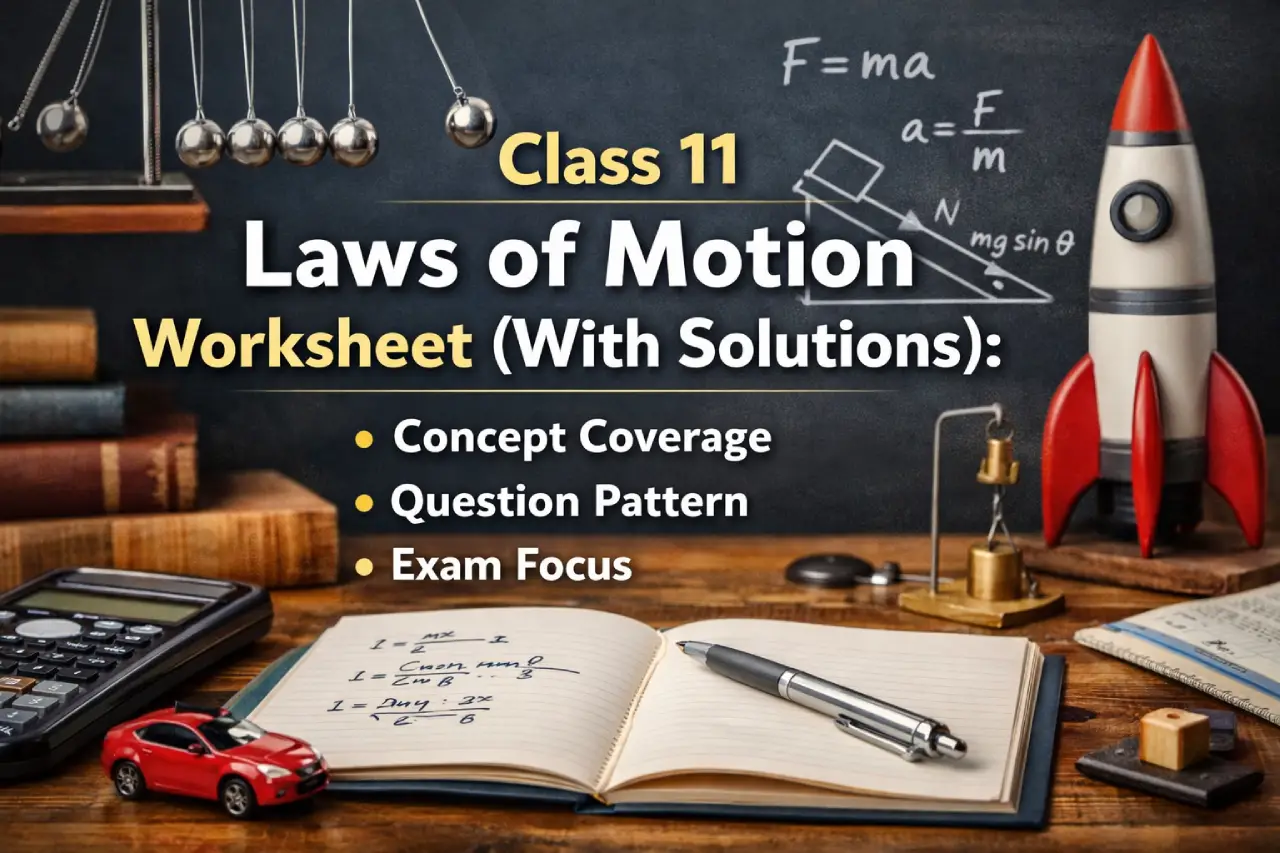
This physics worksheet on Laws of Motion, prepared for Class 11 CBSE students, is designed mainly for board exam preparation and concept strengthening. It contains 75 multiple-choice questions covering Newton’s first, second and third laws of motion, momentum, impulse, friction, circular motion, lift and elevator problems, rockets, banking of roads, and real-life force applications. The questions are framed directly from NCERT concepts and reflect the type of numerical and conceptual MCQs commonly asked in school examinations Laws of Motion WS 1.
I am writing about this worksheet because Laws of Motion is one chapter where students often understand formulas but struggle with application. Mistakes usually happen in identifying forces, directions, free-body diagrams, or interpreting real-life situations like lifts, cars, and circular motion. A worksheet like this helps convert textbook theory into exam-oriented thinking. By analysing the questions closely, students can clearly see how basic laws are tested through different situations and how clarity in concepts directly improves scores.
Structure of the Laws of Motion Worksheet
The worksheet consists of 75 MCQs, with each question carrying one mark. The questions range from simple definition-based problems to multi-concept numerical questions. Many problems look lengthy, but most can be solved quickly if the underlying concept is clear.
The overall difficulty level ranges from moderate to high, making it suitable for revision as well as strengthening weak areas.
Newton’s Laws and Momentum-Based Questions
A large number of questions are based on Newton’s three laws of motion. Students are tested on:
- Definition and vector nature of momentum
- Applications of Newton’s first law in everyday situations
- Second law as a vector equation
- Conservation of momentum in recoil and explosion problems
These questions help students understand that laws of motion are not just statements but tools to analyse motion in real situations Laws of Motion WS 1.
Force Analysis and Free-Body Concepts
Several MCQs focus on identifying correct forces acting on bodies. Questions include:
- Forces acting on vehicles, planks, and ladders
- Internal and external forces
- Net force direction and magnitude
- Equilibrium conditions
Such problems test whether students can visualise forces correctly, which is essential for solving numerical questions accurately.
Friction and Its Applications
Friction-related questions form a major part of the worksheet. Topics covered include:
- Static and kinetic friction
- Limiting friction
- Motion on inclined planes
- Friction in lifts, vehicles, and blocks
These questions show how friction plays a role in both starting motion and stopping moving objects, a key NCERT concept.
Download this Laws of Motion PDF File: Click Here
Circular Motion and Centripetal Force
The worksheet includes multiple questions based on circular motion, such as:
- Centripetal acceleration and force
- Vehicles taking turns on curved roads
- Banking of roads
- Motion of objects tied to strings
These problems require proper understanding of direction of acceleration and force rather than memorisation of formulas.
Lift, Elevator and Apparent Weight Problems
Several MCQs deal with lift and elevator motion. Students are tested on:
- Apparent weight during upward and downward motion
- Motion with uniform speed and acceleration
- Special cases like free fall
These questions are common in exams and require careful sign conventions.
Impulse, Rocket Motion and Conservation Laws
Impulse and momentum-change problems appear frequently in the worksheet. Topics include:
- Impulse during collision
- Force acting for a short time
- Rocket propulsion
- Conservation of momentum in multiple-particle systems
These questions help students connect theory with practical physics applications.
Real-Life and Conceptual Reasoning Questions
The worksheet also includes conceptual questions such as:
- Motion without force
- Inertial frames of reference
- Motion of people in lifts or vehicles
- Effect of sudden loss of gravitational force
These questions test understanding rather than calculation, making them scoring if concepts are clear.
What Students Can Learn from This Worksheet
From analysing this worksheet, a few key points stand out:
- Clear free-body diagrams reduce mistakes
- Direction of force and acceleration is crucial
- Laws of motion are applied across many situations
- Friction and circular motion are high-weight areas
- Regular MCQ practice improves speed and confidence
Overall, this Class 11 Laws of Motion worksheet is a strong practice resource that closely follows the CBSE syllabus. It helps students develop conceptual clarity, numerical accuracy, and confidence, all of which are essential for performing well in physics examinations.