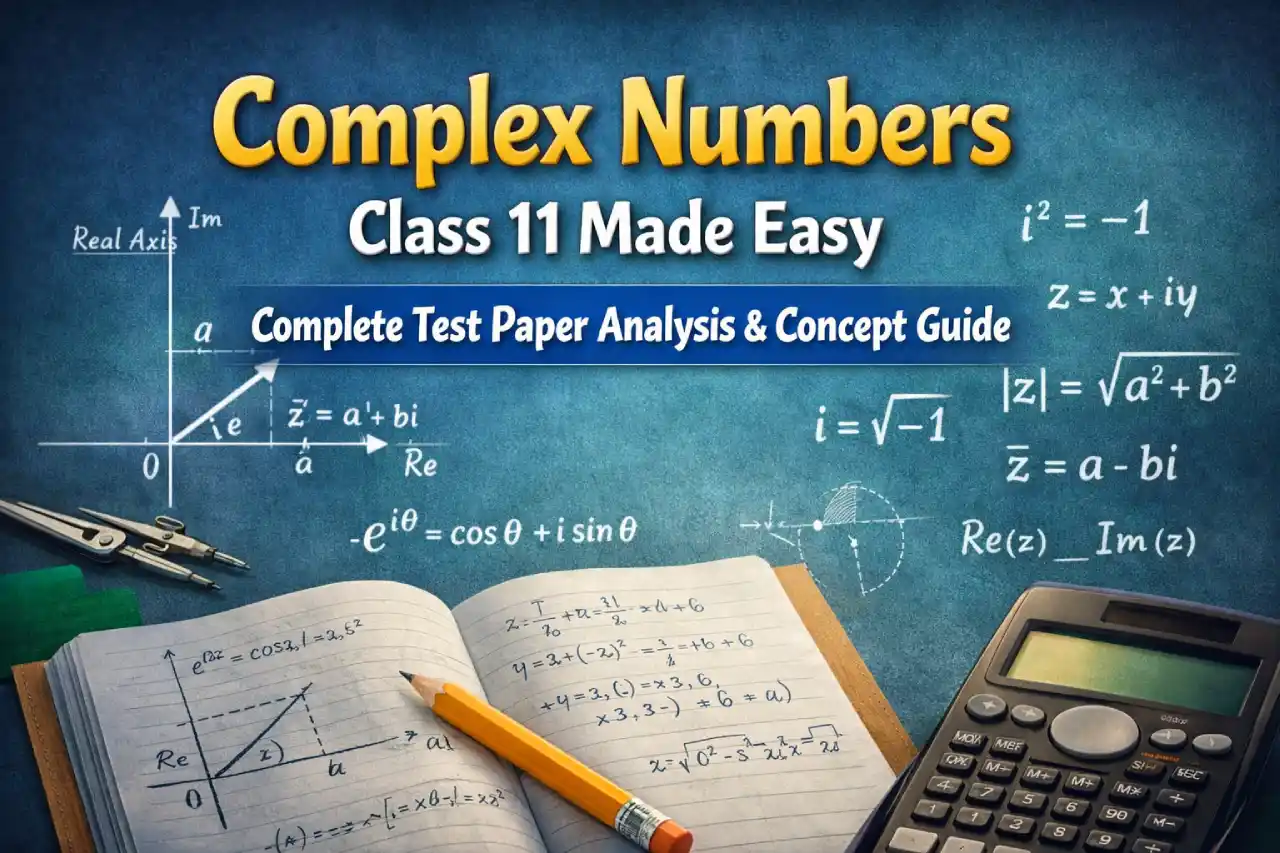
The Class 11 Mathematics test paper on Complex Numbers and Quadratic Equations focuses on the core concepts of complex numbers, their properties, equality conditions and basic operations. The paper includes multiple-choice questions, short-answer problems, match-the-following, fill in the blanks, true or false statements and case-based questions. It mainly tests understanding of expressions of the form Z=x+iy, identification of real and imaginary parts, and operations like multiplication, division and conjugation.
I am writing about this because many students feel that complex numbers are confusing at first glance. The symbol ‘i’ itself creates hesitation. But once you understand that a complex number is simply a combination of a real part and an imaginary part, the entire chapter becomes logical and scoring. From my experience, students lose marks not because the topic is difficult, but because they ignore small definitions and basic rules. This test paper clearly shows that conceptual clarity is the key.
What is a Complex Number?
A complex number is written in the form:
Z = x + iy
Here,
x = real part
y = imaginary part
i = √(-1)
The real part is written as Re(z), and the imaginary part is written as Im(z).
If y = 0, the number becomes purely real.
If x = 0 and y ≠ 0, it becomes purely imaginary.
A complex number is non-real when its imaginary part is not zero.
Understanding this basic definition is extremely important because most questions are built around it.
Equality of Complex Numbers
Two complex numbers are equal only when:
- Their real parts are equal
- Their imaginary parts are equal
For example, if
z₁ = a + ib
z₂ = c + id
Then z₁ = z₂ only if a = c and b = d.
Many short-answer questions in the paper are based on this simple rule. Students are asked to find values of x and y by equating real parts and imaginary parts separately. If you forget this method, you cannot solve such questions correctly.
Download this Complex Numbers and Quadratic Equations TP 1 PDF File: Click Here
Basic Operations on Complex Numbers
The paper includes questions on:
- Addition
- Subtraction
- Multiplication
- Division
- Finding real and imaginary parts
Important identities to remember:
- i² = −1
- √(-a) = i√a
While multiplying complex numbers, always simplify using i² = −1.
While dividing, multiply numerator and denominator by the conjugate.
These operations appear repeatedly in objective as well as case-based questions.
Conjugate of a Complex Number
If
z = a + ib
Then its conjugate is
a − ib
When a complex number is multiplied by its conjugate, the result is always a real number:
(a + ib)(a − ib) = a² + b²
This concept is very important in solving division problems and in case-based questions.
Understanding Real and Imaginary Parts Clearly
The test paper also checks whether students can correctly identify real and imaginary parts in different forms.
For example:
- The real part of a real number like 7 is 7
- The imaginary part of 7 is 0
Students often confuse this and think imaginary part must always contain ‘i’. That is not true. Imaginary part refers to the coefficient of i.
Clear understanding of this idea prevents silly mistakes.
Case-Based Questions Pattern
The paper includes a case where two complex numbers are given and multiple questions are asked based on them. These questions require:
- Finding real part of a product
- Finding imaginary part of a difference
- Evaluating expressions carefully
This shows that CBSE is focusing more on application-based understanding rather than direct formula questions.
Common Mistakes Students Make
From analysing this paper, I feel students usually make these errors:
- Forgetting that i² = −1
- Mixing up real and imaginary parts
- Not simplifying properly after multiplication
- Making sign mistakes during subtraction
These mistakes are avoidable if basics are strong.
How to Prepare This Chapter Properly
If you want to score well in Complex Numbers, follow this approach:
- First, revise definitions thoroughly
- Practise solving equations by equating real and imaginary parts
- Practise division using conjugate method
- Solve case-based questions regularly
- Double-check signs while calculating
In my experience, once you practise 20–25 mixed questions properly, the chapter becomes very comfortable.