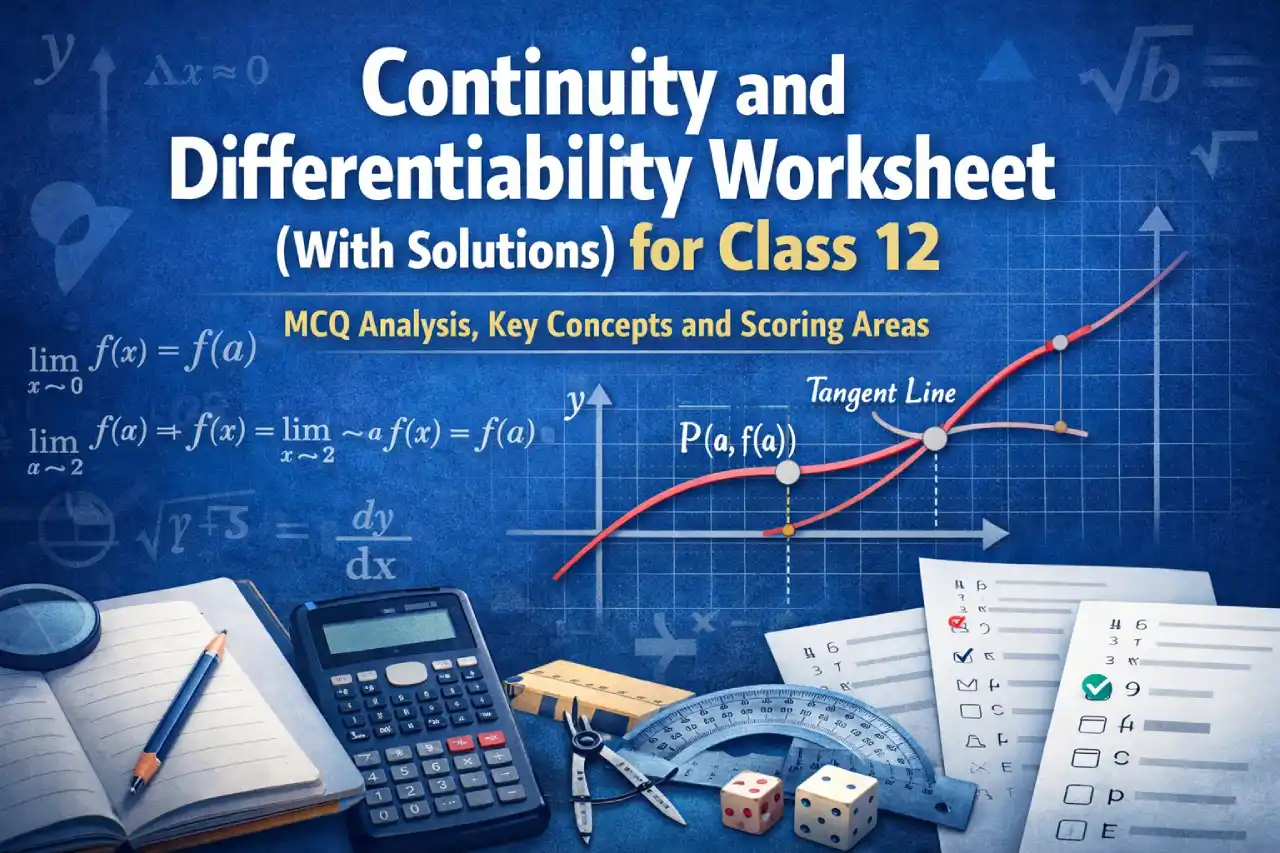
This Class 12 Mathematics worksheet on Continuity and Differentiability, along with its detailed solutions, is prepared mainly for CBSE board exam practice and objective-based revision. The worksheet contains 75 multiple-choice questions, all framed strictly from NCERT concepts. It covers limits, continuity at a point, left-hand and right-hand limits, differentiability, modulus and greatest integer functions, inverse trigonometric functions, logarithmic and exponential differentiation, piecewise functions, and points of non-differentiability. The included solutions explain each answer step by step, making the worksheet useful for both practice and concept clarification Continuity and Differentiabilit….
I am writing about this worksheet because Continuity and Differentiability is one of those chapters where students feel confident but still lose easy marks. Most errors happen due to confusion between continuity and differentiability, mishandling limits, or ignoring left-hand and right-hand derivatives. A worksheet with properly explained solutions helps convert NCERT theory into exam-ready understanding. By analysing these MCQs carefully, students can clearly see how small conceptual details are tested in one-mark questions.
Structure of the Continuity and Differentiability Worksheet
The worksheet consists of 75 MCQs, each carrying one mark, followed by a complete solution section. The questions range from direct formula-based MCQs to concept-heavy problems involving logic and interpretation. Many questions look simple but are designed to test clarity rather than lengthy calculations.
The overall difficulty level ranges from moderate to high, making this worksheet ideal for revision after completing the chapter.
Limits and Continuity-Based Questions
A large portion of the worksheet focuses on limits and continuity at a point. Questions test:
- Evaluation of limits using standard results
- Left-hand limit, right-hand limit, and their comparison
- Continuity of functions at given points
- Finding constant values to make a function continuous
These questions form the foundation of the chapter and are frequently asked in board exams.
Differentiability and Its Conditions
The worksheet clearly highlights the difference between continuity and differentiability. MCQs are based on:
- Conditions required for differentiability
- Functions that are continuous but not differentiable
- Sharp corners and cusps
- Behaviour of functions like |x| and |sin x|
These questions help students avoid the common mistake of assuming that continuity always implies differentiability.
Modulus and Greatest Integer Functions
Several MCQs focus on special functions, especially:
- Modulus functions and corner points
- Greatest integer (floor) function and step behaviour
- Points of discontinuity
- Continuity at integer and non-integer values
These are concept-heavy questions that require careful logical thinking rather than memorisation.
Piecewise-Defined Functions
The worksheet strongly emphasises piecewise functions. Students are tested on:
- Continuity at junction points
- Comparing LHL, RHL, and function values
- Identifying points of discontinuity
- Differentiability at joining points
Such questions are regular favourites in board exams.
Inverse Trigonometric Functions
Many MCQs are based on inverse trigonometric functions, including:
- Continuity of inverse trigonometric expressions
- Differentiation of inverse trigonometric functions
- Domain-based reasoning
- Composite inverse trigonometric expressions
These questions are generally scoring if NCERT formulas are revised properly.
Download this Continuity and Differentiability PDF File: Click Here
Logarithmic and Exponential Differentiation
The worksheet includes multiple MCQs on logarithmic and exponential differentiation, such as:
- Differentiation of expressions involving log x
- Exponential functions with variables in power
- Implicit differentiation using logarithms
- Application of chain rule
These questions test both conceptual clarity and algebraic accuracy.
Continuity Versus Differentiability Logic
Several questions are framed purely to test understanding, such as:
- Continuous everywhere but not differentiable at specific points
- Right continuous or left continuous functions
- Functions continuous but non-differentiable at multiple points
These MCQs are designed to check depth of understanding rather than speed.
What Students Can Learn from This Worksheet
From analysing this worksheet and its solutions, a few important points become clear:
- Continuity must always be verified using limits
- Differentiability requires equal left-hand and right-hand derivatives
- Modulus and GIF questions need careful point-wise analysis
- Piecewise functions demand extra attention at junctions
- Practising solved MCQs reduces conceptual mistakes
Overall, this Class 12 Continuity and Differentiability worksheet with solutions is a strong revision resource. It helps students strengthen fundamentals, improve logical reasoning, and gain confidence in handling one-mark calculus questions in board examinations.