
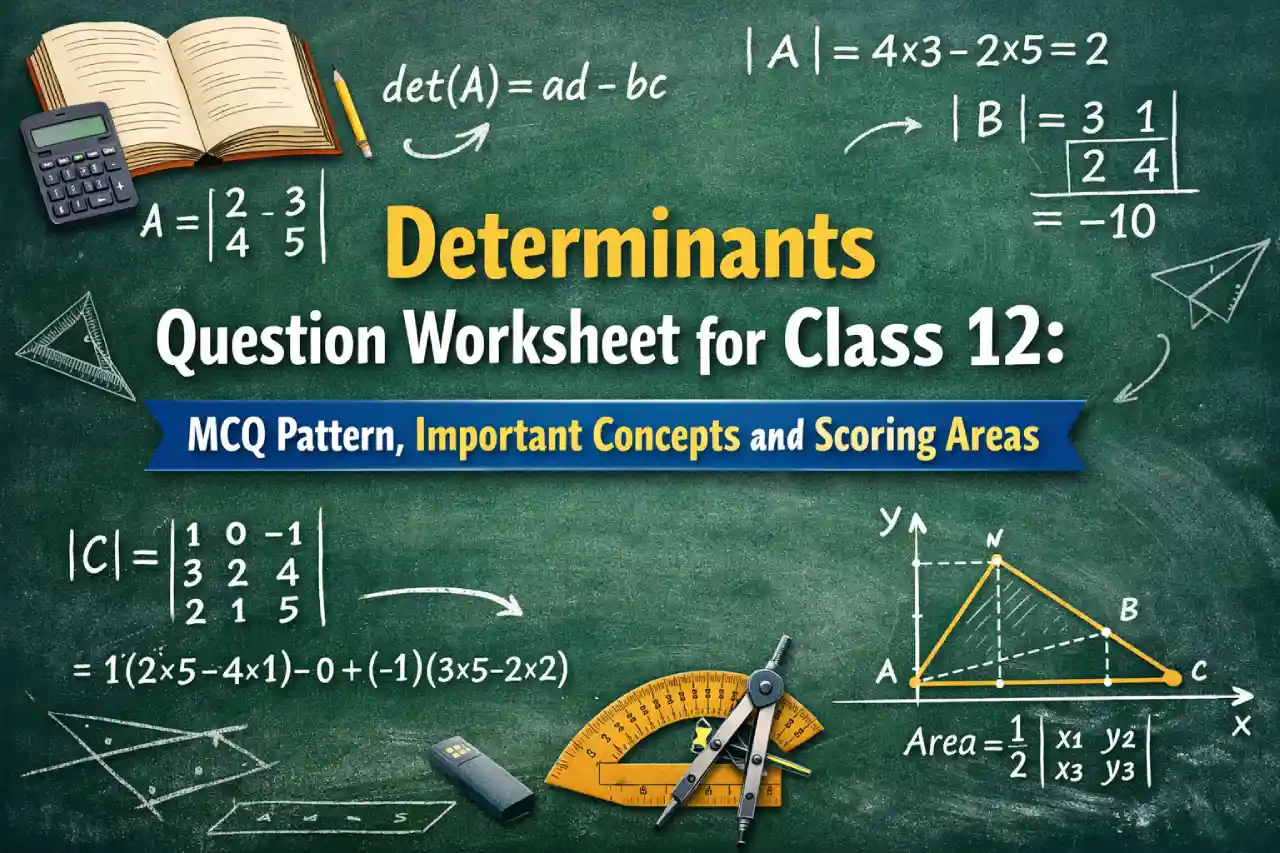
This Class 12 Mathematics worksheet on Determinants is designed mainly for CBSE board exam preparation and objective-based practice. The worksheet contains a wide range of MCQ-type questions strictly based on NCERT. It covers properties of determinants, value of determinants, minors and cofactors, adjoint and inverse of a matrix, singular and non-singular matrices, system of linear equations, consistency of solutions, area of triangles using determinants, and determinant-based identities. The overall question pattern closely matches the one-mark questions asked in board examinations Determinants WS 1.
I am writing about this worksheet because Determinants is a chapter where students often understand formulas but get confused in application-based MCQs. Small mistakes related to properties, adjoint identities, or system of equations can cost easy marks. A structured worksheet like this helps convert NCERT theory into exam-ready understanding. By analysing the questions carefully, students can clearly see which determinant properties are frequently tested and how logic-based MCQs are framed.
Structure of the Determinants Worksheet
The worksheet consists of 75 MCQs, each carrying one mark. The questions range from direct evaluation of determinants to reasoning-based problems involving adjoint, inverse, and system of equations. Many questions appear simple but require careful use of properties rather than direct expansion.
The difficulty level ranges from moderate to high, making it suitable for revision after completing the chapter.
Basic Properties of Determinants
A large number of questions test standard properties of determinants, including:
- Effect of row and column operations
- Determinant of triangular and diagonal matrices
- Determinant of identity and zero matrices
- Conditions when determinant becomes zero
These questions form the foundation of the chapter and are commonly asked in exams.
Minors, Cofactors and Adjoint Matrix
Several MCQs focus on the relationship between determinants and adjoint matrices. Students are tested on:
- Finding minors and cofactors
- Properties of adjoint matrices
- Identities like A(adj A) = |A|I
- Value of adj(adj A)
These questions require clear conceptual understanding rather than calculation.
Singular and Non-Singular Matrices
The worksheet includes many questions on identifying singular and non-singular matrices. Topics include:
- Conditions for existence of inverse
- Determinant equal to zero or non-zero
- Effect of determinant on system of equations
Such questions are direct scoring areas if NCERT definitions are clear.
Inverse of a Matrix Using Determinants
Several MCQs are based on finding or identifying the inverse of matrices. These questions test:
- Formula A⁻¹ = (1/|A|) adj A
- Conditions under which inverse exists
- Inverse of 2×2 and 3×3 matrices
- Properties of inverse matrices
These questions often combine determinants with matrix algebra.
Download this Determinants PDF File: Click Here
System of Linear Equations
A major portion of the worksheet focuses on solving and analysing systems of equations. Students are tested on:
- Unique, no solution, or infinitely many solutions
- Consistency and inconsistency of systems
- Determinant conditions for solution types
These MCQs are frequently asked in board exams.
Area of Triangle and Collinearity
The worksheet also includes application-based questions such as:
- Finding area of triangle using determinants
- Checking collinearity of points
- Geometrical interpretation of determinant values
These questions connect algebra with coordinate geometry.
Determinant-Based Identities and Logic Questions
Many questions test understanding of determinant identities, such as:
- |kA| and its effect on determinant
- |AB| = |A||B|
- |A⁻¹| and |adj A|
- Behaviour of determinant under transpose
These MCQs are logic-oriented and require careful reading.

















