
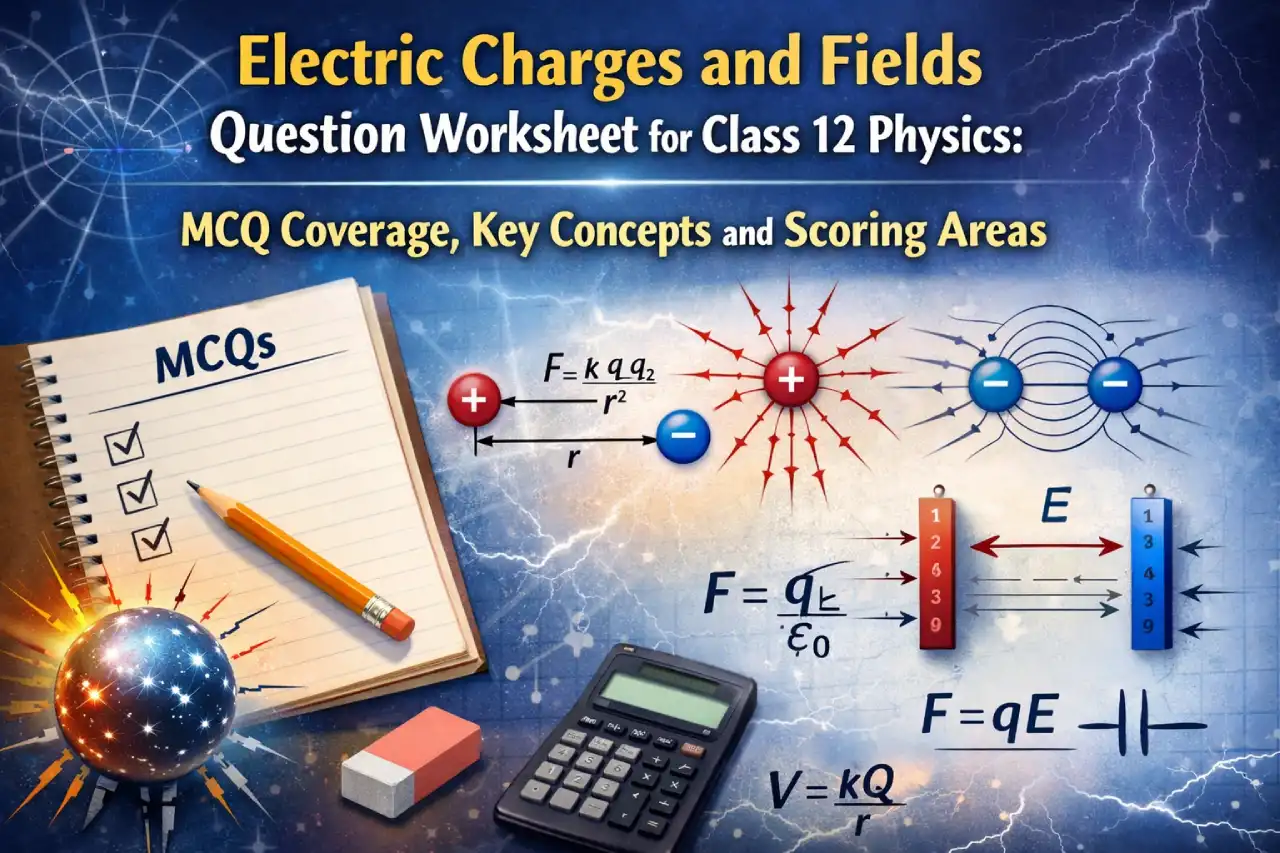
This Class 12 Physics worksheet on Electric Charges and Fields is designed mainly for CBSE board exam preparation and concept-based MCQ practice. The worksheet contains 75 multiple-choice questions, all framed directly from NCERT. It covers basic properties of electric charge, Coulomb’s law, superposition principle, electric field and field lines, electric flux, Gauss’s law, applications of Gauss’s law, electric dipole, torque on a dipole, and electric field due to various charge distributions. Overall, the worksheet reflects the exact mix of numerical, conceptual, and reasoning-based questions students regularly face in board examinations Electric Charges and Fields.
I am writing about this worksheet because Electric Charges and Fields is the foundation chapter of electrostatics, yet many students find it tricky due to sign conventions, vector nature of fields, and interpretation of Gauss’s law. Small mistakes in direction, symmetry, or formula application can easily lead to wrong answers. A structured worksheet like this helps convert NCERT theory into exam-ready understanding. By carefully analysing these MCQs, students can clearly see how basic definitions and laws are tested in one-mark questions.
Structure of the Electric Charges and Fields Worksheet
The worksheet consists of 75 MCQs, with each question carrying one mark. The questions range from simple fact-based items to application-heavy problems involving symmetry and logical reasoning. Many questions appear straightforward but are designed to test clarity of concepts rather than lengthy calculations.
The overall difficulty level ranges from easy to moderate, making it suitable for both revision and self-assessment.
Electric Charge and Basic Properties
Several questions test the fundamental properties of electric charge, including:
- Quantisation and conservation of charge
- Nature of positive and negative charges
- Charging by friction, conduction, and induction
- Number of electrons corresponding to one coulomb
These questions ensure students are clear about basic definitions, which are often directly asked in exams.
Coulomb’s Law and Force Between Charges
A major portion of the worksheet focuses on Coulomb’s law. Questions include:
- Dependence of force on charge and distance
- Effect of medium on electrostatic force
- Force variation when distance or charge changes
- Maximum force conditions when charge is divided
These MCQs test understanding of inverse square law rather than memorisation.
Electric Field and Electric Field Lines
Several MCQs are based on the concept of electric field. Topics covered include:
- Electric field as force per unit charge
- Direction of electric field due to positive and negative charges
- Properties of electric field lines
- Field due to point charges and charge systems
These questions help students visualise electrostatic fields correctly.
Electric Dipole and Its Behaviour
The worksheet includes multiple questions on electric dipoles, such as:
- Electric field on axial and equatorial lines
- Torque acting on a dipole in a uniform electric field
- Dependence of torque on angle
- Dipole moment and its direction
Dipole-based questions are frequently asked in board exams and are easy scoring if concepts are clear.
Electric Flux and Gauss’s Law
A large section of the worksheet is devoted to electric flux and Gauss’s law. Students are tested on:
- Meaning and unit of electric flux
- Flux through closed surfaces
- Electric field due to point charge using Gauss’s law
- Flux through cube, sphere, and plane surfaces
These questions strongly emphasise symmetry and conceptual understanding.
Download this Electric Charges and Fields PDF File: Click Here
Applications of Gauss’s Law
Several MCQs focus on standard applications of Gauss’s law, including:
- Electric field due to infinite line of charge
- Field due to infinite plane sheet of charge
- Field inside and outside a charged conducting sphere
- Charge enclosed within Gaussian surfaces
These questions are important from both board and competitive exam perspectives.
Conductors, Insulators and Charge Distribution
The worksheet also includes conceptual questions on conductors and charge distribution, such as:
- Where charge resides on a conductor
- Electric field inside a conductor
- Effect of earthing
- Behaviour of conductors placed in external fields
These MCQs test theoretical understanding rather than numerical skill.
Electric Field Due to Continuous Charge Distributions
Some questions deal with electric field due to uniformly charged rods, rings, and spheres. Topics include:
- Field at the centre or axis
- Dependence on geometry
- Use of symmetry arguments
These questions train students to identify when Gauss’s law or direct calculation is applicable.
What Students Can Learn from This Worksheet
From analysing this worksheet, a few important points clearly emerge:
- NCERT definitions are the base of most MCQs
- Sign convention and direction matter greatly
- Gauss’s law questions rely on symmetry, not formulas alone
- Electric dipole concepts are high-weight topics
- Regular MCQ practice improves speed and confidence
Overall, this Class 12 Electric Charges and Fields worksheet is a strong revision resource. It helps students strengthen fundamentals, improve conceptual clarity, and gain confidence in handling one-mark questions from the very first chapter of electrostatics.

















