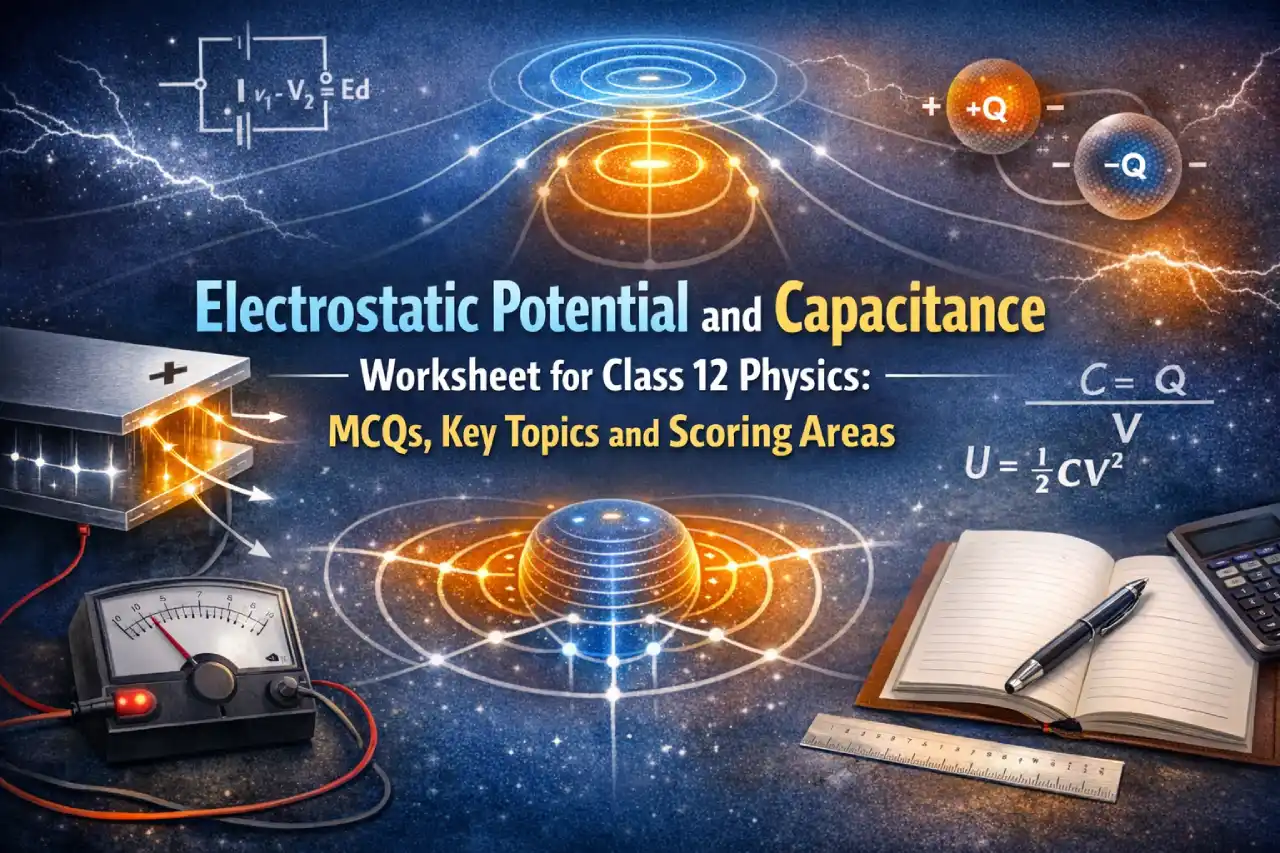
This Class 12 Physics worksheet on Electrostatic Potential and Capacitance is prepared mainly for CBSE board exam practice and objective-type revision. The worksheet contains 75 multiple-choice questions, all strictly framed from NCERT concepts. It covers electrostatic potential, potential energy, work done in electric fields, equipotential surfaces, capacitors, energy stored in capacitors, effect of dielectrics, series and parallel combinations of capacitors, charging and discharging behaviour, and practical applications such as earth’s capacitance and electrolytic capacitors. Overall, the worksheet reflects the exact mix of conceptual and numerical MCQs commonly asked in board exams Electrostatic Potential and Cap….
I am writing about this worksheet because Electrostatic Potential and Capacitance is a chapter where students often know formulas but struggle to apply them correctly. Confusion usually arises in energy relations, dielectric effects, capacitor combinations, and interpretation-based questions. A structured worksheet like this helps students convert textbook theory into exam-ready understanding. By analysing these MCQs carefully, one can clearly see which concepts are tested repeatedly and how small conceptual twists are used to frame scoring one-mark questions.
Structure of the Electrostatic Potential and Capacitance Worksheet
The worksheet consists of 75 MCQs, with each question carrying one mark. The questions are a mix of direct formula-based problems, reasoning-based conceptual MCQs, and application-oriented numericals. Many questions look lengthy at first glance but can be solved quickly with clear concepts.
The overall difficulty level ranges from moderate to high, making this worksheet ideal for revision after completing the chapter.
Electrostatic Potential and Work Done
Several questions focus on electrostatic potential and potential energy, including:
- Potential due to point charges
- Potential energy of charge systems
- Work done in moving a charge in an electric field
- Relation between electric field and potential
These MCQs test conceptual understanding of potential as a scalar quantity.
Equipotential Surfaces
A number of questions are based on equipotential surfaces. Topics include:
- Properties of equipotential surfaces
- Angle between electric field lines and equipotential surfaces
- Potential variation inside conductors
- Behaviour of equipotential surfaces in uniform fields
Such questions are frequently asked as direct conceptual MCQs.
Capacitance and Capacitors
The worksheet strongly emphasises capacitance concepts. Students are tested on:
- Definition and unit of capacitance
- Parallel plate capacitors
- Effect of plate area and separation
- Capacitance of spherical conductors and earth
These are easy scoring questions if NCERT definitions are clear.
Download this Electrostatic Potential and Capacitance PDF File: Click Here
Energy Stored in a Capacitor
Many MCQs are based on energy relations, such as:
- Energy stored in a charged capacitor
- Change in energy due to change in voltage or charge
- Energy density between capacitor plates
- Heat produced during discharge
These questions often test proportional reasoning rather than calculation.
Effect of Dielectrics
A major portion of the worksheet focuses on dielectric materials. Questions include:
- Meaning of dielectric constant
- Effect of inserting a dielectric slab
- Change in capacitance, electric field, and potential
- Polarisation and energy storage
Dielectric-based MCQs are common sources of confusion and are high-weight topics.
Combination of Capacitors
Several questions test series and parallel combinations of capacitors, including:
- Equivalent capacitance calculation
- Charge and potential distribution
- Reconnection of charged capacitors
- Energy change during rearrangement
These MCQs require careful logical steps.
Charging and Discharging of Capacitors
The worksheet includes questions on capacitor charging and discharging, such as:
- Current behaviour during charging
- Energy dissipation in resistors
- Time-dependent reasoning without heavy maths
These questions help students understand practical circuit behaviour.
Capacitors of Different Geometries
Some MCQs deal with special capacitor geometries, including:
- Spherical capacitors
- Cylindrical capacitors
- Earth as a capacitor
These questions test application of standard formulas and dimensional logic.
Real-Life and Application-Based Questions
The worksheet also includes application-oriented MCQs, such as:
- Submarine cables acting as capacitors
- Electrolytic capacitors and polarity
- Breakdown voltage considerations
- Temperature dependence of dielectric constant
These questions connect electrostatics with real-world physics.
What Students Can Learn from This Worksheet
From analysing this worksheet, a few key points become clear:
- Electrostatic potential often simplifies problem solving
- Energy-based MCQs are frequently asked
- Dielectric insertion logic must be very clear
- Capacitor combinations require careful charge tracking
- Regular MCQ practice improves speed and accuracy
Overall, this Class 12 Electrostatic Potential and Capacitance worksheet is a strong revision resource. It helps students strengthen conceptual clarity, avoid common mistakes, and gain confidence in handling one-mark MCQs from one of the most important chapters of electrostatics.