
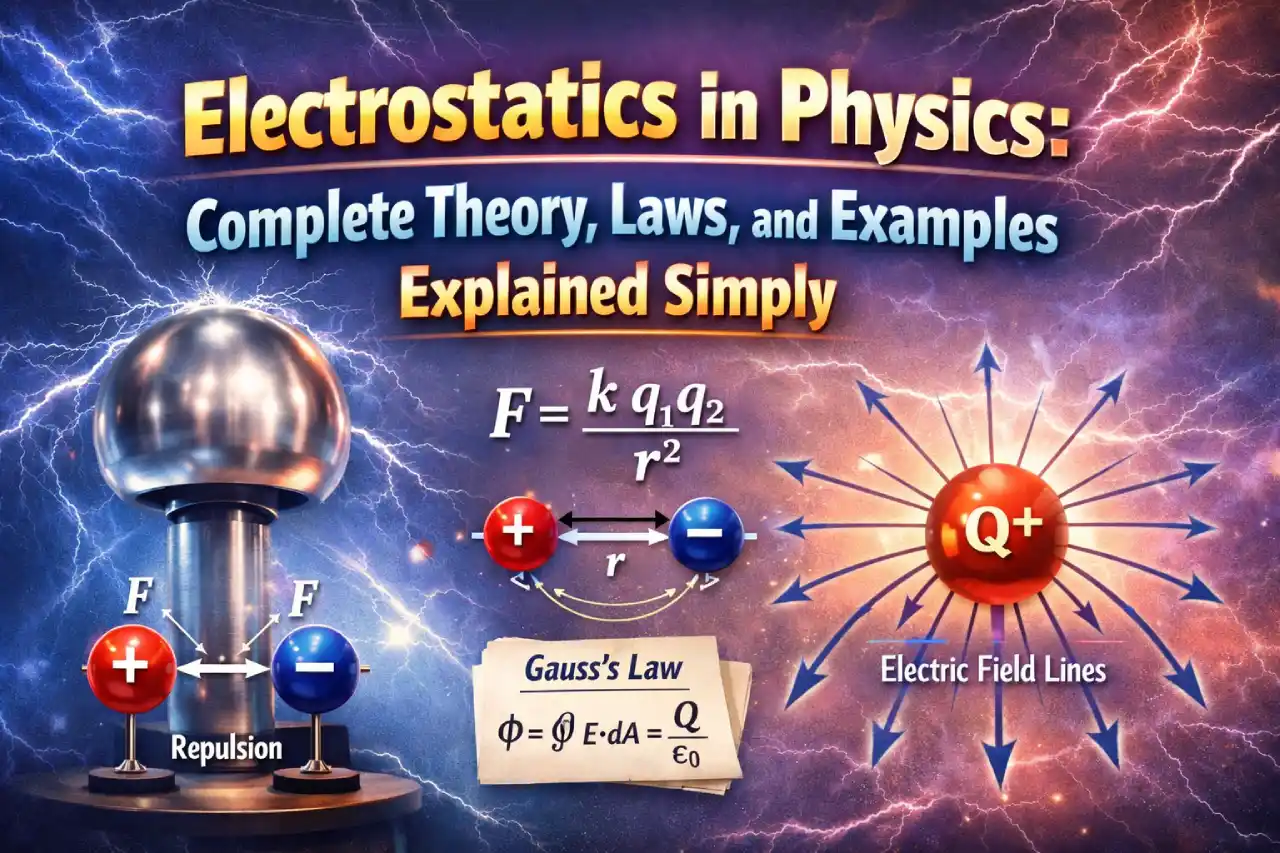
a detailed theory document on Electrostatics, covering the fundamentals of electric charges, forces, fields, and potentials. It is written for Physics students preparing for competitive exams and explains concepts step by step with definitions, derivations, solved examples, and practice questions. The content follows a logical flow, starting from basic ideas of charge and moving towards advanced applications like electric field, potential, and equilibrium.
I am writing about this topic because Electrostatics forms the foundation of electricity and magnetism in Physics. Many students struggle with this chapter due to heavy formulas and vector-based reasoning. This article explains exactly what the PDF teaches, in a clear and structured way, so learners understand the scope of the chapter and how concepts are connected.
What Electrostatics Means
The PDF begins by defining electrostatics as the branch of Physics that deals with electric effects produced by charges at rest. It introduces electric charge as a physical property responsible for electrical and magnetic interactions. Units of charge, dimensional formula, and common sub-units like microcoulomb and nanocoulomb are clearly explained.
The document also explains the existence of two types of charges, positive and negative, and establishes the basic rule that like charges repel while unlike charges attract.
Properties of Electric Charge
A full section of the PDF is dedicated to properties of charge. It explains that charge is a scalar quantity and is conserved in an isolated system. Quantisation of charge is discussed in detail, with reference to the elementary charge and Millikan’s oil drop experiment.
Other important properties covered include charge being always associated with mass, charge being invariant with speed, and the behaviour of electric and magnetic fields produced by charges at rest and in motion.
Methods of Charging a Body
The PDF explains multiple methods by which a body can be charged. These include charging by friction, conduction, and induction. Each method is explained step by step, showing how electrons are transferred or redistributed.
Additional methods such as thermionic emission, photoelectric effect, and field emission are also included. The concept of grounding and its role in charging by induction is clearly described with examples.
Gold Leaf Electroscope and Detection of Charge
The gold leaf electroscope is introduced as a device used to detect the presence and nature of electric charge. The PDF explains how divergence of gold leaves indicates charging and how it can be used to compare charges.
Examples are provided to show how attraction and repulsion help identify whether a body is charged or neutral, concluding that repulsion is the sure test of electrification.
Coulomb’s Law and Electrostatic Force
Coulomb’s law is explained as the inverse square law governing the force between two point charges. The PDF provides the mathematical form of the law, explains the role of permittivity, and discusses how the medium affects electrostatic force.
Vector form of Coulomb’s law is also included, along with numerical examples showing force calculation, scaling of force with distance and charge, and real-life interpretation of large charge values.
Download this PDF File: Click Here
Principle of Superposition
The principle of superposition is explained as the method of calculating net force due to multiple charges. The PDF shows how forces due to individual charges are added vectorially to obtain the resultant force.
Several solved examples demonstrate force cancellation, symmetry-based reasoning, and equilibrium conditions for multiple charge systems.
Electrostatic Equilibrium
The document explains electrostatic equilibrium and classifies it into stable, unstable, and neutral equilibrium. Examples show how equilibrium changes with direction of displacement and why some configurations lead to restoring forces while others do not.
Applications include motion of charged particles and conditions for simple harmonic motion in electrostatic systems.
Electric Field and Electric Field Intensity
The concept of electric field is introduced as the region around a charge where another charge experiences force. Electric field intensity is defined mathematically and explained as a vector quantity.
The PDF explains electric field due to a point charge, system of charges, charged ring, infinite line charge, infinite sheet, spherical shell, and solid sphere. A detailed formula table is included to summarise field expressions for different charge distributions.
Electric Potential and Potential Difference
Electric potential is defined as work done per unit charge in bringing a test charge from infinity to a point. Its properties, unit, and relation with electric field are clearly explained.
The PDF derives expressions for potential due to point charge, ring, disc, spherical shell, and solid sphere. It also explains potential difference, uniform electric field, and energy concepts related to motion of charges.
Equipotential Surfaces
Equipotential surfaces are introduced as surfaces having constant potential. The PDF explains their properties, including zero work done along them and their perpendicular relationship with electric field lines.
This concept helps visualise electric fields and understand why charges move in specific directions.
Examples, Numericals, and Exam Orientation
Throughout the PDF, a large number of solved examples and numerical problems are included. These examples focus on force calculation, field direction, potential difference, equilibrium, and motion of charges. Objective questions at the end of sections help reinforce learning and exam readiness.

















