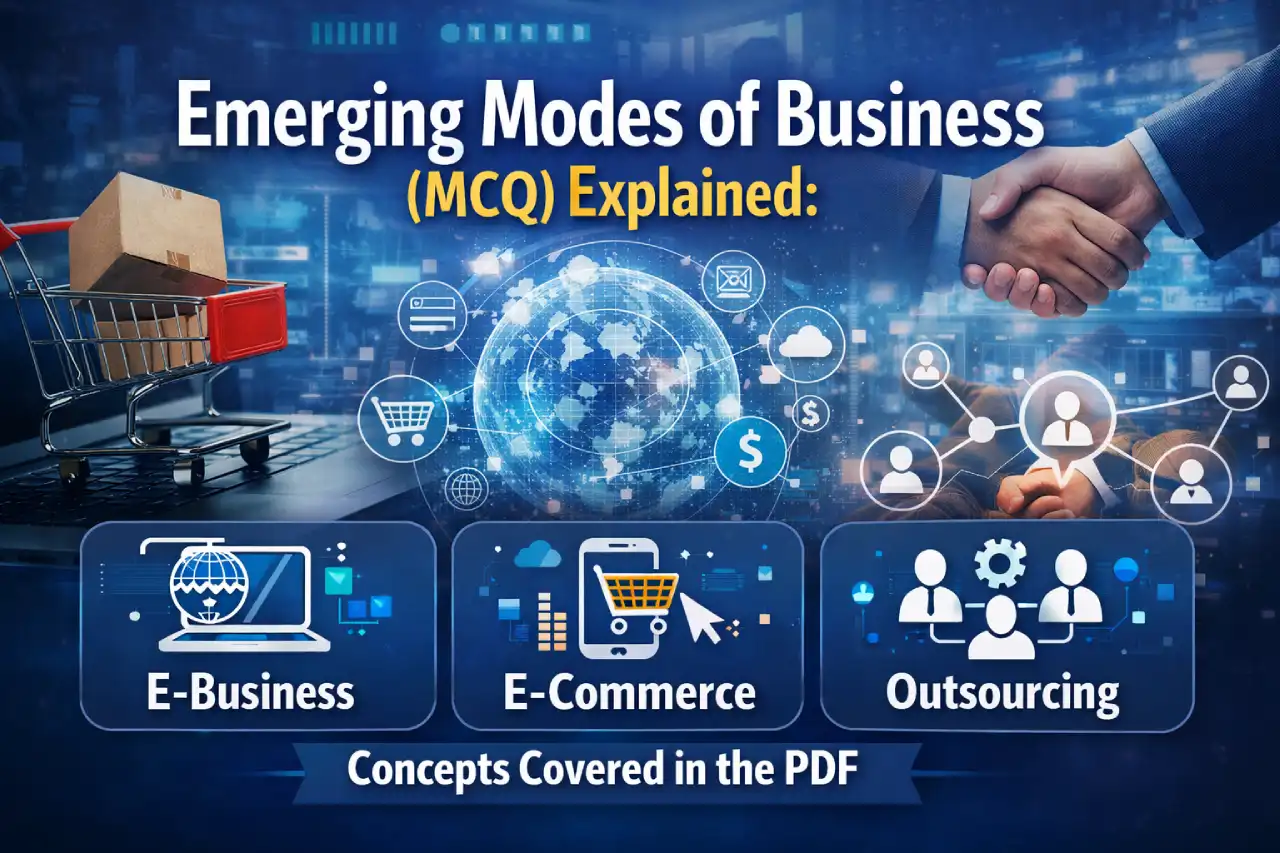
This PDF is a comprehensive, exam-oriented question bank on the chapter Emerging Modes of Business from Business Studies. It focuses mainly on modern ways of doing business such as e-business, e-commerce, and outsourcing. The PDF covers core definitions, objectives, types of electronic transactions, applications of e-business, online payment systems, security risks, and the growing role of Business Process Outsourcing. All topics are presented through objective questions that repeatedly test conceptual clarity and real-world application.
I am writing about this PDF because the topic of emerging modes of business directly reflects how businesses operate today. Students often find this chapter lengthy due to technical terms and examples. This PDF simplifies preparation by clearly indicating what areas are important from an exam point of view. Understanding these topics is also useful beyond exams, as they explain how online platforms, digital payments, and outsourcing have changed traditional business practices.
Meaning of Emerging Modes of Business
As explained in the PDF, emerging modes of business refer to new and innovative ways of conducting business activities using information and communication technology. In India, the two main emerging modes highlighted are e-business and outsourcing. These modes focus on speed, convenience, global reach, and cost efficiency compared to traditional business systems.
E-Business and Its Scope
The PDF clearly distinguishes e-business from e-commerce. E-business is described as a broader concept that includes not only buying and selling but also production, marketing, finance, human resources, and internal communication using electronic networks. Activities like online procurement, e-delivery, online trading, and internal email communication fall under e-business.
Meaning of E-Commerce
According to the PDF, e-commerce refers specifically to the buying and selling of goods and services through electronic networks, mainly the internet. It involves electronic processing and transmission of data including text, sound, and images. E-commerce is shown as a part of e-business, not a substitute for it.
Types of E-Commerce Transactions
The PDF covers different types of e-commerce transactions, including:
- B2B transactions between business firms
- B2C transactions between businesses and customers
- C2C transactions between consumers
- C2B transactions where consumers provide services to businesses
- Intra-B transactions within the same organisation
Each type is tested through practical examples.
Online Transaction Process
A significant portion of the PDF focuses on the steps involved in online transactions:
- Registration with the online seller
- Placing the order
- Selecting the payment method
- Making payment
- Delivery of goods
Payment methods discussed include cash on delivery, credit cards, debit cards, net banking, and digital cash.
Download this Emerging Modes Of Business PDF File: Click Here
Security Risks in E-Business
The PDF highlights security as a major concern in e-business and e-commerce. It covers risks such as hacking, virus attacks, data theft, default on payment, default on delivery, and denial of order placement. Concepts like encryption, digital signatures, secure sockets layer, and cybercrime cells are included as protective measures.
Outsourcing and Its Meaning
Outsourcing is defined in the PDF as contracting out certain business activities to external agencies that were earlier performed within the organisation. It includes both core and non-core activities and may be domestic or international in nature.
Types of Outsourcing
The PDF explains various forms of outsourcing:
- Business Process Outsourcing
- Knowledge Process Outsourcing
- Legal Process Outsourcing
- Offshore outsourcing
- Near-shore outsourcing
- Onshore outsourcing
It also mentions contract manufacturing, contract research, and IT-enabled services.
Reasons and Benefits of Outsourcing
According to the PDF, outsourcing is adopted to reduce costs, focus on core competencies, improve efficiency, gain access to specialised skills, and achieve flexibility. India is highlighted as a preferred destination for outsourcing due to availability of skilled and cost-effective manpower.
Advantages and Limitations of E-Business
The PDF lists advantages such as 24×7 availability, global reach, lower transaction cost, paperless operations, and convenience. At the same time, it clearly mentions limitations like lack of personal touch, security risks, difficulty in training, and dependence on technology.