
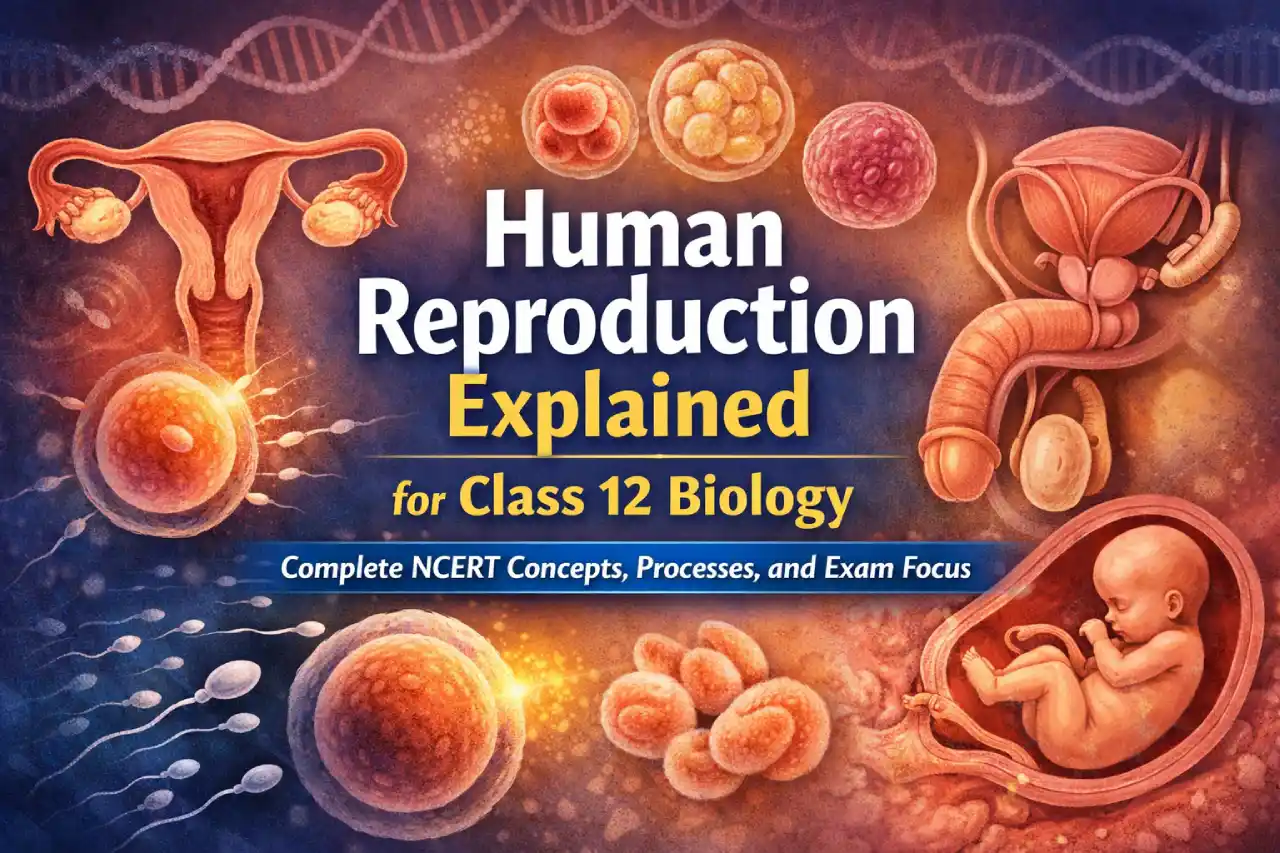
Human Reproduction is a core chapter of Class 12 Biology that explains how humans produce gametes, ensure fertilisation, support pregnancy, and give birth to offspring. The uploaded PDF is a Biology Smart Booklet based strictly on NCERT Class 12 (2024 updated syllabus). It covers detailed theory, labelled diagrams, NCERT line-by-line MCQs, assertion–reason questions, and NEET previous year questions. The content follows the exact NCERT sequence, making it highly relevant for CBSE board exams and NEET preparation.
I am writing about this PDF because Human Reproduction is often considered lengthy and confusing by students due to multiple processes, hormones, and stages involved. This PDF brings everything together in a structured, exam-oriented manner and clearly shows what NCERT actually expects students to learn. Understanding what this PDF contains helps students focus on high-weightage areas, avoid unnecessary memorisation, and prepare confidently for both objective and descriptive questions.
Overview of Human Reproduction Covered in the PDF
The PDF is fully dedicated to Chapter 3: Human Reproduction of NCERT Class 12 Biology. It explains the structure and function of reproductive systems, gamete formation, menstrual cycle, fertilisation, pregnancy, embryonic development, parturition, and lactation.
Human Reproductive System
The PDF begins with a detailed explanation of the human reproductive system.
Male Reproductive System
It explains:
- Location of testes in the scrotum outside the abdominal cavity
- Structure of testes, seminiferous tubules, and testicular lobules
- Role of Sertoli cells in nutrition
- Role of Leydig cells in androgen secretion
- Male accessory ducts such as rete testis, vasa efferentia, epididymis, vas deferens, and urethra
- Male external genitalia including penis and foreskin
Labelled diagrams and MCQs are used to reinforce these concepts.
Female Reproductive System
The PDF covers:
- Ovaries, oviducts, uterus, cervix, vagina, and external genitalia
- Structure of fallopian tube including infundibulum, fimbriae, ampulla, and isthmus
- Uterine layers: perimetrium, myometrium, and endometrium
- Mammary glands and their role in lactation
The functional coordination of these organs during reproduction is clearly explained.
Gametogenesis
The PDF explains gametogenesis as the formation of gametes in primary sex organs.
Spermatogenesis
Key points include:
- Begins at puberty
- Role of spermatogonia, spermatocytes, spermatids, and spermatozoa
- Processes of spermiogenesis and spermiation
- Hormonal control by GnRH, LH, FSH, and androgens
- Structure of sperm with head, acrosome, middle piece, and tail
This section is heavily supported by NEET-level MCQs.
Oogenesis
The PDF explains:
- Initiation during embryonic development
- Formation of primary oocytes and arrest in prophase I
- Development of primary, secondary, tertiary, and Graafian follicles
- Unequal meiotic divisions producing polar bodies
- Ovulation and release of secondary oocyte
Differences between spermatogenesis and oogenesis are repeatedly tested.
Download this BIOLOGY 12 – HUMAN REPRODUCTION PDF File: Click Here
Menstrual Cycle
The menstrual cycle is explained as a cyclic reproductive process in human females.
The PDF covers:
- Menarche and menopause
- Menstrual phase, follicular (proliferative) phase, ovulatory phase, and luteal (secretory) phase
- Hormonal regulation by FSH, LH, estrogen, and progesterone
- LH surge and its role in ovulation
- Changes in ovary and uterus during each phase
Flowcharts and hormone graphs are included for conceptual clarity.
Fertilisation and Implantation
This section explains:
- Copulation and transport of gametes
- Site of fertilisation at the ampullary–isthmic junction
- Capacitation of sperms in female reproductive tract
- Acrosomal reaction and prevention of polyspermy
- Formation of zygote and cleavage
- Morula and blastocyst formation
- Implantation of blastocyst in the endometrium
This topic carries high weightage in NEET and assertion–reason questions.
Pregnancy and Embryonic Development
The PDF explains:
- Formation of placenta and chorionic villi
- Role of placenta as a structural, functional, and endocrine organ
- Hormones produced during pregnancy such as hCG, hPL, estrogen, progesterone, and relaxin
- Differentiation of germ layers
- Month-wise development of embryo and foetus
Important milestones like heart formation, limb development, and foetal movements are clearly mentioned.
Parturition and Lactation
The final section covers:
- Parturition as the process of childbirth
- Foetal ejection reflex and role of oxytocin
- Lactation and mammary gland activation
- Colostrum and its antibody-rich nature
This section links physiology with real-life biological significance.
Exam-Oriented Content in the PDF
A major strength of the PDF is its extensive question bank:
- NCERT line-by-line MCQs
- Assertion–reason questions
- Match-the-following
- Diagram-based questions
- NEET previous year questions with solutions
This makes it a complete revision tool rather than just theory notes.

















