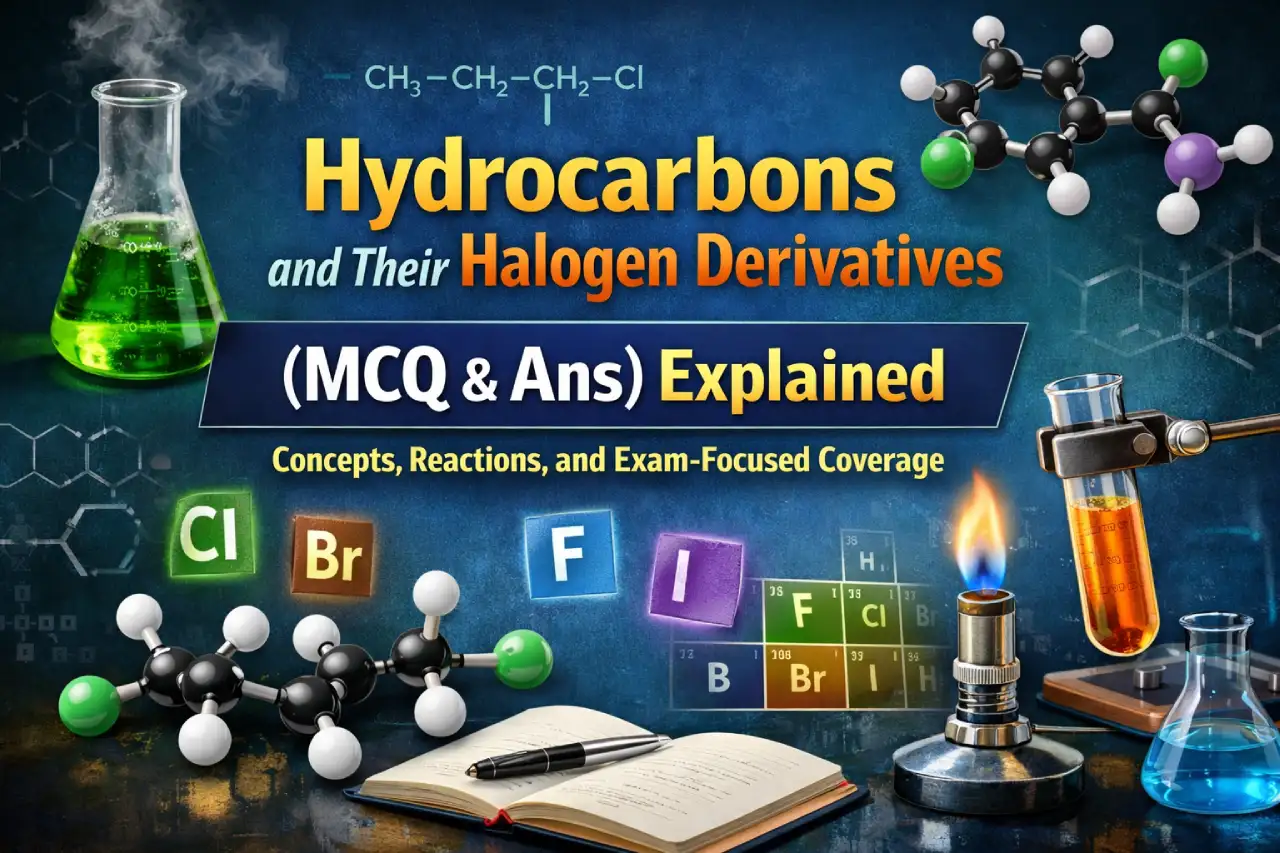
Hydrocarbons and their halogen derivatives form a core part of organic chemistry, especially for senior secondary and competitive exam students. The PDF you uploaded focuses on the classification, structure, reactions, and mechanisms related to alkanes, alkenes, alkynes, aromatic hydrocarbons, and halogen-containing organic compounds. It also links these concepts directly with application-based and previous-year competitive questions, making the coverage both conceptual and exam-oriented.
I am writing about this PDF because it brings together theory and problem-solving in a very practical way. Many students struggle to connect reaction mechanisms with real exam questions, and this material bridges that gap clearly. Understanding hydrocarbons is not just about memorising reactions but about knowing why they happen, how conditions affect products, and where these concepts are tested in exams like JEE Main. This document helps build that clarity step by step.
Overview of Hydrocarbons Covered in the PDF
The PDF begins with a structured syllabus outline of hydrocarbons. It explains how hydrocarbons are classified based on saturation and structure, covering alkanes, alkenes, alkynes, and aromatic hydrocarbons. Each class is discussed with respect to nomenclature, preparation methods, physical properties, and chemical reactions. Special attention is given to isomerism, which is a recurring exam topic.
The content also emphasises IUPAC naming rules, helping students avoid common mistakes in identifying and naming organic compounds. These basics form the foundation for understanding more complex reaction mechanisms later in the chapter HYDROCARBONS & THEIR HALAGEN DE….
Alkanes: Structure, Conformations, and Reactions
Alkanes are discussed as saturated hydrocarbons with single bonds. The PDF explains conformational analysis using Sawhorse and Newman projections, particularly for ethane. These projections are important for visualising staggered and eclipsed conformations and understanding stability based on torsional strain.
Reaction-wise, halogenation of alkanes is explained through a free radical mechanism. The steps of initiation, propagation, and termination are clearly implied through problem-based questions. This helps students understand why tertiary hydrogens are more reactive and why certain products dominate under given conditions.
Alkenes and Alkynes: Addition Reactions and Isomerism
For alkenes, the PDF focuses strongly on geometrical isomerism and electrophilic addition reactions. Concepts like Markovnikov’s rule, anti-Markovnikov addition through peroxide effect, and ozonolysis are repeatedly tested through objective questions. Polymerisation reactions are also included to show real-world relevance.
Alkynes are covered with emphasis on their acidic nature and addition reactions. The PDF highlights how alkynes differ from alkenes in reactivity and product formation. These distinctions are crucial in multi-step reaction questions, which are common in competitive exams.
Download this HYDROCARBONS & THEIR HALAGEN DERIVATIVES PDF File: Click Here
Aromatic Hydrocarbons and Electrophilic Substitution
Aromatic hydrocarbons, mainly benzene and its derivatives, are discussed with respect to aromaticity and stability. The mechanism of electrophilic aromatic substitution is central here. Reactions like nitration, halogenation, Friedel–Crafts alkylation, and acylation are repeatedly reinforced through exam questions.
The directive influence of substituents in monosubstituted benzene rings is another key area. The PDF helps students understand why certain groups are ortho-para directing while others are meta directing, linking electronic effects directly to reaction outcomes.
Organic Compounds Containing Halogens
A dedicated section covers haloalkanes and haloarenes. Topics include methods of preparation, physical and chemical properties, and the nature of the carbon–halogen bond. Substitution reactions such as SN1 and SN2 are indirectly reinforced through comparative questions and reaction-based problems.
The environmental and practical aspects of halogen compounds are also mentioned. Effects of substances like chloroform, iodoform, freons, and DDT are included, reminding students that organic chemistry is closely linked to environmental science and public health.
Exam-Oriented Questions and Learning Approach
One of the strongest aspects of the PDF is its extensive collection of previous-year JEE Main questions. These questions span multiple years and test both conceptual clarity and application skills. By studying these, students can identify common patterns, frequently tested reactions, and typical traps set in objective exams.
The inclusion of answer keys and explanations further strengthens understanding. Instead of rote learning, students are encouraged to analyse why an option is correct or incorrect, which is essential for improving accuracy in exams.