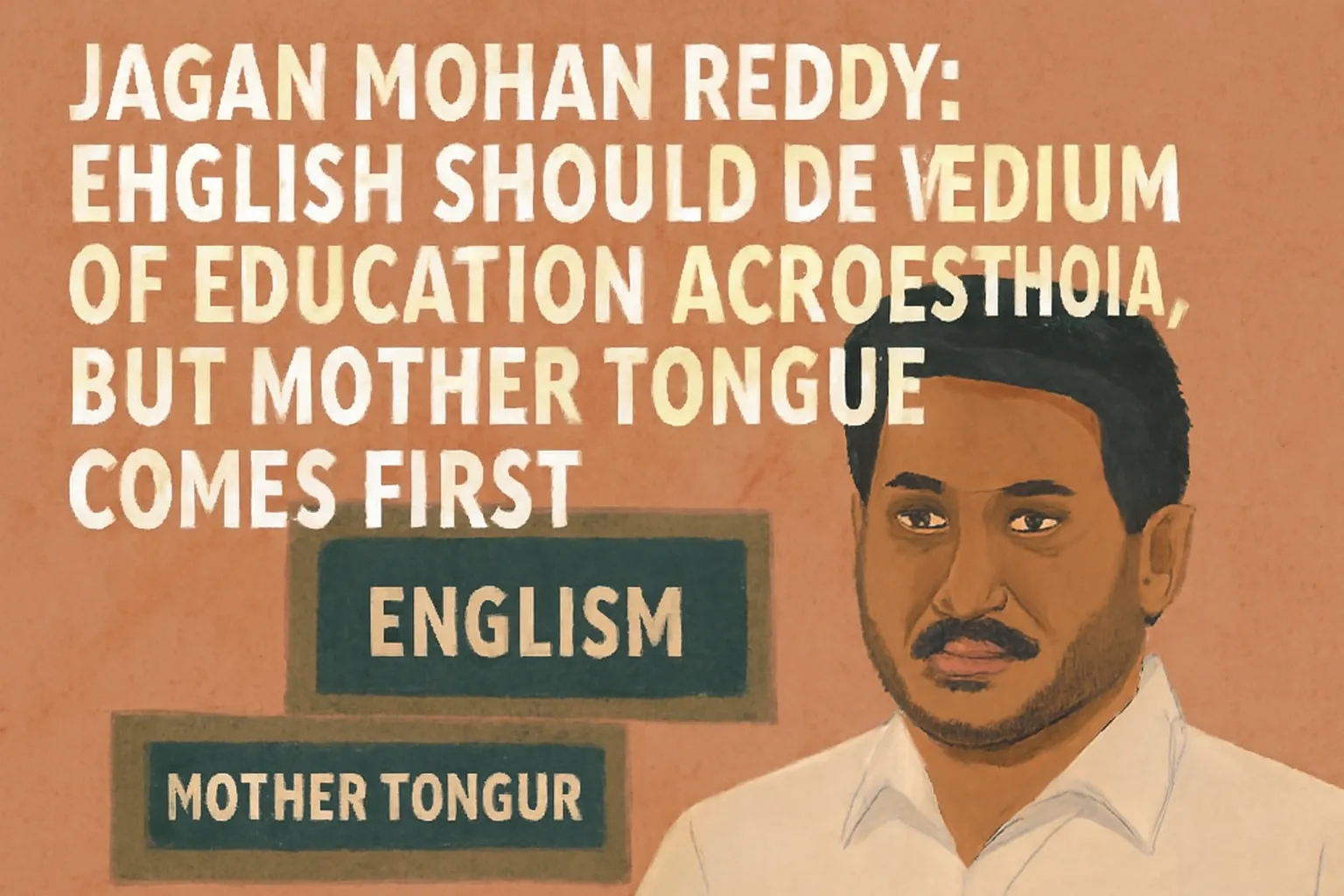
Andhra Pradesh Chief Minister YS Jagan Mohan Reddy recently spoke about the need for English to be adopted as the primary medium of instruction in schools across India, while also stressing that mother tongue must never be neglected. He was addressing a gathering on the occasion of World Telugu Conference in Tirupati, where he clearly stated that while English is important for global opportunities and national competitiveness, students must also be grounded in their regional languages for identity, culture and emotional development.
I found this topic important because it touches on a debate that’s both practical and emotional for many Indian families. As someone who has seen parents struggle to pick between English medium and mother tongue schools, I believe this is a conversation that needs attention. Balancing career prospects with cultural roots is not easy, and when political leaders take a stand on this, it influences educational policy and public opinion. Jagan’s view reflects what many people feel — that English can’t be ignored, but neither should we forget the languages we grew up speaking at home.
English as a Tool for Opportunity
During his speech, Jagan said English should become the universal medium of instruction in India to help children succeed in a globalised world. He explained that fluency in English gives students a head start in competitive exams, higher education and job markets, both in India and abroad.
In his own state of Andhra Pradesh, the government has already made English medium mandatory in government schools from Class 1 onwards. This shift is supported by large investments in school infrastructure, digital learning tools and teacher training to help manage the transition.
Some points he highlighted:
- English proficiency gives students better access to resources and information
- It helps bridge the rural-urban education gap
- Parents themselves prefer English medium as they see it as a way for their children to get ahead in life
Importance of Mother Tongue in Education
While he firmly stood by the push for English, Jagan was also clear that mother tongue should not be left behind. He said a child’s emotional and cultural development is tied closely to their native language. That’s why Telugu language studies remain mandatory in schools across Andhra Pradesh, even in English medium institutions.
He stated that:
- Learning in mother tongue in the early years helps children understand basic concepts better
- Cultural identity and pride are rooted in language
- Students should be fluent in both their mother tongue and English for a complete education
What the NEP Says About Language
Jagan’s view aligns partially with the National Education Policy (NEP) 2020, which promotes multilingual education. The NEP suggests using the mother tongue or regional language as the medium of instruction at least until Class 5, but it does not ignore the importance of English.
The NEP aims to make children proficient in at least three languages. However, there’s flexibility for states to implement this policy based on their local needs. Andhra Pradesh’s decision to go with full-scale English medium from Class 1 is a departure from the NEP’s recommendations but follows a practical outlook many states are considering.
Public Response and Ground-Level Realities
Many parents in Andhra Pradesh have supported this English medium policy, even in rural areas. Enrolment in government schools has increased in some districts due to this shift. However, critics say rushing into English medium without sufficient teacher preparation could backfire.
Teachers’ unions have raised concerns about training gaps and pressure on students who are first-generation English learners. Some also argue that Telugu-medium education should have been improved instead of being phased out.
Still, the government claims that the change is being made with proper planning and phased implementation, including bridge courses and support for teachers.